
Umeda Kamatake Udon gives Osaka’s station-district noodle culture a compact, serious expression: udon, curry udon, and tempura in a small Shin-Umeda Shokudogai setting. Its Tabelog Udon WEST 100 selection in 2024 places it among Kansai’s notable specialist counters rather than the city’s broader casual noodle field.
Pearl is the En Primeur Club membership app — saves, bookings, and concierge access live there. Same editors, same standards.
- Address
- 大阪府大阪市北区角田町9-25 新梅田食道街
- Phone
- +81663637746
- Website
- kamatake.com
 Saves & bookings on Pearl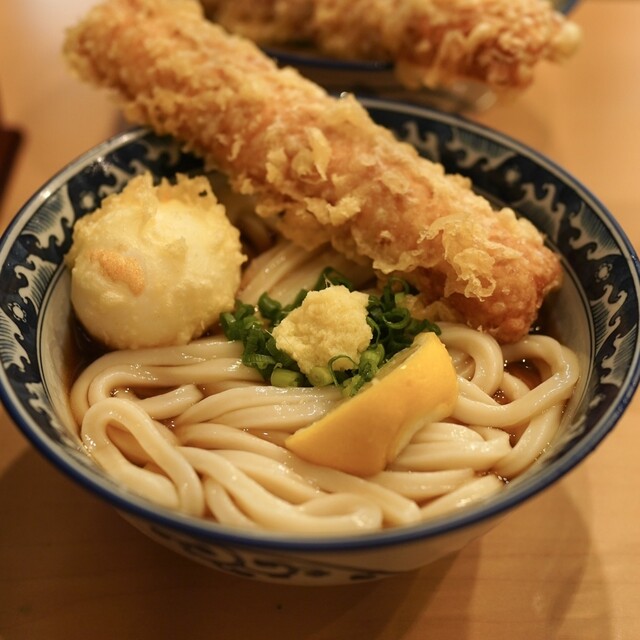
Shin-Umeda Shokudogai compresses Osaka dining into a few hurried lanes: steam at doorways, counter stools turning over fast, office workers cutting through the arcade with the confidence of regulars. In that setting, udon makes sense. It is not a long-form tasting menu, but a short sequence with its own rhythm: noodles first, broth or curry as the frame, tempura as punctuation. Umeda Kamatake Udon belongs to that station-side grammar, where the meal is measured less by ceremony than by texture, timing, and a clean exit back into the city.
Osaka’s casual food reputation often leans on okonomiyaki, takoyaki, kushikatsu, and department-store sweets, but its udon culture rewards closer attention. Kansai udon traditionally works in a lighter register than many Kanto bowls, with the noodle itself carrying much of the argument. A specialist shop near Umeda Station therefore competes on a narrow field: not breadth, not theatricality, but consistency under pressure. Selection for Tabelog’s Udon WEST 100 in 2024 is the relevant trust signal here, because the category isolates udon rather than folding it into a general restaurant ranking.
A station-district udon meal built as a compact progression
The editorial interest is the meal’s compression. A luxury tasting menu may stretch progression across ten or more courses; Osaka udon houses do it in minutes. The opening move is the noodle, judged by firmness, elasticity, and how it holds the sauce or broth. Curry udon changes the pace, turning wheat noodles into a carrier for spice and weight. Tempura adds contrast, giving the table a separate register of crunch and oil without turning the meal into a multi-plate production.
That format suits Umeda’s geography. The area around Osaka and Umeda stations is not a slow dining quarter in the Kyoto sense; it is a commercial engine with railway basements, food halls, arcades, and tight independent rooms feeding commuters and shoppers. Within that context, a 13-seat udon shop with counter seating reads as a disciplined urban form. Capacity matters because small rooms in major Japanese stations create a different kind of pressure from destination restaurants: turnover, line discipline, and ordering clarity shape the experience as much as the cooking.
Comparisons in Osaka sharpen the point. Curry Shop MASARA and Okonomiyaki Kiji Honten occupy adjacent parts of the same casual-meal economy, with higher everyday spend bands than a sub-¥1,000 udon stop. ECHIRE MARCHE AU BEURRE and Al Roikku Hankyu umeda honten sit in the lighter purchase tier, closer to snack or takeaway logic, while Tachinomiya Shiraishi moves toward drinking-counter culture. Umeda Kamatake Udon sits in the noodle-specialist lane: low spend, narrow category, and a public award signal that matters because udon is the subject rather than a side act.
Why the Umeda setting changes the read
Shin-Umeda Shokudogai is part of Osaka’s practical dining intelligence. The arcade’s value is not polish; it is density. Visitors who understand the city through high-rise hotel lobbies and department-store dining floors miss a defining Osaka pattern: serious food can sit inside cramped, utilitarian corridors if the category is focused enough. In this neighbourhood, the room does not need to slow the city down. It needs to deliver a clear bowl at the pace the district demands.
That is why the Tabelog Udon WEST 100 recognition carries more weight than a generic popularity claim. Udon in western Japan is a crowded category, and Osaka has enough casual specialists that a place needs more than convenience to enter a category-specific selection. The 2024 listing places this shop inside a regional conversation that includes craft, price discipline, and repeatability, not simply tourist visibility. For travellers, that distinction is useful: this is not a detour built around spectacle, but a station-area meal with enough category validation to justify planning around it when already in Umeda.
The trade-off is built into the format. A compact noodle counter does not offer the pacing, privacy, or wine-service architecture of a destination dining room. It rewards diners who want a focused lunch or early-day meal rather than a prolonged evening. It also fits solo dining especially well, because udon counters remove the social friction that can make some small Japanese restaurants difficult for single travellers. The better expectation is precision and pace, not a lingering table.
How to fold it into an Osaka food day
For a polished Osaka itinerary, Umeda Kamatake Udon works as an anchor between transit and more expansive eating. It can precede a deeper look at the city’s casual canon, from pork buns at 551 Horai (551蓬莱) to bakery stops such as 52CHO-ME BAKERY and café-led pauses at .cafe. For a different register, Osaka also has room for Italian-leaning meals at a canto (Italian) and 99 Pizza Napoletana Gourmet. The point is not to rank these meals against each other, but to understand how Osaka lets low-cost specialist formats sit beside more international dining without losing credibility.
Travellers building the wider trip should use the city rather than a single meal as the frame. Our full Osaka restaurants guide maps the broader dining field, while Our full Osaka hotels guide, Our full Osaka bars guide, Our full Osaka wineries guide, and Our full Osaka experiences guide help place the meal within a complete stay. For cross-city context, compare how focused Japanese formats travel: sukiyaki in -Grilled beef Sukiyaki- KAMAKURA TANUKIAN 鎌倉 たぬき庵 in Kamakura, charcoal tuna dining at. 鮪と炭火焼き うお炭 秋葉原店 in Tokyo, curry specialization at [Curry Senmon Ten] Maruyama Kyoju. in Sapporo, Kyoto cooking at [ki:] in Kyoto, and regional independents such as.know in Kumamoto and (Shoku) Vietnam in Kawasaki. Abroad, the same single-format clarity appears differently at Jōdo Saké Bar in Los Angeles and Onigiri Time in Pasadena.
The critical read is simple: the restaurant is strongest when treated as a concise Osaka meal rather than a grand dining event. The category recognition, small-room format, and station-district location point in the same direction. Go for udon as craft under everyday pressure, and let the rest of the day carry the city’s wider appetite.
How It Stacks Up
Comparable venues side-by-side for orientation.
| Venue | Cuisine | Price | Notes |
|---|---|---|---|
| Umeda Kamatake UdonThis venue — the venue you are viewing | Osaka Sanuki Udon Shop | $ | Not listed |
| SOMA | Spice-focused Japanese curry | $ | Kita |
| Osama no Spoon | Osaka curry & soup curry shop | $ | Kita |
| Spice and Curry Ougon no Kaze | Japanese spice curry | $ | Kita |
| Taniguchi Curry | Osaka spice curry & Japanese curry | $ | Chūō |
| Ichifuji Shokudo | Osaka shokudo with udon and oyakodon | $ | Kita |
Recognition history
Dated appearances from independent guides and award organizations, with the underlying list record or original source where available.
Tabelog 100 #89 · No. 89
Tabelog · Tabelog 100 - Udon - WEST - 2024
Continue exploring
More in Osaka
Restaurants in Osaka
Browse all →




Bars in Osaka
Browse all →




Hotels in Osaka
Browse all →



Wineries in Osaka
Browse all →
At a Glance
- Lively
- Classic
- Cozy
- Solo
- Casual Hangout
- After Work
- Group Dining
- Standalone
A compact, counter-heavy noodle shop in the Shin-Umeda Shokudogai arcade with bright, functional lighting, constant turnover, and the bustling noise of commuters and slurping noodles rather than leisurely conversation.