Lhasa Fast Food
Tony meets Heems, AKA Himanshu Suri, rapper and member of the Swet Shop Boys hip hop group, and his friend, attorney, and community organizer, Ali Najmi. They had thentuk, which is a hand torn noodle soup with chilies and ginger. Also, shaptra or chili-fried beef made of thinly sliced beef cooked with chili oil, soy, and Sichuan peppercorns; and sha momo, or steamed beef dumplings.
Pearl is the En Primeur Club membership app — saves, bookings, and concierge access live there. Same editors, same standards.
- Address
- 76-03 37th Ave, Jackson Heights, NY 11372
- Phone
- +1 347 952 6934
- Website
- lhasafastfood.com
- Directions
- Get directions
 Saves & bookings on Pearl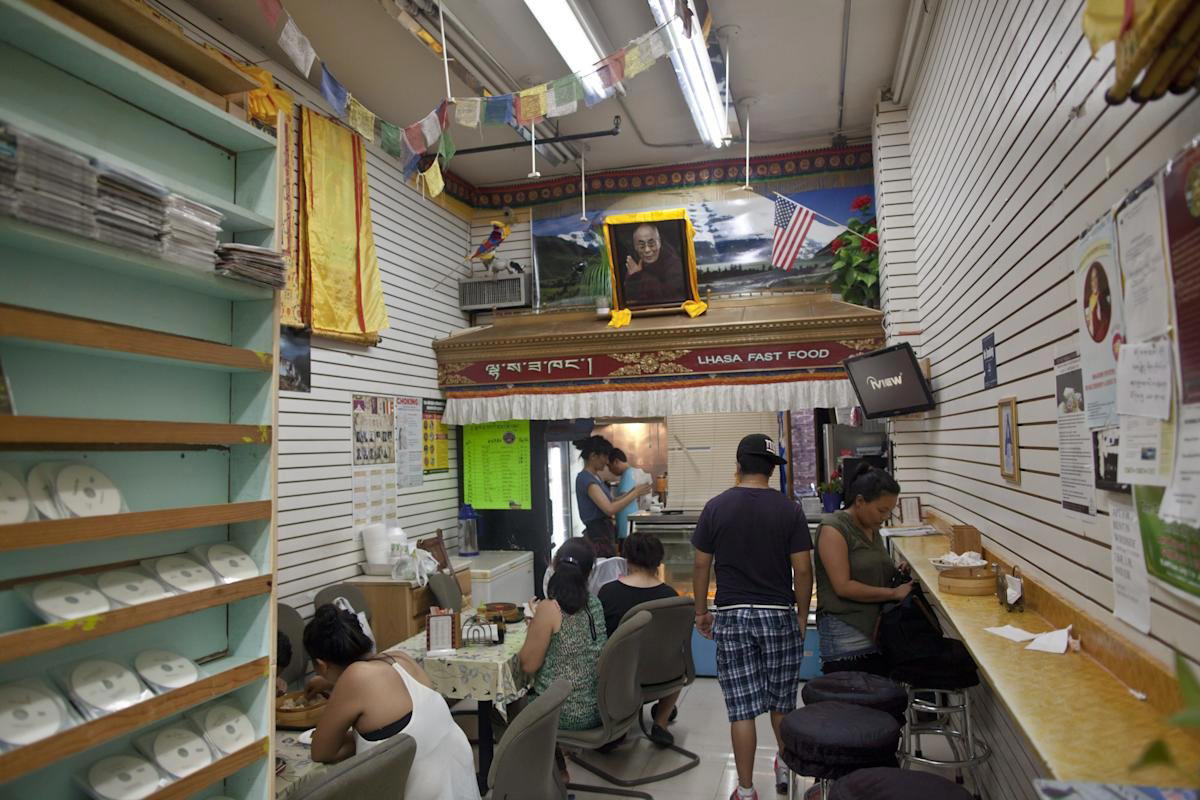
Jackson Heights and the Tibetan Dining Corridor
Jackson Heights occupies a specific position in New York's outer-borough food geography: dense, multilingual, and organized by wave rather than trend. The stretch of 37th Avenue between 74th and 82nd Streets contains South Asian sweets shops, Nepali snack counters, and Tibetan fast food operations that function less as destinations than as neighborhood infrastructure. Lhasa Fast Food at 76-03 37th Ave sits within that corridor, one address in a cluster that has made Jackson Heights the coherent Tibetan eating district in the northeastern United States.
That context matters more than any individual address. Tibetan cooking in New York does not have the institutional backing of, say, the city's Sichuan or Korean dining scenes. The neighborhood's Tibetan counters are shaped more by local demand than by formal awards or tasting-menu formats. What exists instead is a community-sustained food economy where the menus are short, the prices are low relative to Manhattan, and the dishes index directly to Tibetan staples rather than to any adapted or fusion format. Lhasa Fast Food operates inside that logic.
How the Menu Is Built, and What That Tells You
Tibetan fast food menus, as a category, are architecturally sparse in a way that rewards attention. The organizing principle is typically two or three dough-based preparations, a handful of protein and broth combinations, and tea service that runs parallel to the food rather than subordinate to it. Momos, the steamed or fried dumplings that function as the category's most recognizable export, anchor the menu both commercially and culturally. Thukpa, the noodle soup that varies from restaurant to restaurant in broth depth and noodle thickness, occupies the second tier. Tsampa-based preparations and butter tea tend to appear as supporting items rather than headline dishes.
This architecture is not minimalism by design choice so much as an honest map of what Tibetan home cooking actually looks like: a cuisine shaped by altitude, limited agricultural range, and a preservation culture built around barley, yak products, and fermented ingredients. In the context of a Jackson Heights fast food format, the menu reads as a direct translation of that tradition rather than an edited or curated version of it. That directness is the point. The dishes at venues in this category are not attempting to compete with the $350-per-person omakase counters at Masa or the tasting-menu architecture of Eleven Madison Park. They are serving a different function entirely: affordable, filling, culturally specific food for a community that lives in the neighborhood.
Where fast food formats like this diverge from one another is in dough texture, fill ratio, broth salinity, and the calibration of heat from chili oil or fresh green chili. These are not dramatic variables, but for regular customers they are the difference between a kitchen that understands the dish and one that is approximating it. The reputation of any individual Tibetan counter in Jackson Heights travels almost entirely by word of mouth within the Tibetan and Nepali communities themselves, which makes independent editorial assessment from the outside genuinely limited
Where Lhasa Fast Food Sits in New York's Broader Dining Spectrum
New York's restaurant industry has a well-documented bifurcation: a highly visible, heavily awarded fine dining tier concentrated in Manhattan, and a vast outer-borough ecosystem that receives a fraction of the critical attention despite containing some of the city's most culturally specific cooking. The Michelin-starred French seafood format at Le Bernardin, the modernist Korean tasting menu at Atomix, and the Thomas Keller flagship Per Se all operate in a different economic and critical register than a Tibetan fast food counter in Queens. These are not competing categories. But the gap in editorial coverage between them is disproportionate to the gap in culinary interest.
Jackson Heights has drawn increasing attention from food journalists over the past decade, in part because the concentration of subcontinental and Himalayan cuisines in a walkable corridor makes it unusually legible for visitors who are not from the neighborhood. The 37th Avenue strip is a logical stop for anyone building a broader understanding of New York's outer-borough food geography, and it pairs naturally with the kind of exploratory eating that the city's leading guides encourage.
For comparison across the country's broader dining map, the contrast between community-sustained ethnic fast food and destination fine dining is visible in every major city. Lazy Bear in San Francisco, The French Laundry in Napa, Smyth in Chicago, Providence in Los Angeles, and Blue Hill at Stone Barns in Tarrytown all represent one end of that spectrum. The restaurant represents something else: the unglamorous, load-bearing infrastructure of a neighborhood's daily food life. Both ends matter. Neither replaces the other.
Other notable restaurants across the country operating in destination territory include Addison in San Diego, The Inn at Little Washington, Frasca Food and Wine in Boulder, Single Thread Farm in Healdsburg, and Emeril's in New Orleans. Internationally, venues like Atelier Moessmer Norbert Niederkofler in Brunico and Dal Pescatore in Runate illustrate how regional specificity and fine dining can converge. The Tibetan fast food format in Jackson Heights does something different with regional specificity: it keeps it unmediated.
Planning Your Visit
The restaurant is at 76-03 37th Ave, Jackson Heights, Queens. The 7 train to 74th Street-Broadway delivers you within a short walk of the restaurant strip. Jackson Heights is generally most active on weekends, when the sidewalk food economy expands and wait times at popular counters extend. For Tibetan spots in this neighborhood, arriving at off-peak lunch hours on a weekday typically means faster service and the full menu available. Walk-in service is the practical approach.
Quick Comparison
Comparable venues nearby, for context on price, style, and recognition.
| Venue | Cuisine | Price | Notes |
|---|---|---|---|
| Lhasa Fast FoodThis venue — the venue you are viewing | Tibetan Momos | $ | Not listed |
| Chinatown Ice Cream Factory | Asian-Inspired Ice Cream | $ | Chinatown-Two Bridges |
| Seafood Momo | Tibetan Momo | $ | Queensbridge-Ravenswood-Dutch Kills |
| Nepali Bhanchha Ghar | Traditional Nepali | $ | Jackson Heights |
| La Gran Uruguaya Restaurant | Authentic Uruguayan Parrillada | $$ | Jackson Heights |
| Sweatshop Studios LLC | other | $ | Fort Greene |
Continue exploring
More in New York City
Restaurants in New York City
Browse all →
Bars in New York City
Browse all →
Hotels in New York City
Browse all →






At a Glance
- Cozy
- Casual Hangout
Current opening hours
- Monday
- 11 AM–10 PM
- Tuesday
- 11 AM–10 PM
- Wednesday
- 11 AM–10 PM
- Thursday
- 11 AM–10 PM
- Friday
- 11 AM–10 PM
- Saturday
- 11 AM–10 PM
- Sunday
- 11 AM–10 PM
Hours can change for holidays and private events. Last verified .
Tiny, fluorescent-lit room with orange walls and a casual hole-in-the-wall charm.