Las Tapas
Our verdict
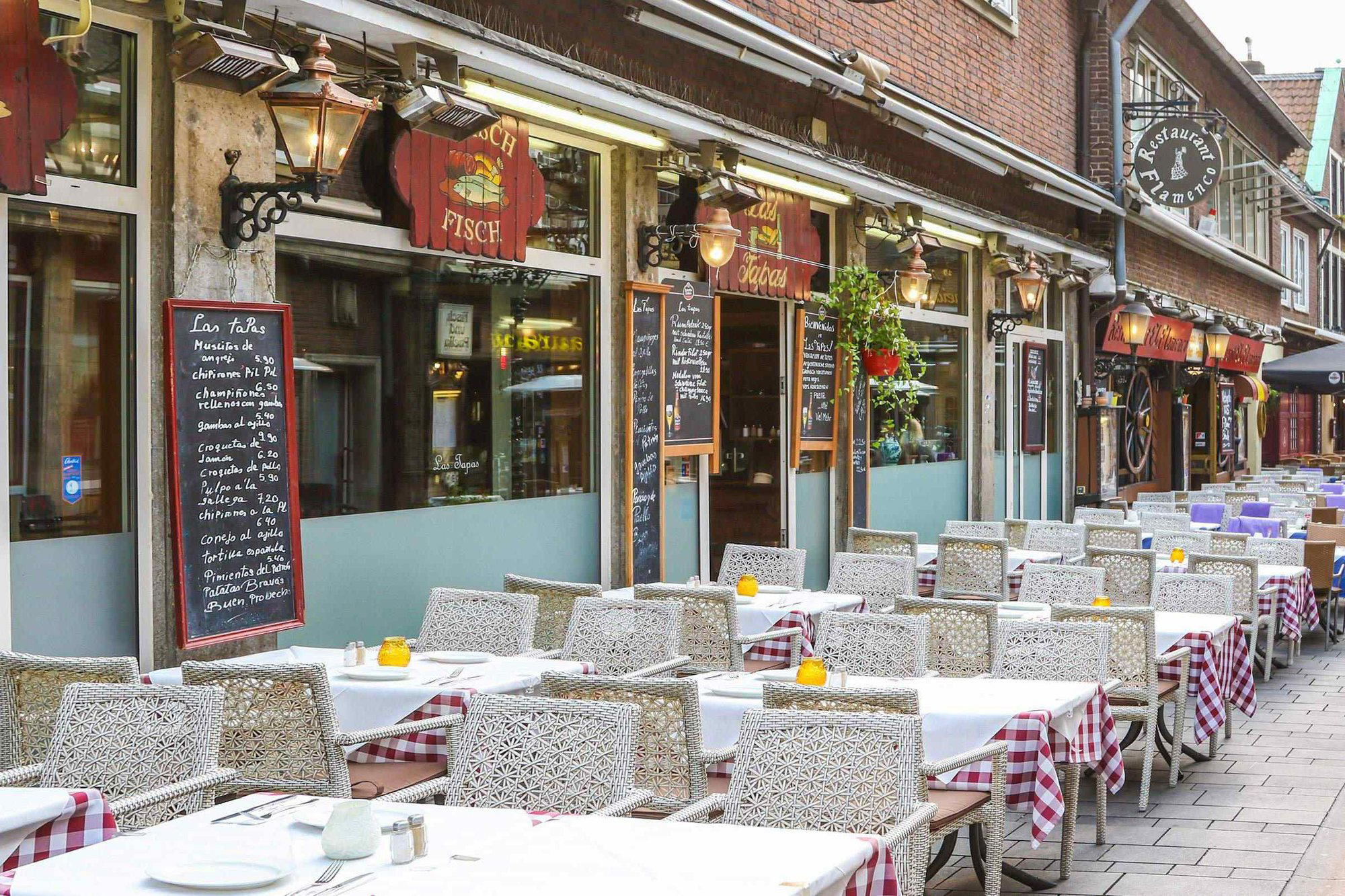
Las Tapas occupies a corner of the Altstadt's most animated pedestrian lane, Schneider-Wibbel-Gasse, where Spanish small-plate dining has found a natural home in Düsseldorf's already convivial old town. The menu architecture follows the logic of the tapas tradition itself: many small dishes, shared across the table, building a meal from accumulation rather than sequence. It sits in the mid-range casual tier of the city's international dining scene.

Pearl is the En Primeur Club membership app — saves, bookings, and concierge access live there. Same editors, same standards.
- Address
- Schneider-Wibbel-Gasse 2-4, 40213 Düsseldorf, Germany
- Phone
- +492113239930
- Hours
- Daily 11:30 AM–12 AM
- Website
- lastapas-duesseldorf.de
- Directions
- Get directions
- Booking
- Book on Zenchef
The menu
What to order
- Patatas bravas
- Gambas al ajillo
- Pulpo a la gallega
- Pata negra
- Iberico ham
- Pork loin in brandy sauce
A Lane Built for Grazing
Schneider-Wibbel-Gasse is one of the Altstadt's most sociable streets, a narrow pedestrian corridor that connects the old town's bar and restaurant cluster to the quieter residential edges near the Rhine. The lane has the density of a market street without the daytime-only limitation: tables spill outward in warmer months, noise carries, and the architecture of the buildings encourages exactly the kind of unhurried, glass-in-hand dining that tapas formats reward. Las Tapas at numbers 2 to 4 occupies this address in a neighbourhood that already functions the way a tapas culture expects its streets to function.
Düsseldorf's Altstadt earns its reputation as one of Germany's most concentrated drinking and dining districts, with something close to 300 bars and restaurants within a relatively compact grid. That density creates a specific kind of competition: venues are not competing on destination draw alone but on how well their format fits the rhythm of the street. A tapas format, built around shareable small plates and flexible pacing, maps well onto an area where guests move between venues and rarely commit to a single long dinner from the outset.
What the Menu Format Tells You
The tapas structure is one of the more legible menu architectures in European dining. Unlike a tasting menu, where the kitchen controls the sequence and the guest surrenders curation to the chef, a tapas spread distributes authorship across the table. Guests order progressively, adjust by appetite and by what's working, and the meal scales up or contracts based on how the evening develops. That flexibility is structural, not incidental, and it suits a venue positioned on a high-footfall street where group sizes and dining intentions vary considerably.
In Spain, the distinction between tapas, raciones, and pinchos reflects a genuine regional grammar. Tapas in the Andalusian tradition are smaller, often complementary to a drink rather than constituting a full meal in themselves. Raciones are larger, more substantial, and closer to shared plates in the contemporary sense. Restaurants outside Spain operating under a tapas banner typically consolidate these categories into a single list, which gives the kitchen flexibility but requires the menu to signal clearly whether dishes are scaled for one or for the table. That architecture decision shapes how a table orders, how long they stay, and how the bill builds. It is the central design question for any venue working in this format.
For visitors building an Altstadt evening across multiple stops, the format at Las Tapas positions it as a viable anchor rather than a brief appetiser break. The surrounding area supports both approaches. Venues like Amuni Wein- und Käsebar operate in an analogous sharing-plate and wine format, while Anfora and Arca Alacati offer Mediterranean adjacencies that help frame where Spanish small-plate dining sits within the Altstadt's broader international dining range.
Spanish Dining in the German Altstadt Context
Germany's major cities have absorbed Spanish food culture in distinct waves. The first generation brought sangria-heavy restaurant formats with broad menus aimed at accessibility. A second generation, accelerating through the 2010s, followed the global rise of Basque and Catalan cooking, bringing pintxos bars and more ingredient-focused formats into cities including Berlin, Hamburg, and Düsseldorf. The question for any Spanish-format venue now is which of those registers it occupies and how the menu signals that positioning to a guest who may be arriving with either reference point in mind.
Düsseldorf's international dining scene has become more granular at the upper end over the past decade. Germany's concentration of Michelin-starred restaurants extends to venues like Aqua in Wolfsburg, JAN in Munich, and Schwarzwaldstube in Baiersbronn, along with more experimental formats like CODA Dessert Dining in Berlin. Las Tapas operates well below that tier, in the casual and accessible bracket where format legibility matters more than culinary ambition. That is not a criticism of the venue so much as an observation about how it fits: the Altstadt's dining ecosystem needs both registers, and Schneider-Wibbel-Gasse specifically rewards venues that can turn tables comfortably and welcome walk-in guests rather than requiring advance reservation planning.
Neighbouring restaurants on the Altstadt circuit include Alanya Döner and 3h's burger & chicken, both positioned squarely in the quick-service, high-volume tier. Las Tapas sits a bracket above in the sit-down, shareable-plates format, though it occupies the same casual price range rather than the formal dining category. The distinction matters for how you sequence an Altstadt evening: Las Tapas works as a mid-evening anchor where you settle in and order progressively, rather than a quick stop before or after a longer meal elsewhere.
Planning a Visit
The Altstadt in general requires some timing awareness, particularly on Friday and Saturday evenings when the street-level density increases sharply and venues fill from early evening. Schneider-Wibbel-Gasse sits close to the Rhine waterfront and the main concentration of Altstadt nightlife, which means that by 8pm on a weekend the neighbourhood is operating at full capacity. For a relaxed tapas meal with room to order in rounds, arriving before 7pm or targeting a weekday evening gives the table more space and the kitchen more attention per order. Those arriving later on a weekend should have realistic expectations about pace and availability.
Visitors spending more time in Germany's fine dining circuit can extend the trip beyond Düsseldorf: Vendôme in Bergisch Gladbach and Waldhotel Sonnora in Dreis represent the formal end of the regional spectrum, while ES:SENZ in Grassau, Victor's Fine Dining by christian bau in Perl, Restaurant Haerlin in Hamburg, and Schanz in Piesport cover other corners of serious German dining. For reference points outside Germany at the top of the international scale, Le Bernardin in New York City and Atomix in New York City sit in a structurally different category. The full Düsseldorf picture, across price tiers and cuisine types, is covered in our full Dusseldorf restaurants guide.
Frequently asked questions
What's Las Tapas's location?
Las Tapas is located at Schneider-Wibbel-Gasse 2-4, 40213 Düsseldorf, Germany, Dusseldorf.
Is Las Tapas in Düsseldorf suitable for a group dinner?
The tapas format at Schneider-Wibbel-Gasse 2-4 suits group dining naturally: shared small plates remove the coordination overhead of individual ordering and allow the table to cover more of the menu. Düsseldorf's Altstadt venues with this structure tend to handle groups better than tasting-menu or à la carte kitchens. Contacting the venue directly ahead of a larger booking is advisable given the street's popularity on weekends.
What dish is Las Tapas famous for?
Las Tapas sits on Schneider-Wibbel-Gasse in Düsseldorf's Altstadt, a street where the expectation is grazing across multiple plates rather than a signature set piece. The kitchen's range is better judged by visiting during off-peak hours when ordering is less pressured.
Should I book Las Tapas in advance?
The Altstadt, particularly around Schneider-Wibbel-Gasse, sees sharp increases in foot traffic on Friday and Saturday evenings, which tightens availability at street-level venues across the district. Booking ahead is the sensible approach for weekend visits. For weekday evenings or lunch, walk-in access is generally more manageable in this part of Düsseldorf's old town.
Standing Among Peers
Comparable venues nearby, for context on price, style, and recognition.
| Venue | Cuisine | Price | Notes |
|---|---|---|---|
| Las TapasThis venue — the venue you are viewing | Traditional Spanish Tapas | $20–30 | Not listed |
| Louisiana Düsseldorf Altstadt | American BBQ & Burgers | $20–30 | Altstadt |
| Green Club | Healthy Mediterranean Bowls | $10–20 | Unterbilk |
| KYO Burger | Japanese Fusion Burgers | $20–30 | Stadtmitte |
| Hashi, petite chinoiserie | Modern Chinese-French Fusion | Not listed | Flingern Nord |
| Libanon Restaurant | Authentic Lebanese | $20–30 | Altstadt |
Continue exploring
More in Düsseldorf
Restaurants in Düsseldorf
Browse all →
Bars in Düsseldorf
Browse all →
Hotels in Düsseldorf
Browse all →
Wineries in Düsseldorf
Browse all →
Las Tapas
The wine
- Wine program
- Curated wine list
- Extensive wine list
Details
- Rustic
- Cozy
- Lively
- Group Dining
- Casual Hangout
- Family
- Date Night
- Terrace
- Standalone
- Extensive Wine List
- Small Plates
- A La Carte
- Spanish Wine
- Rioja
- Vegetarian Friendly
Current opening hours
- Monday
- 11:30 AM–12 AM
- Tuesday
- 11:30 AM–12 AM
- Wednesday
- 11:30 AM–12 AM
- Thursday
- 11:30 AM–12 AM
- Friday
- 11:30 AM–12 AM
- Saturday
- 11:30 AM–12 AM
- Sunday
- 11:30 AM–12 AM
Hours can change for holidays and private events. Last verified .
Warm and inviting rustic Spanish atmosphere with solid wood furnishings, traditional Spanish décor, and a lively but relaxed energy; well-heated interior with attentive service.