Our verdict
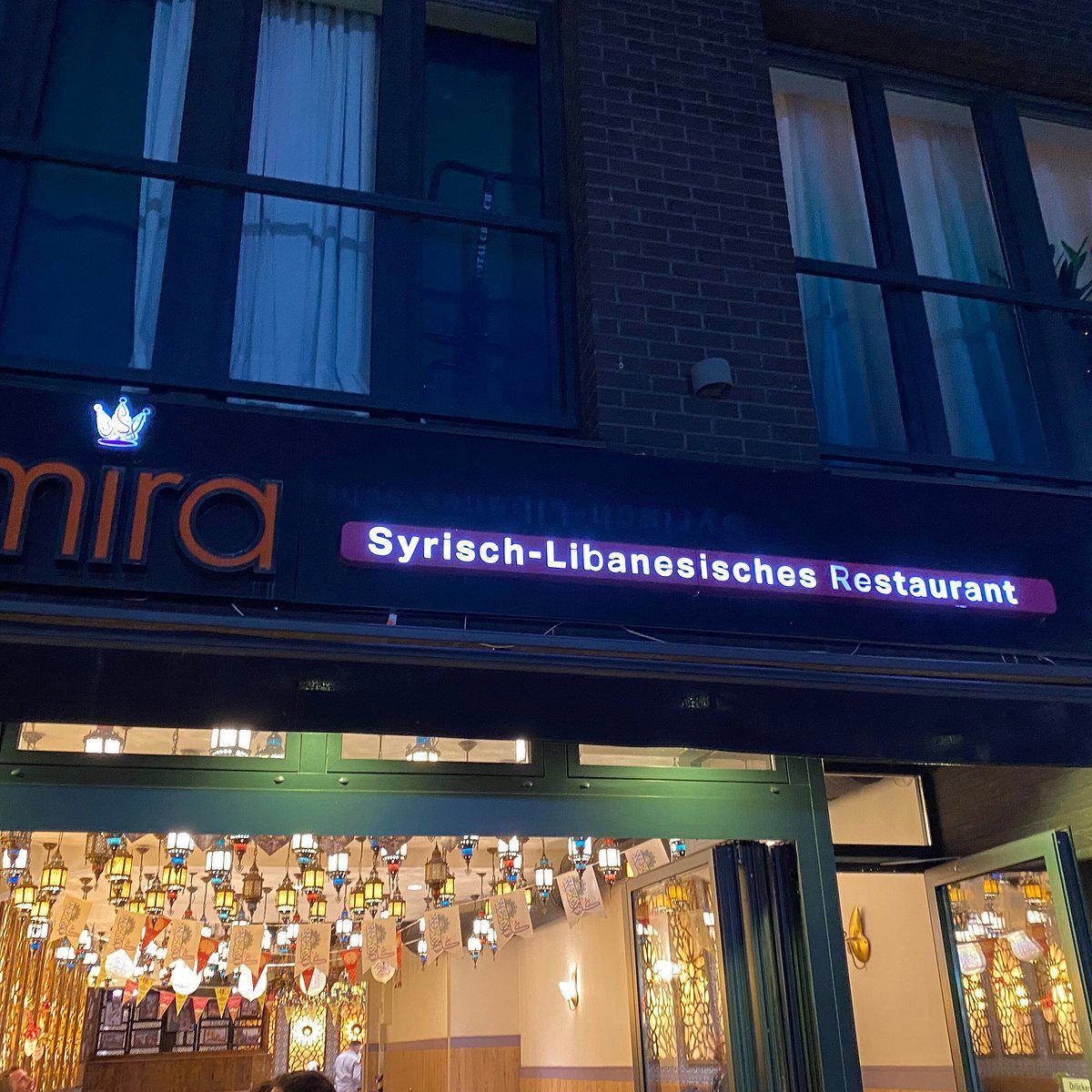
On Steindamm in Hamburg's St. Georg district, L'Amira occupies a stretch of the city where Middle Eastern and North African food culture runs deep. The address places it at the intersection of Hamburg's immigrant-shaped culinary identity and a neighbourhood that has long fed the city's appetite for food from elsewhere. Visitors looking for an honest read on the local dining scene should consider it alongside the city's broader restaurant mix.

Pearl is the En Primeur Club membership app — saves, bookings, and concierge access live there. Same editors, same standards.
- Address
- Steindamm 58, 20099 Hamburg, Germany
- Phone
- +494037027926
- Hours
- Daily 9 AM–12 AM
- Website
- lamira-steindamm.de
- Directions
- Get directions
The menu
What to order
- Chicken shawarma
- Meat platter for 2
- Mezze appetizers
- Homemade ice cream
- Mocha
Where Steindamm Places You
Steindamm is not a dining street that announces itself. Running through St. Georg in Hamburg's eastern inner city, it is a corridor where kebab counters, halal butchers, Lebanese pastry shops, and grocery importers occupy the same blocks as late-night bars and transit hotels. The neighbourhood has absorbed successive waves of migration since the post-war decades, and the food culture it carries reflects that layering directly: not as theme or aesthetic choice, but as a working, unglamorous record of where people came from and what they needed to eat. L'Amira Steindamm, at number 58, sits inside that record.
For readers arriving from Hamburg's fine-dining corridor — where Restaurant Haerlin and The Table Kevin Fehling represent the city's most formally credentialed end of the spectrum — Steindamm operates at a completely different register. That contrast is not a weakness. It is the point. Cities that produce serious food cultures need both ends of that range, and the middle stretches of St. Georg have historically supplied Hamburg with ingredient-driven, community-rooted cooking that the starred rooms cannot replicate.
The Ingredient Logic of a Street Like This
The editorial angle that matters most on Steindamm is sourcing. Restaurants in districts like St. Georg typically operate inside dense supply networks: the butcher two doors down, the importer of dried goods who has been supplying the same block for twenty years, the wholesale fruit and vegetable operation that opens before the rest of the city wakes. L'Amira's address at Steindamm 58 places it within walking distance of Hamburg's most concentrated Middle Eastern and North African wholesale infrastructure.
This matters because the ingredient logic of this part of the city is different from what drives kitchens in HafenCity or Eppendorf. Supply here tends to be direct, culturally specific, and less intermediated by the premium provenance chains that high-end restaurants use as a marketing signal. When a kitchen on Steindamm sources lamb, it is likely sourcing from a supplier whose customer base is the neighbourhood's own community, not a fine-dining showcase. The result, when the cooking is competent, is food that reflects actual sourcing relationships rather than constructed ones.
Across Germany's mid-tier and community restaurant scene, this structural difference increasingly draws attention from food writers and serious eaters alike. Venues such as 100/200 Kitchen have made ingredient provenance a primary editorial statement at the premium end. The conversation on streets like Steindamm is quieter but no less grounded: the sourcing is simply assumed, embedded in the supply chain, rather than announced on a tasting menu card.
Hamburg's Culinary Geography and Where This Fits
Hamburg's restaurant scene in 2024 has consolidated around a handful of identifiable clusters. The Alster lakeside and Eppendorf carry the classic European fine-dining and modern brasserie formats, with Lakeside and bianc representing the Mediterranean-influenced tier at the higher price points. HafenCity pulls design-conscious openings and international formats. St. Georg, by contrast, has remained the city's most consistently diverse eating district, with Steindamm as its spine.
That diversity is not accidental. St. Georg's proximity to the central station has made it a transit neighbourhood for over a century, and the food businesses that took root here did so because of foot traffic from travellers, workers, and immigrant communities rather than because of the kind of destination dining logic that now drives openings in Eppendorf or the Schanzenviertel. The result is a street where the competitive pressure comes from community loyalty rather than review cycles, and where a restaurant earns its audience through consistency over time rather than through launch attention.
Across Germany more broadly, the fine-dining conversation is anchored by addresses like Aqua in Wolfsburg, Schwarzwaldstube in Baiersbronn, and Vendôme in Bergisch Gladbach. Hamburg's own contribution to that conversation comes through its starred rooms. But the city's texture as an eating destination comes substantially from streets like Steindamm, where the food is less photogenic and the clientele less international but the cooking is often more direct.
Planning a Visit to Steindamm
Steindamm 58 is within a ten-minute walk of Hamburg Hauptbahnhof, making it one of the more accessible addresses in the city for visitors arriving by rail. St. Georg's restaurant strip is generally most active in the evenings, though many establishments on Steindamm operate through the afternoon given the neighbourhood's foot traffic patterns. Walk-ins are common on Steindamm as a general principle, the street does not carry the reservation culture of Hamburg's formal dining rooms, but confirming in advance remains the sensible approach.
For readers building a Hamburg itinerary that covers both the neighbourhood character of St. Georg and the city's more celebrated dining rooms, our full Hamburg restaurants guide maps the city's options across price points and districts. Internationally, the kind of community-embedded, sourcing-grounded cooking that Steindamm represents has analogs in cities from New York, where Atomix and Le Bernardin anchor the formal end while the outer borough streets carry an equivalent informal depth, to Germany's own mid-sized city restaurant scenes at addresses like JAN in Munich, ES:SENZ in Grassau, or Schanz in Piesport.
Readers with a specific interest in how German restaurants handle dessert-forward formats or boundary formats might also look at CODA Dessert Dining in Berlin. For western Germany's fine-dining anchors, Waldhotel Sonnora in Dreis, Bagatelle in Trier, and Victor's Fine Dining by Christian Bau in Perl cover the region's highest-credentialed rooms.
Frequently asked questions
Where exactly is L'Amira Steindamm?
L'Amira Steindamm is located at Steindamm 58, 20099 Hamburg, Germany, Hamburg.
What kind of neighbourhood is L'Amira Steindamm in, and how does that shape the experience?
L'Amira Steindamm is at Steindamm 58 in the St. Georg district of Hamburg, a corridor known for its dense mix of international food shops, kebab counters, and community-facing restaurants rather than the formal dining rooms found further west in the city. St. Georg's eastern stretch around Steindamm has a functional, working-neighbourhood character that sits apart from Hamburg's tourist-facing restaurant clusters. Visitors arriving from Hamburg Hauptbahnhof reach the address in under ten minutes on foot, making it a practical first or last stop in the city.
What do people recommend at L'Amira Steindamm?
Specific menu recommendations for L'Amira Steindamm are best gathered from current visitors, as the offering reflects the supply-driven, neighbourhood character of Steindamm in St. Georg. The address at Steindamm 58 sits within a street known for Middle Eastern and international provisions, which typically shapes what kitchens in this corridor put forward.
Do they take walk-ins at L'Amira Steindamm?
No booking policy is formally documented for L'Amira Steindamm. Restaurants on Steindamm generally operate with a walk-in culture given the street's footfall from Hamburg Hauptbahnhof, a ten-minute walk away. Arriving early in the evening is a reasonable approach if you have not reserved.
What do critics highlight about L'Amira Steindamm?
The venue sits outside the clusters that attract mainstream Hamburg restaurant coverage, which tends to concentrate on the Alster lakeside and Eppendorf.
Can L'Amira Steindamm handle vegetarian requests?
Restaurants operating in St. Georg's Steindamm corridor frequently draw on ingredient networks that include substantial produce and pulse-based components common to Middle Eastern and Mediterranean cooking traditions. Contacting the venue at Steindamm 58, Hamburg before visiting is the reliable way to confirm current options.
Is L'Amira Steindamm overpriced or worth every penny?
No price range is currently documented for L'Amira Steindamm. Steindamm sits in a part of Hamburg where restaurants tend to operate at accessible price points rather than the higher end seen in Eppendorf or the Alster waterfront. For a calibrated read on value, checking recent visitor accounts tied to the Steindamm 58 address is the most direct route.
Comparable Spots
Comparable venues nearby, for context on price, style, and recognition.
| Venue | Cuisine | Price | Notes |
|---|---|---|---|
| L'Amira SteindammThis venue — the venue you are viewing | Authentic Syrian & Lebanese | $20–30 | Not listed |
| Saliba | Authentic Syrian | $20–30 | Neustadt |
| Falafel Haus | Traditional Lebanese Street Food | $10–20 | Rotherbaum |
| An Vegan House | Vegan Vietnamese | $20–30 | Barmbek |
| La Casita | Authentic Mexican Taqueria | $10–20 | St. Pauli |
| Café Kaltehofe | German Café with Hearty Dishes and Cakes | $10–20 | Peute |