Tabelog 100 #5
Our verdict
Lakshmi places Osaka’s curry culture in a compact Shinmachi setting, where Indian and Nepalese references meet the city’s appetite for precise, personal cooking. Its selection for Tabelog Curry WEST “Tabelog 100” in 2019, 2020, 2023 and 2024 gives it a clear credibility signal within western Japan’s curry conversation.

Pearl is the En Primeur Club membership app, where members save venues, book tables and use the concierge.
The menu
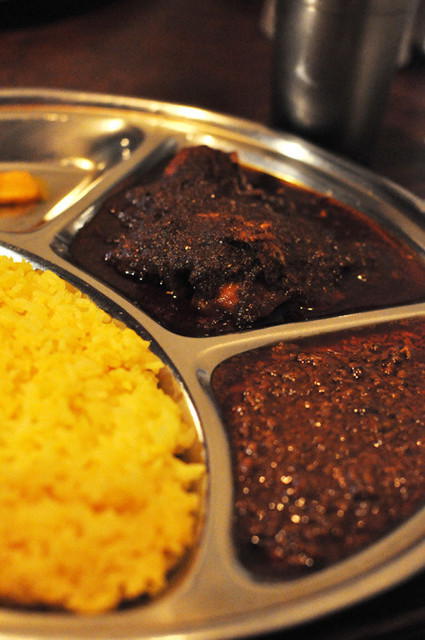
See the current menu on ne.jp →Osaka has a quieter rhythm beyond its busiest eating corridors: narrower streets, design offices, small apartment blocks, and restaurants that reward intent rather than wandering. In that setting, Lakshmi belongs to Osaka’s more focused curry culture, a scene shaped by imported spice grammar, Japanese portion logic, and the city’s habit of turning casual food into serious specialization.
Osaka is often reduced to takoyaki, okonomiyaki, and late-night counter food, but its curry map is more revealing. The city has long absorbed outside techniques and made them local through scale, routine, and repetition. Indian and Nepalese categories sit beside Japanese curry rice, spice-curry counters, and café-style lunch rooms; the interesting work happens where those formats overlap rather than where they remain pure. Lakshmi’s listing across curry, Indian, and Nepalese categories places it in that hybrid zone, where the method points outward and the dining cadence feels Osaka.
Osaka curry through Indian and Nepalese technique
The useful way to read this kind of restaurant is not as a replica of the subcontinent, nor as a standard Japanese curry shop. Osaka’s curry culture has its own internal hierarchy: quick lunch rooms at one end, spice-focused counters at another, and a small group of recognized names that signal sustained local approval. Lakshmi’s inclusion in the 2024 Tabelog Hyakumeiten record puts it inside that visible group, a recognition category that matters because curry is crowded, opinionated, and intensely comparative.
The global-technique, local-usefulness equation is the point. Spice work carries the vocabulary of Indian and Nepalese cooking, while the restaurant’s function belongs to Osaka: focused, practical, and calibrated for regulars as much as travelers. That makes it different from broader-format restaurants built around banquets or long à la carte menus. It also separates it from softer comfort formats, where sweetness and familiarity can dominate. Here, the value is in a narrower proposition: curry as a specialist craft rather than a supporting item.
That specialization is worth placing against citywide choices. Labyrinth operates as a useful comparison for understanding how far Osaka’s spice-focused dining can stretch. Yotsubashi Cafe and YAMAMOTO KASHITEN speak more to the city’s café and sweets rhythm, while Yoshoku Teshima sits closer to a comfort-food tradition. tamanegi shows how Osaka can support small, genre-specific restaurants without relying only on tourist traffic. Lakshmi fits that same city pattern, but curry gives it a sharper identity within Osaka’s everyday dining language.
A focused curry format with regional recognition
The format matters because curry at this level is rarely about ceremony. A focused restaurant experience concentrates attention on timing, pace, and the plate rather than on extended service rituals. The experience is closer to a specialist curry stop or casual meal than a destination tasting menu. That practical read is part of the appeal for travelers who want serious food without the signals of luxury dining.
Recognition also needs interpretation. A Tabelog score of 3.61 in Japan is not the same signal as a Western review average; on that platform, scores tend to cluster tightly, and selection into a Hyakumeiten category often says more than the decimal alone. For travelers, the stronger clue is the 2024 Hyakumeiten listing itself. That signal suggests credibility in a field where novelty alone is not enough. It is also a reminder that Osaka’s serious dining is not confined to high-price sushi, kappo, or kaiseki. Some of the city’s more instructive meals happen in formats that look modest from the street.
For a wider Osaka itinerary, this is the kind of address that pairs well with contrast rather than repetition. A day might move from bakery culture to casual local staples, then into smaller specialist rooms across the city. That mix shows Osaka more accurately than a single prestige meal: the city eats across categories, price bands, and neighborhoods with unusual ease.
The same principle applies across Japan. Travelers tracking curry, casual Japanese formats, and small-room specialists can compare Lakshmi with other unnamed regional dining rooms. Different cuisines tell the same story: Japan’s smaller restaurants often express imported technique through local expectations of pace, precision, and format.
How to fit it into a serious Osaka food trip
Lakshmi is strongest as a focused Osaka curry stop rather than as a grand final meal. The city suits travelers who prefer walking between independent restaurants, cafés, shops, and low-key streets instead of building every meal around a major station. The better expectation is focused, compact, and informal, with the Hyakumeiten recognition doing the credibility work rather than luxury signals.
Because Osaka rewards category-hopping, curry should sit beside rather than replace the city’s other dining traditions. Use Our full Osaka restaurants guide for restaurant planning, then layer in sleep, drinks, wine, and cultural time through Our full Osaka hotels guide, Our full Osaka bars guide, Our full Osaka wineries guide, and Our full Osaka experiences guide. For travelers extending the trip, useful contrasts include other unnamed regional dining rooms and casual specialists beyond Osaka.
Frequently asked questions
Is Lakshmi suitable for children?
Publicly provided details for Lakshmi identify it as a curry, Indian, and Nepalese restaurant in Osaka. For family suitability and the latest service details, check the venue's official channels before visiting.
What should I expect atmosphere-wise at Lakshmi?
Expect a focused curry meal rather than a formal dining setup. Lakshmi is listed in the curry, Indian, and Nepalese categories, and its appeal is best understood as part of Osaka’s specialist casual dining culture.
How much does it cost to eat at Lakshmi?
Pricing at Lakshmi is listed as Dinner: JPY 1,000 - JPY 1,999; Lunch: JPY 2,000 - JPY 2,999.
Is Lakshmi open every day?
Current opening days and hours should be confirmed through the venue's official channels before visiting.
Cuisine and Credentials
Comparable venues in the metro at similar price points.
| Venue | Cuisine | Price | Awards | Notes |
|---|---|---|---|---|
| LakshmiThis venue (the venue you are viewing) | Indian Curry House | $10–20 | Tabelog 100 #5 | Not listed |
| Satch's Curry | Indian-style Curry Shop | $10–20 | Tabelog 100 #44 | Kita |
| Moja Curry Shin osaka honten | Japanese Curry | Not listed | Tabelog 100 #21 | Yodogawa |
| Ceylon Curry | Authentic Sri Lankan Curry House | $10–20 | Tabelog 100 #12 | Chūō |
| Bonabona | Indian-style Curry House | $1–10 | Tabelog 100 #75 | Nishi |
| Spice Curry Babiru no To | Spice curry & Indian-style curry | $1–10 | Tabelog 100 #2 | Chūō |
Recognition history
Dated appearances from independent guides and award organizations, with the underlying list record or original source where available.
Tabelog 100 #5 · No. 5
Tabelog · Tabelog 100 - Curry - WEST - 2024