Tabelog 100 #2
Our verdict
Osaka’s spice-curry culture rewards compact rooms, lunch discipline, and regulars who understand the rhythm before they reach the door. Spice Curry Babiru no To belongs to that lane: a 10-seat Tanimachi 4-chome curry counter and table room, selected for Tabelog Curry WEST 100 in 2019, 2020, 2023, and 2024, with vegetable-conscious options and an Indian-curry frame.

Pearl is the En Primeur Club membership app, where members save venues, book tables and use the concierge.
The menu
What to order
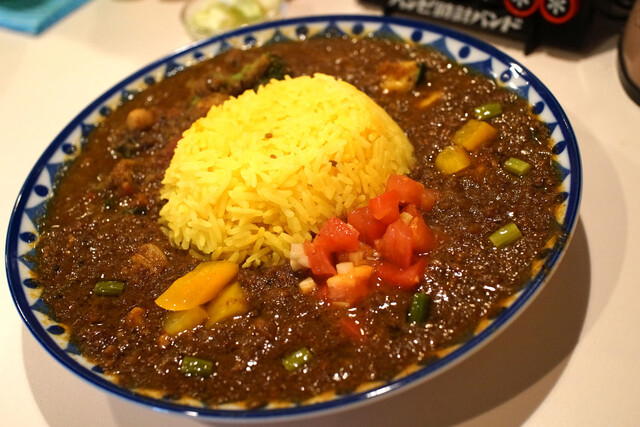
- Katsuo keema curry
- Daily meat curry (e.g., mutton keema)
- Split plate of meat and bean curries
Osaka curry often begins away from the city’s louder dining corridors, in straightforward rooms where the rice-and-spice rhythm matters more than ceremony. Across Osaka, that format has force: office workers, solo diners, and curry regulars move through meals efficiently, knowing the cooking is the point and the room turns attention toward the plate.
Spice Curry Babiru no To fits that Osaka pattern clearly. Its listed categories are curry and Indian curry, not hotel dining or chef’s-counter theatre, and its recognition includes Tabelog’s Curry WEST 100 selection in 2024. That inclusion matters because Osaka’s spice-curry scene is crowded, price-sensitive, and fiercely local. A current listing can mark a shop that regulars and list-makers continue to take seriously.
Osaka spice curry, judged by repeat behavior
Osaka’s modern spice-curry culture is neither generic curry rice nor a direct copy of Indian restaurant cooking. The local idiom often prizes layered spice, focused menus, and lunch-friendly service, with many rooms shaped by turnover and regular-client knowledge. In that context, a specialist curry listing signals a familiar Osaka bargain: the diner comes for concentration rather than ceremony.
The regulars’ perspective helps because this kind of curry shop rarely depends on spectacle. The unwritten menu is less about secret dishes than knowing the house style, ordering clearly, and reading the room’s pace. Its listed categories, curry and Indian curry, place the cooking in a specialist lane rather than the broader catch-all of casual Japanese dining. That distinction matters before comparing it with a pork-cutlet shop or late-night drinking curry.
Within Osaka, the comparison set is broad. Mannen Curry and Mori no Rakuda sit in a similar everyday curry conversation, while Dahl works at an even leaner casual register. New Babe moves differently, and Fujiya 1935 belongs to innovative fine dining rather than a curry-shop conversation. Spice Curry Babiru no To is best understood as a specialist curry address: not expansive, not luxurious, and not trying to be a multi-course statement.
That narrower identity is a strength. Osaka dining has long rewarded single-purpose rooms, from takoyaki counters to udon shops, and curry has earned its own discipline. The city’s better curry addresses are judged by consistency and return value rather than theatrics. Here, Tabelog Curry WEST 100 recognition for 2024 gives an external marker for what regulars respond to: a focused format built around spice, rice, and repeatable satisfaction.
A focused curry format with little room for dithering
The category shapes the meal. Osaka curry rooms often make indecision visible, and that is part of the grammar of the format: diners order directly, respect the pace, and keep attention on the food. The experience is aligned with curry rather than lingering, so the best approach is to arrive ready for the meal and follow the room’s tempo.
The absence of grand-occasion framing also defines the category. This is not a client-entertainment address or long-form social meal. It is a focused curry stop for diners who value precision over amplitude. Solo dining often fits this kind of Osaka format, where many rewarding casual meals happen in rooms designed for people eating with intent.
Its Osaka location further defines the audience. The restaurant does not need to trade primarily on tourist spectacle; it belongs to the city’s everyday curry culture. Regulars are not returning for a view or souvenir photograph; they return because a curry meal has to work.
For readers mapping a wider Osaka itinerary, this contrasts with the city’s broader casual and destination dining. The EP Club Osaka restaurant index includes other bakery, café, comfort-food, pizza, and Italian stops across the city. Curry occupies a different register: faster, more regular-driven, and often more revealing of how local diners structure a day.
Where it fits in a serious Osaka food day
Spice Curry Babiru no To makes sense as a precise curry anchor, not a flexible all-day plan. Its category and Curry WEST 100 selection place it in the specialist tier of Osaka casual dining. That makes it useful for travelers seeking one meal that explains why the city’s curry scene has become its own pursuit, not just a fallback between sushi and okonomiyaki.
The caveat is format. A curry specialist rewards diners comfortable with direct service and a menu world organized around the house’s curry logic. Visitors wanting a long meal, extensive drink pairing, or chef biography-driven narrative are in the wrong category. Better to read this as Osaka everyday excellence: relatively affordable, focused, repeatable, and serious without behaving like fine dining.
Seen alongside the broader city, it shows why Osaka remains a strong eating destination beyond the obvious hits. The city supports premium tasting menus, late-night bars, bakeries, coffee rooms, and curry specialists without forcing them into one vocabulary. For wider planning, Our full Osaka restaurants guide gives the food map; Our full Osaka hotels guide, Our full Osaka bars guide, Our full Osaka wineries guide, and Our full Osaka experiences guide fill in the rest of the trip.
Travelers following curry and casual Japanese dining beyond Osaka can compare the form with other unnamed curry rooms and compact casual restaurants across Japan. For transpacific context on Japanese casual formats, similar tightly defined food ideas abroad show how well a disciplined format can travel when the focus stays clear.
Frequently asked questions
What price level is Spice Curry Babiru no To?
Pricing at Spice Curry Babiru no To is listed as - JPY 999 JPY 1,000 - JPY 1,999 View spending breakdown. The listed budget is Dinner: - JPY 999; Lunch: JPY 1,000 - JPY 1,999.
Is Spice Curry Babiru no To open every day?
Specific opening days and hours are not provided here. Check directly with Spice Curry Babiru no To before planning a visit.
Where exactly is Spice Curry Babiru no To?
Osaka.
What makes Spice Curry Babiru no To worth seeking out?
Its strongest credential is external: Tabelog’s Curry WEST 100 list for 2024. Its listed score is 3.68, and its categories are curry and Indian curry. That makes it a sharp curry stop in Osaka.
How does Spice Curry Babiru no To handle allergies?
Detailed allergy information is not provided here. Diners should state any allergy clearly before ordering and confirm directly with the restaurant if they need ingredient-level assurance.
Is Spice Curry Babiru no To suitable for children?
Child-specific facilities or policies are not provided here. Families should treat it as a focused curry stop and confirm current conditions directly if they need extra space, timing flexibility, or other accommodations.
Peers You’d Cross-Shop
Comparable venues to calibrate price, style, and recognition.
| Venue | Cuisine | Price | Awards | Notes |
|---|---|---|---|---|
| Spice Curry Babiru no ToThis venue (the venue you are viewing) | Spice curry & Indian-style curry | $1–10 | Tabelog 100 #2 | Not listed |
| Mannen Curry | Japanese Curry | $10–20 | Tabelog 100 #83 | JPY 1,000 - JPY 1,999 JPY 1,000 - JPY 1,999 View spending breakdown |
| Mori no Rakuda | Japanese-style tea room & cake café | $10–20 | Tabelog 100 #71 | JPY 1,000 - JPY 1,999 JPY 1,000 - JPY 1,999 View spending breakdown |
| New Babe | Tonkatsu | $20–30 | Tabelog 100 #25 | JPY 3,000 - JPY 3,999 JPY 1,000 - JPY 1,999 |
| Fujiya 1935 | Modern Japanese with European influences | $100–150 | 2 Michelin Stars · La Liste Top Restaurants | Innovative |
| Dahl | Japanese curry house | $10–20 | Tabelog 100 #27 | JPY 999 - JPY 999 View spending breakdown |
Recognition history
Dated appearances from independent guides and award organizations, with the underlying list record or original source where available.
Tabelog 100 #2 · No. 2
Tabelog · Tabelog 100 - Curry - WEST - 2024