Kobawoo House
Kobawoo House on Vermont Avenue has anchored Koreatown's bossam tradition for decades, drawing a loyal crowd to its no-frills dining room for slow-boiled pork wraps and the kind of banchan spread that signals a kitchen built around repetition rather than reinvention. It occupies the reliable, workhorse tier of K-Town dining: affordable, consistent, and resolutely local in character.
Pearl is the En Primeur Club membership app — saves, bookings, and concierge access live there. Same editors, same standards.
- Address
- 698 S Vermont Ave #109, Los Angeles, CA 90005
- Phone
- +1 213 389 7300
- Website
- kobawoola.com
- Directions
- Get directions
 Saves & bookings on Pearl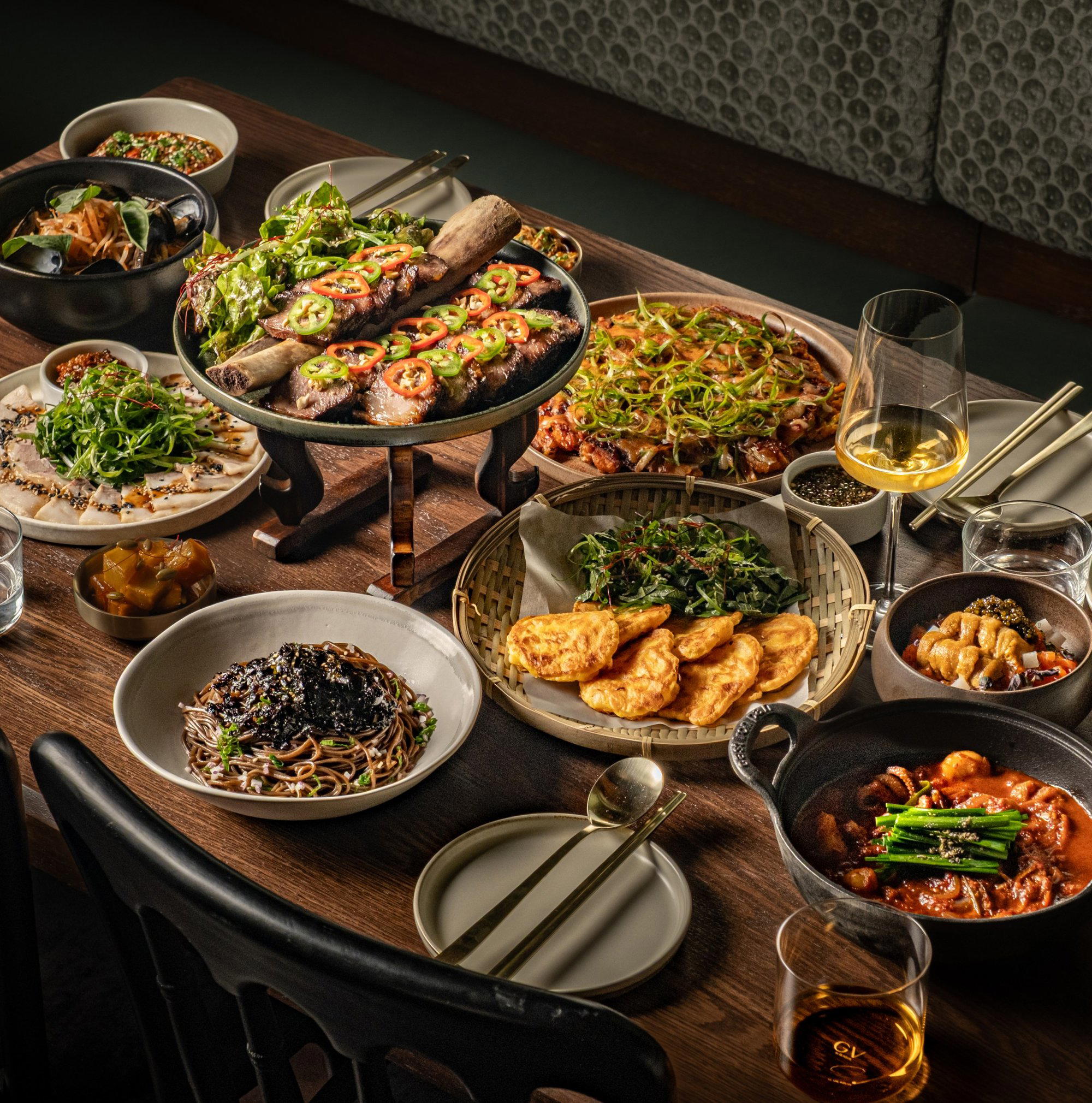
Vermont Avenue and the Architecture of the Korean Table
Koreatown's dining identity is not built on tasting menus or reservation queues. It is built on a tradition of communal, centrepiece-led eating where the table itself becomes the delivery mechanism — banchan arriving in clusters, proteins cooked or assembled tableside, and the meal structured by refill and rotation rather than by sequential courses. Kobawoo House, at 698 S Vermont Avenue, sits squarely inside that tradition, and what the menu reveals about the restaurant is precisely this: it is not trying to be everything. It has chosen a narrow lane — bossam above all, and committed to it with the kind of discipline that only comes from years of repetition.
That focus is worth understanding in the context of what Koreatown has become. The neighbourhood running along Vermont and Western Avenues now spans a wider dining register than at any point in its history, from late-night soondae stalls to the more composed Korean-American cooking emerging at venues like Kato, which has pushed New Taiwanese and broader Asian-American fine dining into conversation with Los Angeles's Michelin-tracked scene. Kobawoo operates at the other end of that register, and makes no apologies for it. The room, inside a strip-mall complex, bright-lit, built for throughput, signals exactly what the kitchen is doing: spending its energy on the food, not the frame.
What the Menu Is Actually Telling You
Menu architecture at a venue like this is instructive. The bossam section anchors the card, and its prominence is not accidental. Bossam, slow-boiled pork belly and shoulder, served with napa cabbage, radish kimchi, fermented shrimp paste, and raw oysters, is one of the more technically demanding dishes in the Korean canon to execute at volume and at consistency. The pork must be cooked long enough to reach the right texture without collapsing into mush, and served promptly enough that it arrives at the table with residual warmth. Getting that right, night after night, in a busy room, is the operational challenge the kitchen has organised itself around.
The banchan that accompanies a meal here functions less as decoration and more as calibration, a signal of how seriously the kitchen takes the supporting cast. In Korean table culture, the depth and rotation of small plates communicate the kitchen's investment in the full meal rather than just the headliner. A sparse or repetitive banchan spread is a reliable indicator of a kitchen cutting corners. The scope of what arrives at Kobawoo's tables has long been part of its reputation in the neighbourhood.
This is a different structural logic from what you encounter at the city's high-end Korean cooking. Atomix in New York, for reference, uses a cards-and-courses format to reframe Korean ingredients inside a fine-dining grammar. Kobawoo operates on the opposite premise: the format is entirely traditional, and the measure of success is fidelity to that tradition rather than departure from it. Neither approach is inherently superior; they are answers to different questions.
Koreatown's Position in the Broader Los Angeles Dining Map
Los Angeles has a more differentiated Korean dining scene than any other American city, and Koreatown is its centre of gravity. The neighbourhood functions as both a destination for the Korean-American community and an increasingly visited zone for diners from across the city who understand that some of the most consistent cooking in Los Angeles happens in strip-mall rooms with minimal English-language signage. That dynamic, serious food in deliberately unpretentious settings, is not unique to Korean cuisine here, but it is nowhere more concentrated than along this corridor.
The contrast with the city's Michelin-tier venues is significant. Restaurants like Providence, Hayato, and Somni operate within a different system of expectations around pacing, service architecture, and price. Kobawoo belongs to the tier that defines itself by different coordinates: the reliability of a single dish done at scale, pricing that allows a full table of food without financial calculation, and hours that accommodate the late-eating habits of the neighbourhood. For the record, venues in this tier across Los Angeles tend to run in the $ to $$ range, well below the $$$$ bracket occupied by Osteria Mozza or the omakase counters further west.
That affordability is not a consolation prize. It is part of the value proposition and part of why Kobawoo has sustained its reputation over years in a neighbourhood with no shortage of competition. Regulars in Koreatown are not a forgiving audience; the community eats out frequently and has calibrated expectations formed by home cooking. Longevity in this zip code is earned.
Where Kobawoo Sits in the American Korean Dining Conversation
The American restaurant conversation around Korean food has shifted substantially in the past decade. Fine-dining Korean cooking has moved from niche to mainstream recognition, with venues in New York and Los Angeles drawing the kind of critical attention previously reserved for Japanese or French formats. But that elevation of the high end has not diminished the importance of the workhorse tier, if anything, it has thrown it into sharper relief. The bossam specialists, the sundubu joints, the late-night galbi rooms: these are the venues that form the connective tissue of Korean dining culture in America, and they operate largely outside the awards framework that tracks venues like The French Laundry, Le Bernardin, or Blue Hill at Stone Barns.
That absence from the awards conversation does not reflect quality. It reflects category. Kobawoo is not competing for Michelin stars any more than Addison in San Diego is competing to be Koreatown's leading bossam. They are answering different questions for different diners. For the reader planning a Los Angeles trip, the more useful frame is this: if you want to understand what Korean food in America actually looks like at its most consistent and least performative, Koreatown's strip-mall rooms are where that education happens, and Kobawoo is one of the places that has kept that standard over time.
For a broader map of where Kobawoo fits within the Los Angeles dining scene, the full Los Angeles restaurants guide covers the city's range from Koreatown to the Westside and beyond.
Know Before You Go
- Address: 698 S Vermont Ave #109, Los Angeles, CA 90005
- Neighbourhood: Koreatown, Los Angeles
- Format: Traditional Korean, bossam-focused
- Price tier: Low to mid-range ($ to $$) by Los Angeles standards
- Reservations: Walk-ins accommodated; high-traffic periods may involve a wait
- Parking: Strip-mall lot on site
- Leading for: Groups comfortable with communal, sharing-format meals
- Hours/phone/website: Confirm directly before visiting, current details not verified
Budget and Context
| Venue | Cuisine | Price | Awards |
|---|---|---|---|
| Kobawoo HouseThis venue — the venue you are viewing | Not listed | This venue | Not listed |
| Kato | New Taiwanese, Asian | $$$$ | Michelin 1 Star |
| Hayato | Japanese | $$$$ | Michelin 2 Star |
| Vespertine | Progressive, Contemporary | $$$$ | Michelin 2 Star |
| Holbox | Mexican Seafood, Mexican | $$ | Michelin 1 Star |
| Sushi Kaneyoshi | Sushi, Japanese | $$$$ | Michelin 1 Star |
At a Glance
- Lively
- Classic
- Cozy
- Group Dining
- Casual Hangout
- Family
- Standalone
- Beer Program
Current opening hours
- Monday
- Closed
- Tuesday
- 11 AM–10 PM
- Wednesday
- 11 AM–10 PM
- Thursday
- 11 AM–10 PM
- Friday
- 11 AM–10 PM
- Saturday
- 11 AM–10 PM
- Sunday
- 11 AM–10 PM
Hours can change for holidays and private events. Last verified .
Casual strip mall setting with a lively, welcoming atmosphere where patrons gather in the evenings to enjoy traditional Korean fare and soju.
Know Before You Go
- Getting there
- 698 S Vermont Ave #109, Los Angeles, CA 90005