Knickerbocker Bagel
Our verdict
On Knickerbocker Avenue in Bushwick, the bagel shop that shares its name with the street sits inside one of Brooklyn's most concentrated pockets of working-class food culture. The address alone signals something about what the neighbourhood expects: no theatre, no tasting menus, just the kind of serious, daily-use food that defines how New York actually eats. A counter stop for anyone tracing Brooklyn's food character beyond the obvious.

Pearl is the En Primeur Club membership app — saves, bookings, and concierge access live there. Same editors, same standards.
- Address
- 367 Knickerbocker Ave, Brooklyn, NY 11237
- Phone
- (718) 709-8888
- Hours
- Daily 7 AM–5 PM
- Website
- kbbagel.com
- Directions
- Get directions
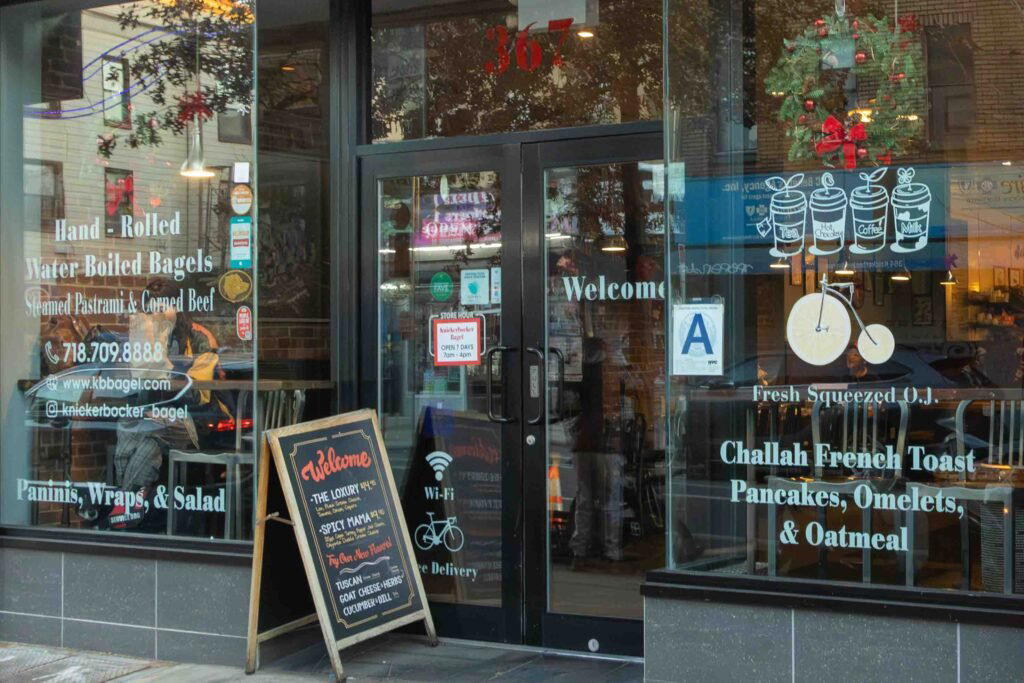
The menu
What to order
- Breakfast Bagels with fresh ingredients
- Loxury Flavored sandwich
- Reuben Sandwich
- Flavored Cream Cheeses
Knickerbocker Avenue and the Bagel as Neighbourhood Document
There is a particular kind of New York address that does its explaining before you walk through the door. Knickerbocker Avenue in Bushwick, Brooklyn, is that kind of street. The avenue runs through a corridor that has absorbed successive waves of immigration, industrial use, and neighbourhood reinvention without ever quite becoming a destination in the way that food media tends to manufacture destinations. The businesses here are not positioned against the fine-dining tier occupied by places like Le Bernardin or Eleven Madison Park. They operate in a different register entirely, one defined by daily return visits, neighbourhood regulars, and food that earns its keep through consistency rather than occasion.
Knickerbocker Bagel sits on that avenue, at 367, and the name is not incidental. It is a declaration of geographic identity. In New York, the bagel is arguably the food most thoroughly embedded in the texture of ordinary street life, and the shops that make them well tend to exist in inverse proportion to their media profile. The best-known bagel counters are rarely the ones writing their own press releases.
Brooklyn's Bagel Culture and Where Bushwick Fits
New York's bagel geography has always been uneven. Manhattan's most prominent spots, particularly on the Upper West Side and in the East Village, absorbed most of the press attention through the 1990s and 2000s. Brooklyn's contribution to the form has been quieter but no less serious. Bagel production in the borough has historically tracked the same immigrant corridors that shaped its neighbourhoods, and Bushwick, with its long history as a working-class community, sits squarely in that tradition.
The borough's food identity has fractured considerably in recent years. Parts of Williamsburg and Park Slope now support the same price tier as Manhattan's serious tasting-menu rooms, with booking windows and tasting-menu prices that would not look out of place beside Per Se or Atomix. Bushwick has gentrified more selectively, and Knickerbocker Avenue specifically has remained closer to the neighbourhood's working character than to its art-world or hospitality-industry reinvention. That context matters when you are thinking about what a bagel shop on this street is actually doing and for whom it is doing it.
Across the wider American dining conversation, the gap between counter-service everyday food and the highly constructed experience at places like Masa or Blue Hill at Stone Barns has become a recurring editorial subject. What gets less attention is the middle category that New York does better than most American cities: the serious, non-performative, neighbourhood food institution that operates with craft and without ceremony.
The Form Itself: Why the New York Bagel Is a Technical Object
A properly made New York bagel is a technical achievement that is easy to underestimate because the result looks simple. The dough requires high-gluten flour to develop the density and chew that separates a New York bagel from the softer, bread-roll approximations that dominate most of the country. Boiling before baking creates the characteristic crust and controls the fermentation process in ways that baking alone cannot replicate. Water chemistry, long a source of debate among enthusiasts and professionals alike, affects the mineral content that interacts with the dough's fermentation. Whether New York tap water is genuinely irreplaceable or whether that claim has been overstated is an ongoing argument, but the output at the better Brooklyn shops tends to settle it empirically.
The neighbourhood bagel shop format, as a category, has faced pressure from two directions: the café-bakery hybrid that repositions the bagel as a premium artisan item, and the industrial producer that sacrifices texture for shelf life and scale. Shops on streets like Knickerbocker Avenue, which serve a neighbourhood clientele rather than a destination audience, often occupy the most defensible position: too local to attract the mark-up pressure of a tourist-facing block, too embedded in daily use to cut corners on the product.
Reading the Address: What 367 Knickerbocker Signals
For a visitor coming from Manhattan's tasting-menu circuit, from the kind of dinner that involves a wine program and a pre-paid booking confirmation, the shift to Bushwick's Knickerbocker Avenue is also a shift in how New York actually sustains itself at ground level. The address is in the L train corridor, accessible from Manhattan via the Montrose or Morgan Avenue stops, a route that runs through the grain of working Brooklyn rather than skirting its edges.
In this context, Knickerbocker Bagel is less interesting as an isolated venue than as evidence of what the neighbourhood retains. Food journalists writing about New York's dining identity tend to concentrate their attention on the upper end: the three-star rooms, the multi-course formats, the addresses that require planning months in advance. But a significant part of what makes New York's food culture credible is the existence, at street level, of places that do one thing seriously and do it for the people who live nearby. That is the category this address represents.
Visitors building a broader New York food itinerary would do well to hold both registers in mind simultaneously. The high-end rooms covered in our full New York City restaurants guide represent one axis of the city's dining identity. The counter stops in Bushwick represent another, and the distance between them is part of the story.
Planning Your Visit
The practical details for Knickerbocker Bagel are consistent with what the neighbourhood format suggests. Address: 367 Knickerbocker Ave, Brooklyn, NY 11237. Reservations: Not applicable for a counter-service format of this type. Getting there: The venue sits in the L train corridor; Montrose Avenue is the closest subway stop. Budget: Counter-service bagel shops in this tier of Brooklyn operate at a fraction of the price of the city's tasting-menu rooms. Context: This is a neighbourhood stop, not a destination dining experience, and the visit is calibrated accordingly.
Frequently asked questions
What's Knickerbocker Bagel's location?
Knickerbocker Bagel is located at 367 Knickerbocker Ave, Brooklyn, NY 11237, New York City.
How does Knickerbocker Bagel's Bushwick location differ from Brooklyn's more prominent bagel destinations?
Most out-of-borough visitors default to bagel shops in Park Slope, Williamsburg, or Bay Ridge — neighbourhoods with established food tourism infrastructure. Knickerbocker Avenue sits further into Bushwick, a corridor that historically served the surrounding Latino and working-class communities rather than weekend food tourists. That address distinction makes 367 Knickerbocker Ave a different kind of reference point within New York City's broader bagel geography.
What's the must-try dish at Knickerbocker Bagel?
The bagel itself is the point. At a counter like this one on Knickerbocker Avenue, the baseline order is a plain or sesame bagel — the formats that most directly reveal whether the dough hydration, boil time, and oven temperature are calibrated correctly. Toppings matter less than the crust-to-crumb ratio underneath them.
Do I need a reservation for Knickerbocker Bagel?
Bagel counters in Brooklyn operate on a walk-in basis. Knickerbocker Bagel at 367 Knickerbocker Ave follows the neighbourhood format: you arrive, you order, you wait as long as the line requires. Peak weekend morning hours tend to draw the longest queues at spots like this across Bushwick.
What do critics highlight about Knickerbocker Bagel?
The address itself is part of the conversation. Knickerbocker Avenue in Bushwick carries a specific cultural weight in Brooklyn food writing — a working-class commercial strip that predates the borough's better-documented food corridors. Coverage of this shop tends to frame it within that neighbourhood context rather than against Manhattan's more prominent bagel destinations.
Can Knickerbocker Bagel accommodate dietary restrictions?
Traditional New York bagel production is dairy-free by default, which makes the format accessible to those avoiding milk-based ingredients. Specific allergen policies and gluten-free options are not documented for this location. Anyone with a serious dietary requirement should confirm directly at the counter at 367 Knickerbocker Ave before ordering.
A Quick Peer Check
Comparable venues nearby, for context on price, style, and recognition.
| Venue | Cuisine | Price | Notes |
|---|---|---|---|
| Knickerbocker BagelThis venue — the venue you are viewing | Authentic New York Bagels | $10–20 | Not listed |
| Elder | American Bar Food | Not listed | Greenpoint |
| Bagel Buffet | NYC Bagel Deli | $10–20 | Greenwich Village |
| H&H Bagels | Classic New York Bagels | $10–20 | Upper West Side (Central) |
| Donut Pub | American Donuts & Cronuts | $10–20 | Greenwich Village |
| Ainsworth Brooklyn | Classic American Gastropub | Not listed | East Williamsburg |
Continue exploring
More in New York City
Restaurants in New York City
Browse all →
Bars in New York City
Browse all →
Hotels in New York City
Browse all →







Details
- Cozy
- Casual
- Brunch
- Casual Hangout
- Solo
- Standalone
- A La Carte
- Coffee
- Tea
- Vegetarian Friendly
- Vegan Options
Current opening hours
- Monday
- 7 AM–5 PM
- Tuesday
- 7 AM–5 PM
- Wednesday
- 7 AM–5 PM
- Thursday
- 7 AM–5 PM
- Friday
- 7 AM–5 PM
- Saturday
- 7 AM–5 PM
- Sunday
- 7 AM–5 PM
Hours can change for holidays and private events. Last verified .
Friendly, relaxed neighborhood spot with a welcoming environment well-suited for casual breakfast and brunch.