H&H Bagels
H&H Bagels on Columbus Avenue has anchored New York's Upper West Side bagel tradition since the 1970s, producing the hand-rolled, kettle-boiled rounds that define what a New York bagel actually means. Positioned against the city's growing wave of artisan bagel shops, H&H represents the original industrial-scale standard against which all local challengers are still measured. A walk-in counter operation with no reservation and no ceremony.
Pearl is the En Primeur Club membership app — saves, bookings, and concierge access live there. Same editors, same standards.
- Address
- 526 Columbus Ave, New York, NY 10024
- Phone
- +12124989828
- Website
- hhbagels.com
- Directions
- Get directions
 Saves & bookings on Pearl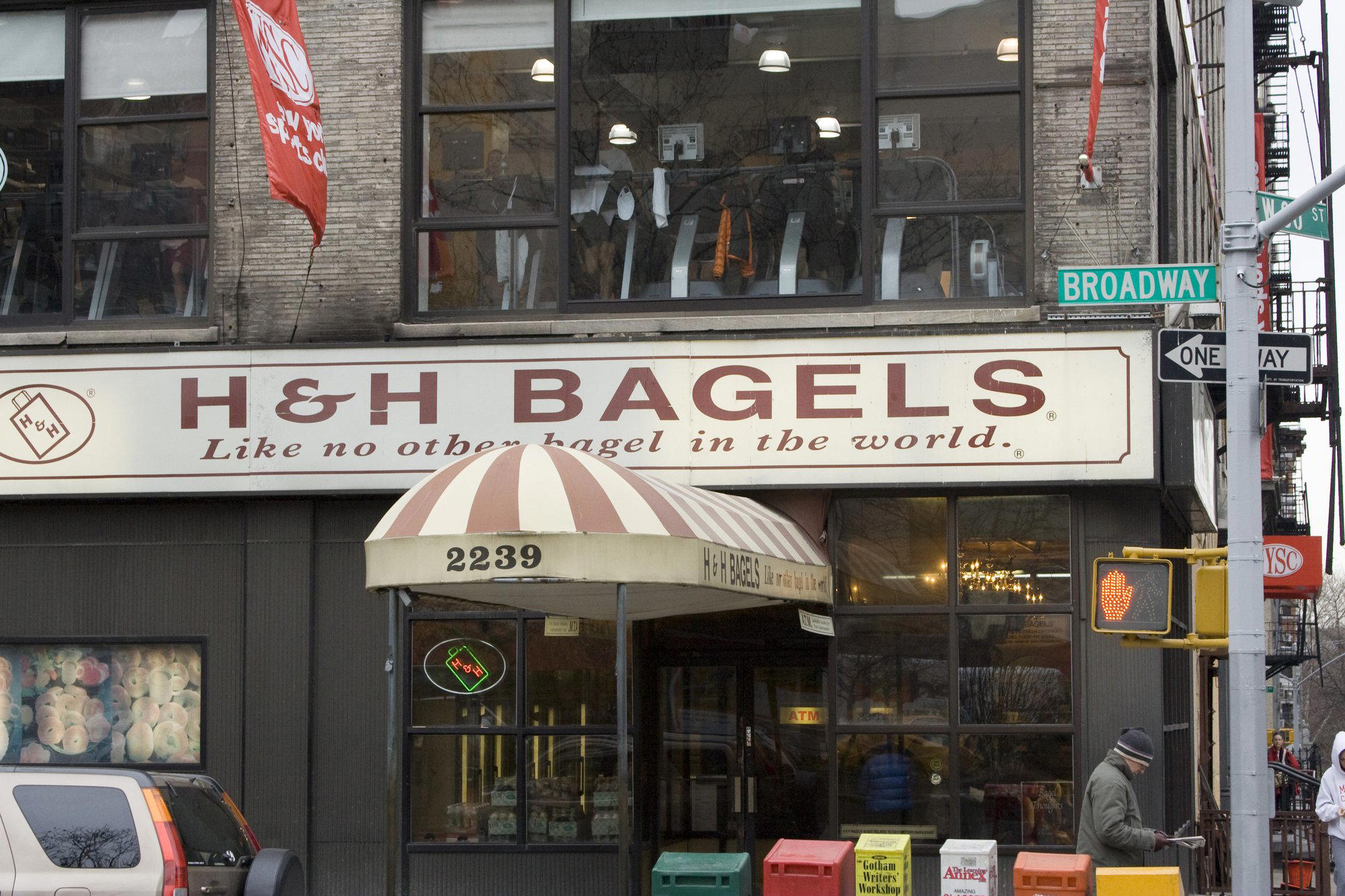
What a New York Bagel Actually Is
Before the sourdough-leavened, sesame-crusted, naturally-fermented bagel revival that swept American cities through the 2010s and 2020s, there was a simpler, more specific object: the New York bagel as defined by a handful of shops that had been making them the same way for decades. H&H; Bagels, operating from its Columbus Avenue address on the Upper West Side, belongs to that foundational tier. Its history stretches back to 1972, when Helmer Toro opened the original location and set the production template that made H&H; a reference point in discussions of what separates a genuine New York bagel from its regional approximations.
The distinction matters more than it might appear. The New York bagel's particular density and chew traces back to a specific production method: hand-rolling the dough, boiling it briefly in water before baking. That boiling step gelatinises the outer starch, producing the characteristic shiny crust and dense interior that distinguishes a New York bagel from the softer, bready versions common in most of the country. H&H;'s formula follows this tradition without deviation, which is why the product reads as a document of technique rather than a trend response. For context on how dramatically New York's broader dining scene has evolved beyond these roots, the full New York City restaurants guide maps everything from counter-service institutions to the multi-course tasting menus at Per Se and Le Bernardin.
The Upper West Side as Context
Columbus Avenue in the 70s and 80s was a working neighbourhood corridor before it gentrified into its current form. H&H;'s longevity on that strip is itself a kind of data point: a production-focused bagel operation that has outlasted dozens of restaurants, cafes, and retail concepts that came and went around it. The Upper West Side has historically maintained a stronger connection to New York's Jewish deli and bakery traditions than most other Manhattan neighbourhoods, and H&H; has functioned as one of the last visible anchors of that food culture on the West Side.
That cultural context distinguishes H&H; from the newer artisan bagel shops that have opened in Brooklyn and the Lower East Side over the past decade. Those operations tend to position themselves as craft responses to industrial decline, emphasising small batches, heritage flours, and extended fermentation. H&H; represents something different: the industrial standard itself, operating at volume, with the consistency and throughput that made New York bagels a category rather than a curiosity. The comparison is analogous to the split in American fine dining between high-volume institutions and precision tasting-menu formats. Venues like Alinea in Chicago or The French Laundry in Napa occupy a different register entirely from a neighbourhood counter, but both are responding to the same question of what American food culture values and why.
Bagels as Cultural Object
The bagel's path from Eastern European Jewish baking tradition to New York street food to national commodity is one of the more compressed and legible stories in American food history. Ashkenazi Jewish immigrants brought the ring-shaped boiled bread to New York's Lower East Side in the late 19th and early 20th centuries, and by mid-century, production had concentrated among a small number of union-organised bakeries in the city. The International Beigel Bakers' Union once controlled output tightly enough that bagel production in New York was genuinely limited and localised.
H&H;'s founding in 1972 came as those union structures were beginning to loosen, and the shop expanded into what became, for many years, a high-volume operation supplying bagels beyond its retail counters. The product became associated with a specific era of New York food identity, the kind that showed up in film and television as shorthand for the city's character: plain, sesame, everything, poppy, eaten with cream cheese or lox, standing at a counter, without much ceremony.
That cultural weight is worth acknowledging separately from the food itself. H&H; does not occupy the same register as the tasting-menu restaurants that draw international attention to New York's dining scene. Operations like Atomix, Masa, or Jungsik New York represent New York as a city of global culinary ambition. H&H; represents something more local and more durable: the food that the city actually runs on, day to day, without a reservation or a dress code.
Where H&H; Sits in the Current Bagel Conversation
New York's bagel scene in the mid-2020s is more contested than it has been in decades. A generation of newer producers, some trained in the older traditions and some approaching bagels from an artisan-bread perspective, has reopened questions about what constitutes the standard. Shops in Brooklyn and elsewhere have drawn significant press coverage by positioning craft process as a corrective to mass production.
H&H; as a legacy operation, occupies a different position in that conversation. It is a baseline, not a challenger. Visitors arriving from cities without a serious bagel tradition will find the product calibrated to the New York norm rather than differentiated from it. That is, in context, a recommendation rather than a criticism. When the goal is to understand what defines the category, the reference point matters more than the outlier. The same logic applies in wine, where understanding Napa Cabernet requires tasting established producers before reaching for the natural-wine corrective fringe, or in French cuisine, where Alain Ducasse's Louis XV in Monte Carlo represents the classical standard against which contemporary departures are measured.
Among American regional food institutions more broadly, this category of foundational counter-service operation is increasingly rare. Dining culture has bifurcated sharply between fast-casual chains and premium experiential formats. The mid-tier neighbourhood institution, producing a single product at volume over decades, has become harder to sustain. That H&H; has maintained presence on Columbus Avenue across more than fifty years puts it in a distinct comparable set nationally, alongside institutions like Emeril's in New Orleans as an example of a venue that carries the weight of local food identity as much as any individual meal.
Planning Your Visit
H&H; Bagels at 526 Columbus Avenue operates as a walk-in counter. There is no reservation system, no tasting menu, and no advance booking required. The operation suits the Upper West Side's residential rhythm: it draws morning and weekend traffic from locals rather than destination diners. For visitors, the practical approach is to arrive early in the day, when the product is freshest. The location sits in the 70s on the West Side, walkable from Central Park and within reach of the Museum of Natural History, which makes it a natural stop before or after time in the neighbourhood.
H&H; does not carry Michelin recognition or position itself within the award frameworks that govern New York's fine-dining tier. Its trust signal is strictly historical: more than five decades of continuous operation producing a product that remains the reference for its category. Visitors accustomed to the reservation-led, multi-course format of New York's leading tables will find the experience structurally opposite. That contrast is part of the point.
Quick reference: Walk-in only, 526 Columbus Ave, Upper West Side, Manhattan.
Just the Basics
Comparable venues nearby, for context on price, style, and recognition.
| Venue | Cuisine | Price | Notes |
|---|---|---|---|
| H&H BagelsThis venue — the venue you are viewing | Not listed | $ | Not listed |
| Mike's Coffee Shop | Clinton Hill, Classic American Diner | $ | Not listed |
| Haagen-Dazs | Not listed | $ | Upper East Side-Lenox Hill-Roosevelt Island, Premium Ice Cream |
| White Castle | Allerton, Classic American Sliders | $ | Not listed |
| Ambassador Grill | Not listed | $$ | East Midtown-Turtle Bay, American Steakhouse with Global Influences |
| Paul's Place | East Village, Classic American Burgers | $ | Not listed |
Continue exploring
More in New York City
Restaurants in New York City
Browse all →
Bars in New York City
Browse all →

Hotels in New York City
Browse all →



Wineries in New York City
Browse all →


At a Glance
- Classic
- Well Known
- Brunch
- Casual Hangout
- Historic Building
Current opening hours
- Monday
- 6 AM–3 PM
- Tuesday
- 6 AM–3 PM
- Wednesday
- 6 AM–3 PM
- Thursday
- 6 AM–3 PM
- Friday
- 6 AM–3 PM
- Saturday
- 6 AM–3 PM
- Sunday
- 6 AM–3 PM
Hours can change for holidays and private events. Last verified .
Casual spot with sitting tables, good coffee, and a no-frills atmosphere focused on fresh bagels.