Our verdict
In Karaman, the traditions of etliekmek and lahmacun represent the culinary backbone of Central Anatolia, and Kısmet Etliekmek ve Lahmacun Salonu sits squarely within that canon. Located on Dr. Mehmet Armutlu Caddesi in the Sekiçeşme neighbourhood, this is a working lokanta built around two of Turkey's most ingredient-dependent flatbread formats, where the quality of the meat and dough determines everything.

Pearl is the En Primeur Club membership app, where members save venues, book tables and use the concierge.
Where Central Anatolian Flatbread Tradition Meets Everyday Life
Walk along Dr. Mehmet Armutlu Caddesi in Karaman's Sekiçeşme district on any given lunchtime and you'll find the kind of scene that defines provincial Turkish food culture: tables filling with tradespeople, families, and local office workers; the smell of woodsmoke or gas-fired stone ovens cutting through the street air; and the particular rhythm of a room organised around two dishes that have remained essentially unchanged for generations. Kısmet Etliekmek ve Lahmacun Salonu operates inside that tradition without apology or embellishment, and that is precisely what makes it worth understanding.
Karaman sits in the south of Konya province, roughly midway between Konya city and the Taurus Mountains, and its food culture reflects that geography. This is the agricultural and pastoral interior of Turkey, where lamb and beef are sourced locally, wheat is milled regionally, and the cooking vocabulary centres on dishes that travel well from oven to table without elaborate preparation. For a deeper survey of where Kısmet fits among the city's eating options, see our full Karaman restaurants guide.
Two Dishes, One Clear Standard
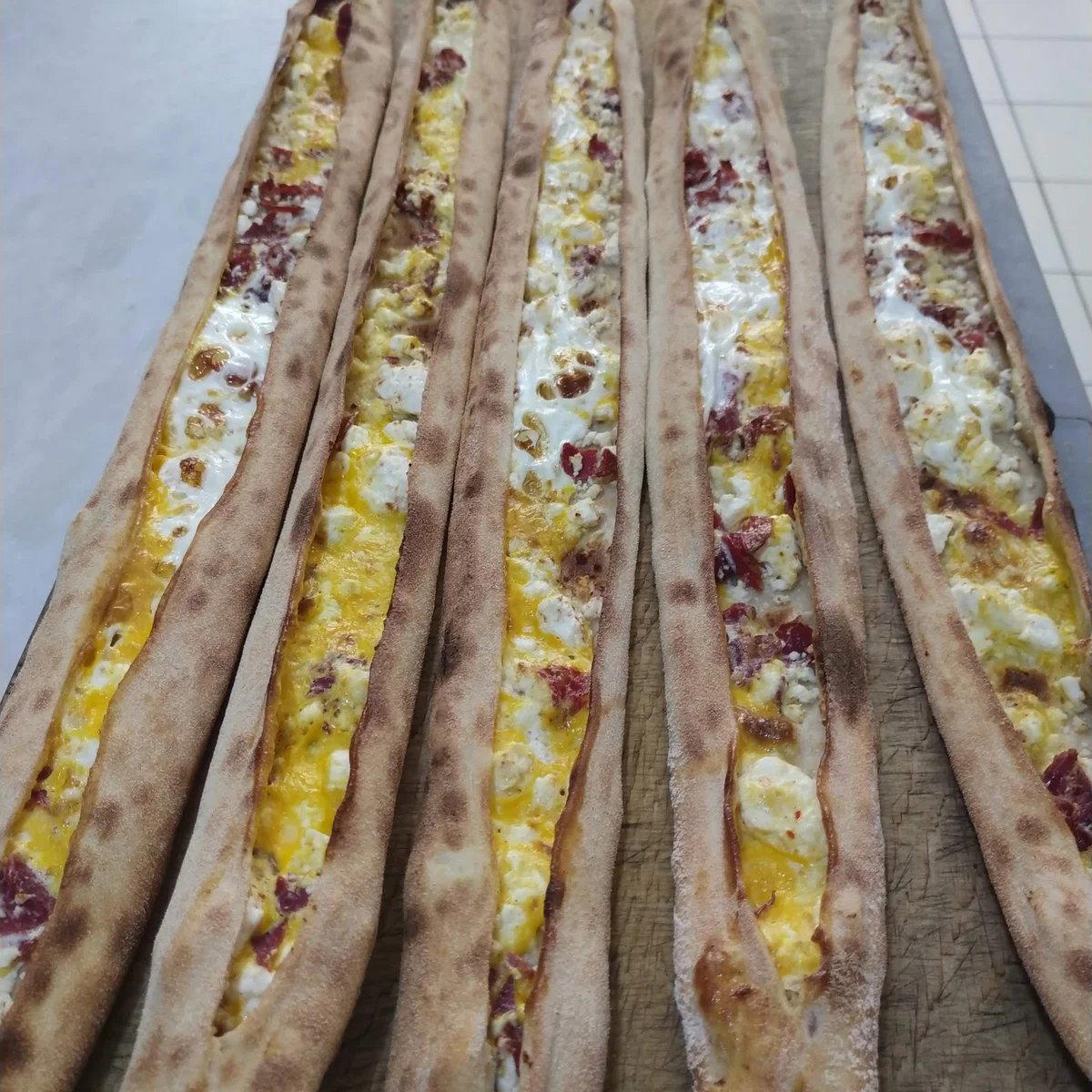
Etliekmek and lahmacun are often discussed together because both rely on the same foundational logic: thin dough topped with seasoned minced meat, cooked at high heat, served immediately. But they are distinct formats with different regional identities. Etliekmek is the Konya tradition, an elongated flatbread that can reach seventy to eighty centimetres in length, topped with a coarser, less spiced meat mixture and baked directly on a stone surface. Lahmacun, which has stronger associations with Gaziantep and the broader southeastern tradition (see Dürümzade in Beyoglu for how the format performs in Istanbul), is thinner, crisper at the edge, and carries a more aromatic spice profile with tomato and parsley worked into the topping.
A salonu that holds both in its name is making a statement about the breadth of its Central Anatolian reference points. The meat topping on each format is where sourcing matters most. In the Konya region, the preference is for locally raised sheep and cattle. The fat ratio in the mince, the coarseness of the grind, and the freshness of the meat all register immediately in the finished product because there is nowhere for a substandard ingredient to hide, no sauce, no layering, no technique to compensate. Across the wider Anatolian tradition, the leading operators in this category source daily and prep to order rather than working from a pre-made mixture held through service. The distinction shows in the texture of the topping once it comes off the heat: properly prepared meat stays cohesive but not dense, with a slight char at the edges where the fat has rendered into the dough.
For a comparative sense of how ingredient sourcing defines flatbread quality across Turkey's regions, the contrast with a place like Ciğerci Mahmut in Adana is instructive, Adana's offal-led cooking tradition shares the same insistence on daily sourcing and immediate service, even though the dishes are entirely different.
The Salonu Format in Context
Turkey's lokanta and salonu culture occupies a different register than the high-concept modern Turkish restaurants that have drawn international attention in recent years. Operations like Turk Fatih Tutak in Istanbul or Narımor in Izmir work within a framework of reinterpretation and technique-driven refinement. A salonu like Kısmet operates on the opposite premise: the dish is already settled, the format is already defined, and the only variable is execution quality. This is not a lesser ambition. In many ways it is a harder one, because there is no novelty to distract from the fundamentals.
Provincial salounus of this type share certain structural characteristics across Turkey: counter service or quick table turnover, minimal printed menus (because the offering rarely changes), pricing that reflects volume and locality rather than positioning, and an interior organised for function rather than atmosphere. The physical environment at a typical etliekmek salonu in Central Anatolia tends to be straightforwardly utilitarian, tiled walls, wooden tables, fluorescent or strip lighting, with the oven as the focal point of the room and the heat from it as the dominant sensory fact. This is food that insists on being experienced as sustenance first and as culture second, even though it is both.
For readers accustomed to the design-led dining environments found at places like Maçakızı in Bodrum or Hiç Lokanta in Urla, the salonu experience requires a different frame. The value is in the dish itself, in the speed and confidence of service, and in the way the room reflects the actual eating habits of the city around it. That is not a consolation prize; it is a different kind of authority.
The broader tradition of Central Anatolian grain and meat cooking has deep historical roots. Asitane in Fatih has spent years reconstructing Ottoman-era recipes that sit upstream of many of these regional dishes. The lineage of etliekmek runs through Seljuk-era Konya, where flatbread and meat were the staple combination of a city positioned at the crossroads of Anatolian trade routes. Karaman, as a city with its own significant Karamanid history, sits within that same cultural geography.
Planning a Visit
Kısmet Etliekmek ve Lahmacun Salonu is located at Sekiçeşme, Dr. Mehmet Armutlu Caddesi in central Karaman, accessible on foot from the city centre. This type of establishment operates on a lunch-forward schedule in most Anatolian cities, with the busiest service running from midday through early afternoon when ovens are at operating temperature and the morning's meat prep is at its freshest. Arriving at peak hours is advisable for the leading product, though it means accepting the room at its most crowded. Pricing at this category of provincial salonu is among the most accessible in Turkish dining, with individual portions of etliekmek or lahmacun typically costing a fraction of what comparable street-format dishes command in Istanbul or Izmir. No booking infrastructure is standard in this format; walk-in is the only mode of entry. For context on how this compares to similarly priced traditional formats elsewhere in the region, see Konya Kebap Evi in Selcuklu.
Frequently asked questions
Would Kısmet Etliekmek ve Lahmacun Salonu be comfortable with kids?
Salonu-format restaurants in Turkey are built around fast, communal, counter-style dining, and Kısmet fits that template. The informal setting on Dr. Mehmet Armutlu Caddesi in Karaman means no dress code, no extended tasting menus, and no reason children would feel out of place. It is the kind of lunch stop that serves working families as naturally as solo diners.
What is the atmosphere like at Kısmet Etliekmek ve Lahmacun Salonu?
Kısmet operates in the salonu register, which in Turkish provincial cities means functional, no-frills rooms oriented around the food rather than the setting. The Sekiçeşme district of Karaman is a workaday neighbourhood, so expect lunchtime crowds of local residents rather than a tourist-facing dining room. The pace is brisk and the interaction direct.
What makes etliekmek at a Karaman salonu different from lahmacun found elsewhere in Turkey?
Etliekmek is a specifically central Anatolian flatbread, most closely associated with the Konya region and its surrounding provinces, including Karaman. It runs longer and wider than the standard lahmacun and is typically cooked in a wood-fired or stone oven, producing a different texture and crust. Kısmet's name placing both dishes side by side reflects Karaman's position within that regional tradition, where etliekmek carries local identity weight that lahmacun alone does not.
What should I order at Kısmet Etliekmek ve Lahmacun Salonu?
The name tells you what to order: etliekmek and lahmacun are the two dishes the kitchen is built around. Both are thin-dough flatbreads topped with seasoned minced meat, though etliekmek is the longer, broader Konya-region variant while lahmacun is the thinner, crispier standard. In Karaman, this combination represents the region's everyday flatbread tradition rather than a novelty offering.
What's the address for Kısmet Etliekmek ve Lahmacun Salonu?
Kısmet Etliekmek ve Lahmacun Salonu is located at Sekiçeşme, Dr. Mehmet Armutlu Cd. No, Karaman.
Can I walk in to Kısmet Etliekmek ve Lahmacun Salonu?
Salonu-format venues in Turkey do not operate reservation systems as a rule, and Kısmet on Dr. Mehmet Armutlu Caddesi in Karaman follows that convention. Walk-in is the standard approach. Arriving outside the peak lunchtime window will generally mean a shorter wait for a table.
A Quick Peer Check
Comparable venues nearby, for context on price, style, and recognition.
| Venue | Cuisine | Price | Notes |
|---|---|---|---|
| Kısmet Etliekmek ve Lahmacun SalonuThis venue (the venue you are viewing) | Turkish Etliekmek & Lahmacun | $1–10 | Not listed |
| The House Of Memories | Traditional Turkish Testi Kebab | $10–20 | Uchisar |
| Bayramoğlu Döner | Traditional Turkish Döner | $10–20 | Kavacık |
| Kofteci Huseyin 1958 | Traditional Turkish Kofte | $10–20 | Beyoglu |
| Metanet Katmer | Traditional Gaziantep Katmer | $1–10 | Suyabatmaz |
| Metanet Lokantasi | Traditional Gaziantep Turkish | $10–20 | Kozluca |
Details
- Casual Hangout
- Open Kitchen
- A La Carte
Current opening hours
- Monday
- 8:30 AM–7:30 PM
- Tuesday
- 8:30 AM–7:30 PM
- Wednesday
- 8:30 AM–7:30 PM
- Thursday
- 8:30 AM–7:30 PM
- Friday
- 8:30 AM–7:30 PM
- Saturday
- 8:30 AM–7:30 PM
- Sunday
- 9 AM–8 PM
Hours can change for holidays and private events. Hours as of .