
Tabelog 100 #10
Our verdict
Kinmochi is a compact Hatsudai curry counter in Tokyo with Tabelog Curry TOKYO 100 selections in 2023 and 2024. Its appeal sits in the everyday side of Tokyo curry culture: counter seating, no reservations, take-out service, and a price tier that keeps the meal closer to a weekday ritual than a destination tasting menu.

Pearl is the En Primeur Club membership app, where members save venues, book tables and use the concierge.
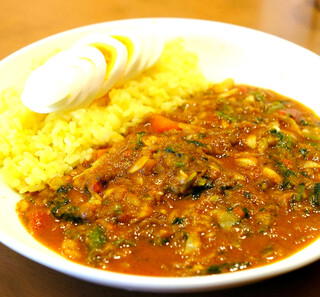
The menu
What to order
- Chicken curry with cheese topping
- Spice curry of the day
Within Tokyo’s vast dining map, Kinmochi belongs to a quieter everyday register. The city’s small specialist restaurants can take on a different role from destination dining: not theatre, not ceremony, but a focused meal as a disciplined local habit. Curry has long belonged to that Tokyo register. It is comfort food, office fuel, solo-dining territory, and a category where regulars often care as much about consistency and speed as about culinary authorship.
That is the frame for Kinmochi. The format places it closer to Tokyo’s everyday specialist shops than to hotel restaurants such as New York Grill, Girandole by Alain Ducasse, or Kozue, where the meal is shaped by view, service cadence, and occasion. Here, the cultural interest is narrower and more revealing: a curry specialist operating at small scale, recognised in the 2024 Tabelog Hyakumeiten selection for Curry, inside a city where the category ranges from station-adjacent chains to obsessive independents.
Tokyo curry as a specialist counter culture, not a luxury performance
Japanese curry is often misread by visitors as a single dish. In Tokyo, it is better understood as a set of micro-scenes: quick rice-and-sauce shops, spice-forward independents, cutlet curry counters, old-school versions, and hybrid kitchens that pull from South Asian, European, and Japanese pantry logic without needing to declare allegiance. The city’s curry culture rewards repeatability. A narrow format can matter more than a broad menu, because the regular customer is often measuring the same bowl against memory.
Kinmochi’s place in that culture is signalled by its 2024 Tabelog Hyakumeiten recognition for Curry rather than by luxury markers. Tabelog’s Hyakumeiten lists are useful in Japan because they separate genre specialists by category and region; a curry selection says something different from a French or sushi accolade. It points to local category credibility, not white-tablecloth prestige. For a traveller reading Tokyo through food, that distinction matters. The city’s dining intelligence is not only found at counters charging omakase prices; it also sits in compact rooms where the proposition is focused on one daily form.
The comparison is instructive. A traveller planning around Tokyo could pair this kind of meal with more formal Japanese dining, yakitori, or a more graphic, café-led stop elsewhere in the city. The value of a curry specialist is that it does not compete on the same axis. It offers a different reading of Tokyo: weekday scale, quick turnover, and the confidence of a kitchen that does not need a ceremonial format to justify attention.
Why the Tokyo setting changes the meal
Tokyo is dense enough that a curry shop can feel both convenient and intensely local. Away from the most formal dining orbit, expectations change: office workers, residents, and everyday repeat customers often matter as much as destination diners. That matters for curry. The category thrives when a restaurant can become part of a local routine, and a compact specialist format reinforces the point: a quick meal is not a compromise here, it is part of the culture.
In Tokyo, curry also works as a useful price and time corrective. A day built around reservations can become heavy with logistics; a small specialist stop restores flexibility, provided the diner accepts the constraints of a focused operation. Kinmochi is not the place to assemble a long, celebratory meal or a large group plan. It is better read as a sharp curry decision in a city where quieter dining rhythms are often just as revealing as the grand ones.
For travellers mapping a wider itinerary, the contrast with other Japanese dining formats is useful. Seafood, grilling, curry specialists, and regional Japanese meals all sit in different lanes. Curry’s lane is less formal, but not less culturally specific. It reflects Tokyo’s affection for specialist repetition: a small set of decisions, executed for regulars who notice drift.
How to place Kinmochi in a Tokyo dining day
The practical reading is simple: treat Kinmochi as a compact curry stop rather than an all-purpose restaurant. Its listed category is Curry, and the provided budget signal is modest, with pricing shown as - JPY 999. The Tabelog score listed for the 2024 recognition is 3.74, which helps place it within the city’s crowded field of genre specialists.
That combination places it in a different category from Tokyo’s hotel dining rooms and from long-form tasting menus. It also makes it useful for visitors who want one meal that speaks to local everyday habits rather than travel-page grandeur. The award signal helps filter the city’s crowded curry field, but the appeal depends on accepting the format on its own terms: focused category, low ceremony, and a meal that makes sense within Tokyo’s daily-use dining culture.
For broader planning, use Our full Tokyo restaurants guide to balance counters, formal rooms, and neighbourhood meals. The wider city edit also includes Our full Tokyo hotels guide, Our full Tokyo bars guide, Our full Tokyo wineries guide, and Our full Tokyo experiences guide. Travellers extending the food map beyond Tokyo can compare the specificity of small-format Japanese dining with other unnamed dining rooms across Japan. For a transpacific contrast in casual Japanese formats, similar everyday categories abroad show how Japanese dining ideas shift once they leave Japan’s daily-use context.
Frequently asked questions
Is Kinmochi suitable for children?
Kinmochi is a curry spot in Tokyo. Its focused format is likely to suit a quick meal more comfortably than a large family outing.
What's the overall feel of Kinmochi?
The feel is compact and practical, with attention centred on curry rather than luxury dining ceremony. Its 2024 Tabelog Hyakumeiten recognition for Curry places it among Tokyo’s notable curry specialists.
Is Kinmochi more mid-range or high-end?
Pricing at Kinmochi is listed as - JPY 999.
What part of town is Kinmochi in?
Tokyo.
Budget Reality Check
Comparable venues at the same tier.
| Venue | Cuisine | Price | Awards | Notes |
|---|---|---|---|---|
| KinmochiThis venue (the venue you are viewing) | Casual Japanese curry counter | $10–20 | Tabelog 100 #10 | Not listed |
| China Soba Osada | Ramen & Tantanmen | $10–20 | Tabelog 100 #66 | Itabashi, Ramen & Tantanmen |
| Soup Curry Ya Oodori Chiyoda kandasurugadai ten | Soup curry & Japanese curry house | $10–20 | Tabelog 100 #92 | Chiyoda, Soup curry & Japanese curry house |
| Sumibi Baisen Coffee Rin | Not listed | $1–10 | Tabelog 100 #60 | Chūō, Japanese Kissaten / Coffee Shop |
| Chuka Soba Waka TOKYO | Modern Tokyo ramen & tsukemen | $10–20 | Tabelog 100 #78 | Shinagawa, Modern Tokyo ramen & tsukemen |
| Rebanira ya Kintaro Toukyou shucchoujo | Japanese Cafeteria | Not listed | Tabelog 100 #55 | Shinagawa, Japanese Cafeteria |
Recognition history
Dated appearances from independent guides and award organizations, with the underlying list record or original source where available.
Tabelog 100 #10 · No. 10
Tabelog · Tabelog 100 - Curry - TOKYO - 2024
Continue exploring
More in Tokyo
Restaurants in Tokyo
All restaurants in Tokyo →




Bars in Tokyo
All bars in Tokyo →






Details
- Cozy
- Intimate
- Solo
- Casual Hangout
- After Work
- Standalone
- A La Carte
- Counter Dining
A simple, no-frills counter curry bar with about ten seats, non-smoking, and a relaxed but efficient atmosphere focused on solo and friend casual lunches rather than lingering dining.