
Tabelog 100 #72
Our verdict
A compact Asakusa sushi house with counter, table, and raised seating, Kibun Zushi belongs to Tokyo’s older neighbourhood sushi register rather than the city’s luxury omakase circuit. Tabelog selected it for Sushi TOKYO Tabelog 100 in 2025 and 2021, with a listed average price of JPY 3,000–3,999 and a reputation built around fish, sake, and repeatable local ease.

Pearl is the En Primeur Club membership app, where members save venues, book tables and use the concierge.
The menu
What to order
- Edomae sushi with tuna
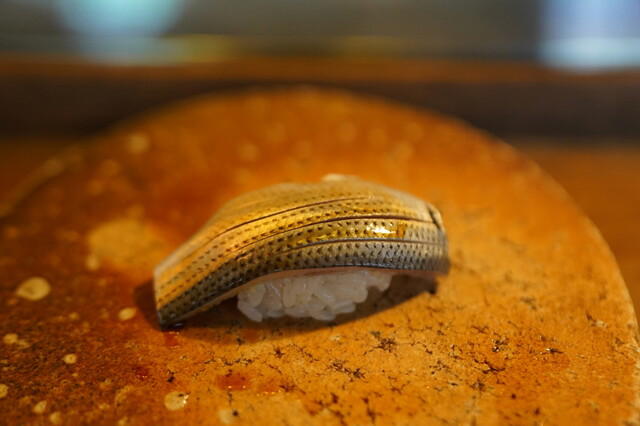
- Kohada (gizzard shad) nigiri
- Sea eel with nitsume sauce
- Boiled clams with nitsume sauce
Tokyo sushi has many registers, from hushed counters to unfussy local rooms. Kibun Zushi fits the latter register: a Tokyo sushi restaurant whose public profile is built less on ceremony than on recognition, price signal, and steady category clarity. This is not the theatrical end of Tokyo sushi; it is the everyday-special end, where the point is not to prove seriousness through formality, but to offer a focused sushi stop with a credible local reputation.
The distinction matters because Tokyo sushi has split into sharper tiers. One tier is reservation-led, chef-centred, and priced for destination dining. Another remains more approachable, where the measure is repeat custom, category focus, and the ability to return without turning dinner into a campaign. Tabelog’s 2025 Hyakumeiten recognition places Kibun Zushi in a credible middle zone: recognised by a major Japanese restaurant platform, but not framed here as a trophy-counter experience.
Tokyo sushi for regulars, not ceremony
The regulars’ perspective is the right lens here. In Tokyo, dining rooms often carry a mixed clientele because the city itself combines visitors, office life, residential habits, and long-running local food culture. A sushi restaurant in that environment has to be more adaptable than a rigid destination script. The appeal is not an unwritten performance, but an unwritten code: understand the pace, order with the room, and let the meal sit closer to local habit than culinary theatre.
That context separates it from other casual choices with different roles. Gyoza no Ousama, Tonkatsu Yutaka, Asakusa Sanboa, Larousse, and 鷹匠 寿 all point to how varied Tokyo dining can be even before leaving the city’s familiar restaurant circuits. Against that spread, Kibun Zushi reads as the sushi option for diners who want informality without abandoning craft signals. The Tabelog score of 3.68 adds another useful marker: in Japan’s restaurant culture, especially on Tabelog, numbers in that range are not casual noise.
Tokyo visitors often over-index on the formal omakase script and miss how much of the city’s sushi culture lives outside that frame. Kibun Zushi is better understood as part of that broader sushi culture rather than as a luxury substitute. Its value lies in category focus, recognisable standing, and a price range that keeps the restaurant within a more approachable lane than many destination counters.
Sushi, price, and the value of a modest room
The public signals are concise but telling: the category is sushi, and the listing gives a clear price range and score. That is enough to place the restaurant in a classic lane. Tokyo’s sushi culture often rewards narrowness, and this sort of address does not need a sprawling identity. The better question is whether the format supports return visits. Here, the combination of category focus and Tabelog recognition makes the experience easier to fold into a Tokyo dining plan than many formal sushi counters.
Price also shapes expectation, even when the exact order varies by diner. Kibun Zushi is listed at JPY 3,000 - JPY 3,999, with the same lunch budget range shown publicly. That bracket should be read carefully: appetite, drinks, and ordering style can change the final bill quickly. The editorial read is simple. Treat it as a recognised Tokyo sushi house, not a bargain hunt and not a luxury omakase substitute.
The Tokyo location reinforces that role. For travellers, the city can feel crowded and transactional around peak sightseeing hours; for locals, it remains a dense dining environment with older habits intact. Sushi here benefits from timing and temperament. Come expecting a restaurant that works within Tokyo’s daily flow, not a stage-managed tasting menu. That expectation will produce a better meal than arriving with luxury-counter benchmarks in mind.
How it fits into a Tokyo food itinerary
Tokyo rewards category planning. Pairing a sushi stop with other city-specific meals gives the city more shape than chasing isolated names across the rail map. For a broader restaurant circuit, start with Our full Tokyo restaurants guide, then compare more casual or specialist directions through other Tokyo dining rooms. The comparison is not about hierarchy; it is about understanding how Tokyo dining changes by format, setting, and price signal.
For travellers extending beyond the capital, the same logic applies across Japan and its diaspora. Contrast a sushi stop with regional or genre-specific dining pages elsewhere, from coastal restaurants to casual counters, specialist bars, and quick-service formats. For the rest of the trip architecture, use Our full Tokyo hotels guide, Our full Tokyo bars guide, Our full Tokyo wineries guide, and Our full Tokyo experiences guide.
The useful verdict is restrained. Kibun Zushi belongs on a Tokyo plan when the goal is recognised sushi in a setting that still reads as approachable rather than ceremonial. Its 2025 Tabelog Hyakumeiten recognition provides the trust signal, while the score of 3.68 and JPY 3,000 - JPY 3,999 price range explain why it sits in a practical middle ground. Tokyo has many sushi rooms built around scarcity. This one is better understood through accessibility, category focus, and the quiet durability of a local address.
Frequently asked questions
Can I bring kids to Kibun Zushi?
The public facts supplied here do not specify a family policy. Treat Kibun Zushi as a Tokyo sushi restaurant and confirm any child-related details directly before visiting.
What's the vibe at Kibun Zushi?
It reads as a recognised Tokyo sushi restaurant rather than a venue defined here by a formal tasting-menu script. The clearest public signals are its sushi category, Tabelog score of 3.68, and 2025 Tabelog Hyakumeiten recognition.
What's the price range at Kibun Zushi?
Pricing at Kibun Zushi is listed as JPY 3,000 - JPY 3,999.
What days is Kibun Zushi closed?
Specific opening days and closing days are not provided in the confirmed facts here. Check directly with Kibun Zushi before planning a visit.
How do I find Kibun Zushi?
Kibun Zushi is located in Tokyo.
What has Kibun Zushi built its reputation on?
The clearest marker is its 2025 Tabelog Hyakumeiten recognition. The confirmed public profile is focused: sushi, a Tabelog score of 3.68, and a listed price range of JPY 3,000 - JPY 3,999.
Awards and Standing
Comparable venues for context, by category and price tier.
| Venue | Cuisine | Price | Awards | Notes |
|---|---|---|---|---|
| Kibun ZushiThis venue (the venue you are viewing) | Traditional Edomae Sushi in Asakusa | $50–100 | Tabelog 100 #72 | Not listed |
| Honda Tokyo Noodle Works (麺処 ほん田) | Shoyu Ramen & Tsukemen | $10–20 | Not listed | Akihabara |
| Kajitsuen Riberu | Fruit Parlor | $10–20 | Not listed | Meguro |
| Sake to Misonikomi Misonikomin | Japanese Udon / Miso Nikomi | $10–20 | Tabelog 100 #85 | Bunkyō |
| Kishida Ya | Traditional Tokyo Izakaya | $30–50 | Tabelog 100 #99 | Chūō |
| Teuchi Soba Kikutani Sugamo honten | Handmade Soba & Soba Kaiseki | $20–30 | Tabelog 100 #1 | Toshima |
Recognition history
Dated appearances from independent guides and award organizations, with the underlying list record or original source where available.
Tabelog 100 #72 · No. 72
Tabelog · Tabelog 100 - Sushi - TOKYO - 2025
Continue exploring
More in Tokyo
Restaurants in Tokyo
All restaurants in Tokyo →









Details
- Classic
- Cozy
- Well Known
- Solo
- Family
- Casual Hangout
- Group Dining
- Chefs Counter
- Standalone
- Sake Program
- A La Carte
- Set Menu
- Counter Dining
- Sake
- Beer
- Pescatarian Friendly
Current opening hours
- Monday
- 12–2 PM, 5–9 PM
- Tuesday
- 12–2 PM, 5–9 PM
- Wednesday
- Closed
- Thursday
- 12–2 PM, 5–9 PM
- Friday
- 12–2 PM, 5–9 PM
- Saturday
- Closed
- Sunday
- Closed
Hours can change for holidays and private events. Hours as of .