Khao Mun Gai Nai Art
Khao Mun Gai Nai Art brings one of Thailand's most deceptively simple dishes to Chiang Rai's street-food circuit, where the quality of poached chicken and rice depends almost entirely on what goes into the pot. In northern Thailand's ingredient-rich corridor, that sourcing question carries real weight. This is the kind of address that rewards visitors who understand what they are actually eating.

Pearl is the En Primeur Club membership app — saves, bookings, and concierge access live there. Same editors, same standards.
Poached Chicken, Northern Ingredients, and Why Sourcing Defines the Dish
Street food in Chiang Rai operates differently from Bangkok's grid of hawker stalls and food courts. The city sits at the northern edge of Thailand's agricultural heartland, where proximity to Chiang Rai's highlands, Mae Fah Luang mountain farms, and cross-border produce networks from Myanmar and Laos shapes what even casual kitchen can access. At that level, the distance between an ordinary bowl and a memorable one is not technique, it is raw material. Khao mun gai, the Thai iteration of Hainanese poached chicken on rice, is among the dishes where that gap is most visible. The chicken either has flavour from the bone out, or it doesn't, and no amount of ginger-soy dipping sauce rescues a bird raised without space or time.
Khao Mun Gai Nai Art sits inside this context. Khao Mun Gai Nai Art is a casual Thai khao mun gai restaurant in Chiang Rai, with about US$5 per person. The name situates the dish plainly, khao mun gai, the place, the person. In a city where food culture leans toward unadorned execution rather than theatrical presentation, that directness is its own signal.
What the Dish Actually Requires
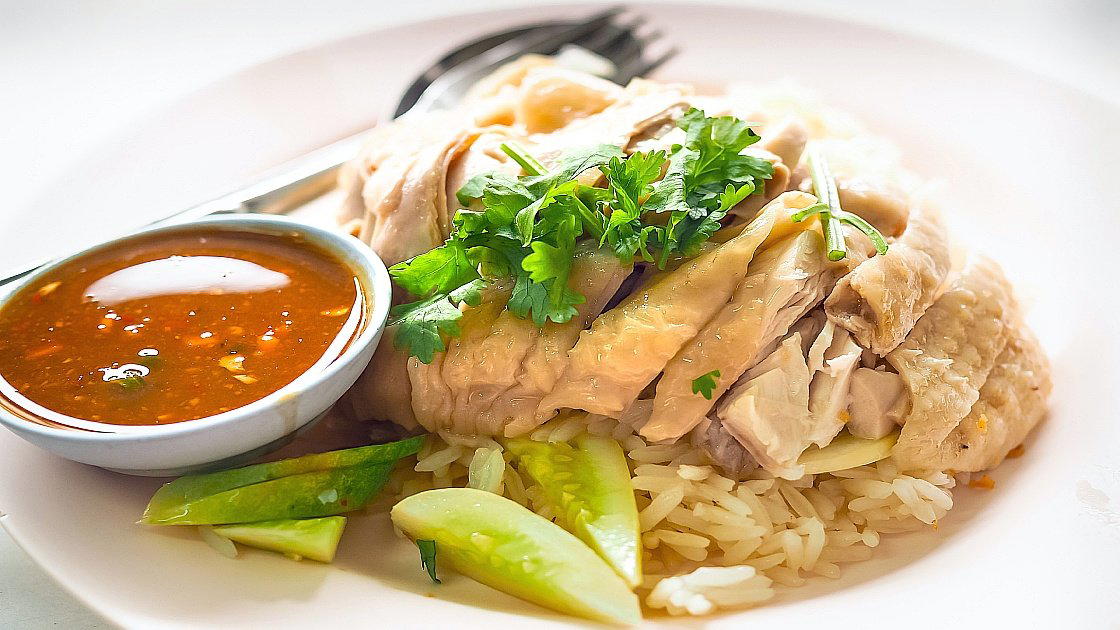
Khao mun gai is one of Southeast Asia's most disciplined single-dish formats. The rice cooks in the same stock as the chicken, absorbing fat and gelatin as it steams. The chicken is poached low and slow, then rested to tighten. What arrives at the table is a study in restraint: pale sliced meat over glistening rice, a cup of clear broth on the side, and a dipping sauce that typically combines fermented soybean paste, ginger, garlic, chilli, and vinegar in varying ratios depending on the region. In Thai hands, that sauce often runs lighter and more acidic than its Singaporean or Malaysian equivalents, and the rice tends toward a slightly drier, more separate grain than the sticky-wet Hainanese original.
The critical variable at every stage is the chicken itself. Birds raised in industrial conditions produce lean, fast-grown meat with minimal intramuscular fat and little depth of flavour once poached. Northern Thailand's access to free-range and heritage breeds, including the darker-fleshed native chickens common to highland markets, changes the arithmetic entirely. Fat renders into the stock, the bones contribute more collagen, and the resulting rice carries a richness that commodity chicken cannot replicate. This is why a khao mun gai specialist in a region with strong agricultural sourcing can perform at a tier well above what the price point and format would otherwise suggest.
For a comparison point on how Thai kitchens at the summit of the price range approach sourcing philosophy, Sorn in Bangkok has built a multi-award framework specifically around ingredient provenance in Southern Thai cooking. The approach is structurally different, tasting menu, fine-dining register, ฿฿฿฿ pricing, but the underlying argument about why sourcing precedes technique applies equally to a bowl of khao mun gai in Chiang Rai. Similarly, PRU in Phuket operates its own farm to control the quality of what reaches the plate, a model that illustrates how seriously the sourcing question is taken across Thai restaurant formats. AKKEE in Pak Kret represents another point of reference for focused Thai cooking that earns recognition through discipline rather than scale.
Northern Thailand's Chicken Cooking Tradition
The north of Thailand has its own roast and poached chicken heritage that runs parallel to the khao mun gai lineage. Cherng Doi Roast Chicken in Chiang Mai represents the grilled register of that tradition, wood-smoke, turmeric marinades, sticky rice on the side, while the poached format that Khao Mun Gai Nai Art works in draws from the Hainanese migration that moved through Thailand's central plains and eventually north. The two formats coexist in Chiang Rai without direct competition, serving different occasions and different times of day. Khao mun gai is typically a morning-to-midday dish, the kind of meal eaten before the heat of the afternoon, when the broth is still hot from the first pot and the chicken has had just enough resting time.
This temporal structure matters for a visitor planning their day. The leading versions of the dish are served from the first batch, when the rice has absorbed maximum stock and the chicken hasn't been sitting. Arriving at or shortly after opening gives access to that first-batch quality, a detail that applies to nearly every khao mun gai specialist in Thailand, not just this one. At hawker-format restaurants like this, the kitchen's rhythm is set by when the pot was started, not by a dining room schedule.
For other examples of how Thailand's street-food specialists operate at a focused, single-dish register, Loet Rot in Mueang Chiang Mai and Khok Kloi Bami Tom Yam Khai in Takua Thung each represent the kind of single-format discipline that produces depth through repetition rather than range. The same logic applies here. Internationally, the discipline of doing one thing with total commitment finds its clearest expression at the opposite end of the price spectrum in places like Le Bernardin in New York City, where a seafood-only format has sustained three Michelin stars across decades, but the editorial point, that constraint produces mastery, holds across categories and price ranges.
Where This Fits in Thailand's Wider Street-Food Conversation
Thailand's street food ecosystem has attracted international attention partly because it operates at a quality level that formal restaurants in many other countries cannot match for the price. The Michelin Guide's entry into Bangkok and eventually other Thai cities formalised what food writers had been arguing for years: that price and quality do not correlate in Thai street food the way they do elsewhere. Khao mun gai as a category sits at the accessible end of that spectrum, and spots like Khao Mun Gai Nai Art in Chiang Rai represent the northern expression of a dish that has dozens of celebrated practitioners across the country.
Visitors coming from other parts of Thailand's dining circuit, whether from the fine-dining register represented by Benz Restaurant at Soneva Kiri in Koh Kood or from Bangkok addresses like 266/1 Siam Square Soi 3 in Pathum Wan, will find that Chiang Rai's street-food scene rewards a different mode of engagement: earlier hours, cash in hand, no reservation infrastructure, and a willingness to eat the same dish every morning until you understand what makes one version different from another. That last part is not a romantic notion but a practical one. Khao mun gai only reveals its variables through repetition.
Planning Your Visit
As is standard for hawker-format chicken rice specialists across Thailand, no reservation system is expected, and payment is almost universally cash. Arriving early, before 10am where possible, gives access to the freshest batch. Chiang Rai's compact city centre means most restaurants within the core are walkable from the main guesthouses and small hotels around Jet Yod Road and the Night Bazaar area, making a morning circuit that combines khao mun gai with the city's fresh markets direct to plan.
In Context: Similar Options
Comparable venues nearby, for context on price, style, and recognition.
| Venue | Cuisine | Price | Notes |
|---|---|---|---|
| Khao Mun Gai Nai ArtThis venue — the venue you are viewing | Thai Khao Mun Gai | $ | Not listed |
| Lib Boong (ข้าวมันไก่ หลิบบุ๊ง) | ข้าวมันไก่แบบดั้งเดิม | $ | วัดใหม่หน้าค่าย |
| Sanguan Sri | Authentic Central Thai Curries | $ | Sukhumwit |
| Hoy Tord Chao Lay (หอยทอดชาวเล) | Chao Lay Oyster Omelette | $ | วัฒนา |
| Loong Pratunam Boat Noodle (ก๋วยเตี๋ยวเรือ ร้านลุงประตูน้ำ) | Thai Boat Noodles | $ | Pathumwan |
| Krua Laew Tae R-Rom | Fresh Catch Thai Curry | $ | Soi Yume, Na Kluea |
Continue exploring
More in Chiang Rai
Restaurants in Chiang Rai
Browse all →

At a Glance
- Casual Hangout
- Standalone
Casual street-side eatery with simple, no-frills atmosphere.