John's Grill
John's Grill has occupied the same address on Ellis Street since 1908, making it one of San Francisco's oldest continuously operating restaurants. Its place in American literary history, tied to Dashiell Hammett's Sam Spade, has kept it a point of reference for a particular kind of old-city dining ritual. The room, the service pacing, and the menu all carry the weight of that longevity.
Pearl is the En Primeur Club membership app — saves, bookings, and concierge access live there. Same editors, same standards.
- Address
- 63 Ellis St, San Francisco, CA 94102
- Phone
- +14159860069
- Website
- johnsgrill.com
- Directions
- Get directions
 Saves & bookings on Pearl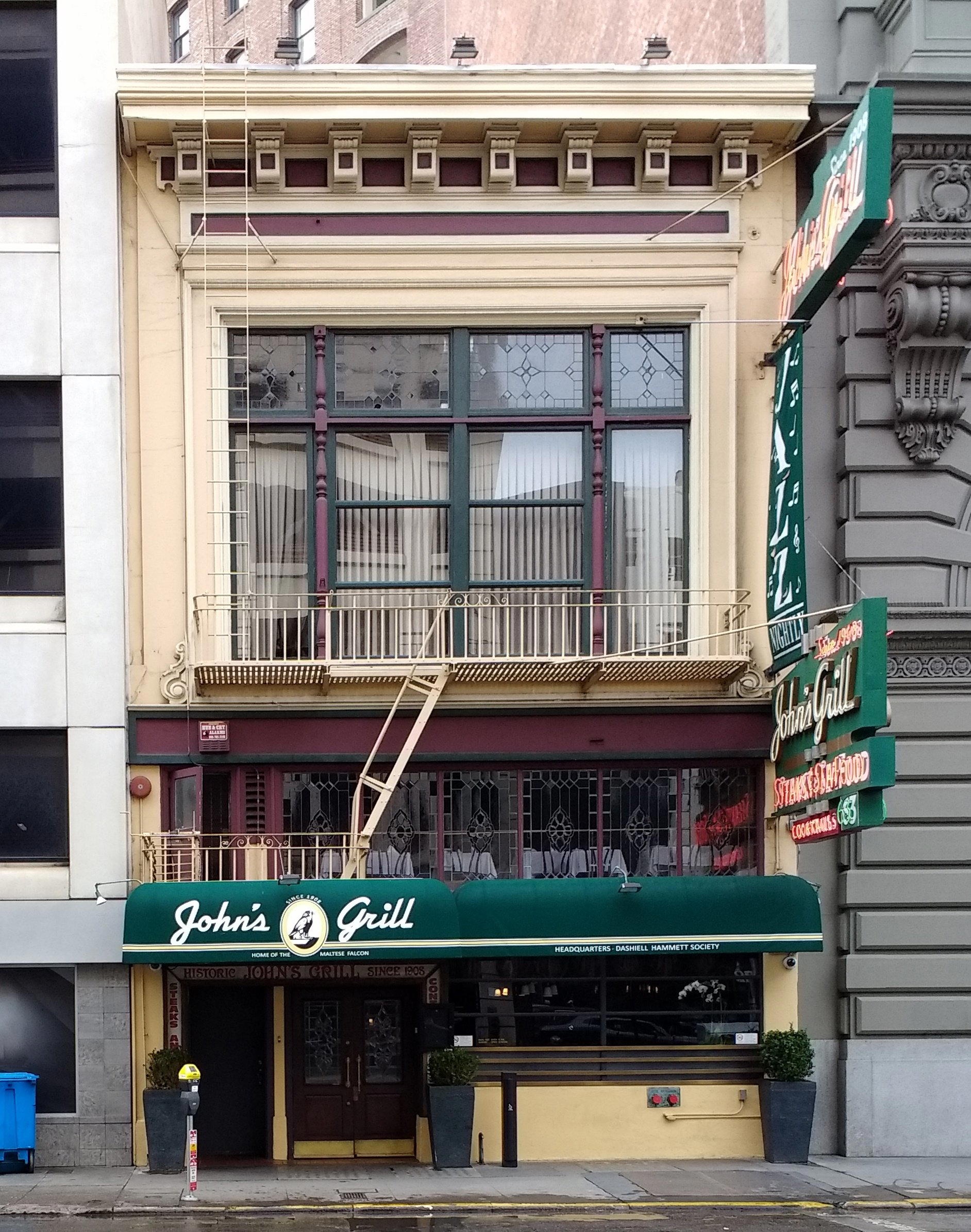
A Room That Runs on Institutional Memory
On Ellis Street, a block south of Union Square, John's Grill presents itself without apology or renovation anxiety. The facade is narrow, the interior runs deep, and the dining room operates on rhythms that predate the open-kitchen movement, the farm-to-table turn, and every other wave of San Francisco restaurant reinvention that has washed through the city since the mid-twentieth century. Entering here is less about choosing a meal and more about submitting to a format that has not asked for your approval since 1908.
San Francisco's restaurant culture has split sharply over the past two decades. The city now hosts particularly technically demanding tasting-menu programs in the country: Lazy Bear runs a communal progressive American format; Atelier Crenn frames Modern French technique inside a poetic conceptual structure; Benu operates at the intersection of French and Chinese culinary logic with three Michelin stars. Against that contemporary tier, John's Grill occupies a different position entirely. It is not competing with those rooms. It is a reminder that a certain kind of American restaurant, the chophouse-adjacent, white-tablecloth, order-from-a-printed-menu format, preceded the tasting-menu era by generations and has outlasted several rounds of it.
The Ritual of the Old-City Steakhouse
The meal format here follows the logic of the pre-modernist American dining room: you are seated, you are handed a menu with discrete courses, you order, and you wait. There is no parade of amuse-bouches, no sommelier presenting a curated pairing arc, no chef's narrative delivered tableside. The pacing is transactional in the old, respectful sense of that word. The server takes your order, the kitchen produces it, the food arrives. This is a ritual that feels almost radical in a city where so much energy goes into orchestrated dining experiences at places like Saison or Quince, where the sequencing of a meal is itself a significant part of what you are paying for.
Across American dining broadly, this format, the la carte steakhouse or grill room with a long institutional history, has been either preserved as a heritage object or quietly allowed to fade. In New Orleans, Emeril's represents one kind of long-running American restaurant institution. In New York, Le Bernardin holds its position through continuous technical refinement rather than historical weight. John's Grill operates by a different logic: the institution is the credential.
Dashiell Hammett and the Literary Geography of the Room
The restaurant's place in American literary history is not incidental decoration. Dashiell Hammett ate here during the years he was writing The Maltese Falcon, and the novel places Sam Spade at a table in this room, ordering chops, baked potato, and sliced tomatoes. That detail has given the restaurant a secondary identity that functions independently of its food program: it is a site on the map of American hardboiled fiction, and the room preserves that association deliberately. A display of Hammett memorabilia reinforces the connection, and the restaurant has leaned into its literary geography as a point of differentiation for over a century.
This kind of literary address is not common in the American restaurant world. The equivalent in terms of cultural embedding might be something like The Inn at Little Washington, where the restaurant's identity is inseparable from the broader mythology of the place, or Blue Hill at Stone Barns in Tarrytown, where the address carries its own intellectual weight. At the restaurant, the address is the argument.
Position in San Francisco's Price and Peer Landscape
San Francisco's upper dining tier is now predominantly tasting-menu and prix-fixe in format, with per-head costs that position those rooms against comparable programs in New York, Chicago, and Los Angeles. The French Laundry in nearby Napa anchors one end of the regional prestige spectrum; Single Thread Farm in Healdsburg operates in a similar register. Nationally, the conversation about this tier includes Alinea in Chicago, Providence in Los Angeles, Addison in San Diego, Bacchanalia in Atlanta, and Atomix in New York.
The restaurant does not position within that comparable set. Its competitive references are the city's older, à la carte dining rooms, and its pricing reflects a mid-market to upper-mid register that has remained accessible to a broader cross-section of the city than the tasting-menu tier allows. For international context, the format is closer to the traditional European grill room, think the kind of institution referenced when critics discuss 8½ Otto e Mezzo Bombana in Hong Kong as an example of a room sustained by reputation and consistent execution rather than constant reinvention.
What the Longevity Argument Actually Means
Operating continuously since 1908 means surviving Prohibition, the Depression, multiple earthquakes, and every shift in American dining culture from Continental cuisine through nouvelle cuisine through the modernist turn and into the current era of hyper-local sourcing narratives. few restaurants anywhere accumulate that kind of operational continuity. The ones that do tend to function as civic institutions as much as dining destinations, with a guest mix that reflects the full range of the city rather than a narrow demographic of destination diners.
That longevity also implies something about the service culture. Rooms that run for over a century on repeat business develop a floor rhythm and a customer-relations approach that is trained into staff over years rather than weeks. The interaction between server and diner in these rooms tends to be confident and unperformed, efficient without being cold, attentive without being theatrical. That tone is its own statement in a city where service in the contemporary fine-dining tier is often highly choreographed.
Know Before You Go
- Address: 63 Ellis St, San Francisco, CA 94102
- Neighbourhood: Union Square
- Format: À la carte, full-service dining room
- Booking: Reservations are recommended
- Context: Part of San Francisco's pre-modern restaurant generation; not a tasting-menu or chef's-counter experience
Reputation Context
Comparable venues nearby, for context on price, style, and recognition.
| Venue | Cuisine | Price | Notes |
|---|---|---|---|
| John's GrillThis venue — the venue you are viewing | Classic American Steakhouse | $$$ | Not listed |
| 1300 on Fillmore | Modern Southern-Inspired American | $$$ | Fillmore Jazz District |
| Bix | Modern American Supper Club | $$$ | Chinatown |
| Prelude | American Bar & Lounge | $$$ | Galleria |
| RT Bistro | Californian Bistro | $$$ | Hayes Valley |
| The Spot Lounge | American Casual | $$ | Mission District |
Continue exploring
More in San Francisco
Restaurants in San Francisco
Browse all →
Bars in San Francisco
Browse all →
Hotels in San Francisco
Browse all →
At a Glance
- Classic
- Well Known
- Historic
- Elegant
- Business Dinner
- Special Occasion
- Celebration
- Historic Building
- Live Music
- Craft Cocktails
- Extensive Wine List
Current opening hours
- Monday
- 11:45 AM–9:30 PM
- Tuesday
- 11:45 AM–9:30 PM
- Wednesday
- 11:45 AM–9:30 PM
- Thursday
- 11:45 AM–9:30 PM
- Friday
- 11:45 AM–9:30 PM
- Saturday
- 11:45 AM–9:30 PM
- Sunday
- 11:45 AM–9:30 PM
Hours can change for holidays and private events. Last verified .
Dark wood paneling, vintage furnishings, historic photographs, white tablecloths, and intimate live jazz creating an old-school, timeless atmosphere.