
Jikitan Momiji gives Kuki a serious ramen address outside the usual Tokyo orbit, with ramen and tsukemen priced in the everyday bracket rather than the luxury-counter tier. Its repeated Tabelog Ramen EAST 100 selections from 2022 through 2025 put it in a regional conversation where sourcing, broth discipline, and noodle texture matter more than spectacle.
Pearl is the En Primeur Club membership app — saves, bookings, and concierge access live there. Same editors, same standards.
- Address
- 埼玉県久喜市樋ノ口584-4
- Phone
- +81480246060
- Website
- tabelog.com
- Directions
- Get directions
 Saves & bookings on Pearl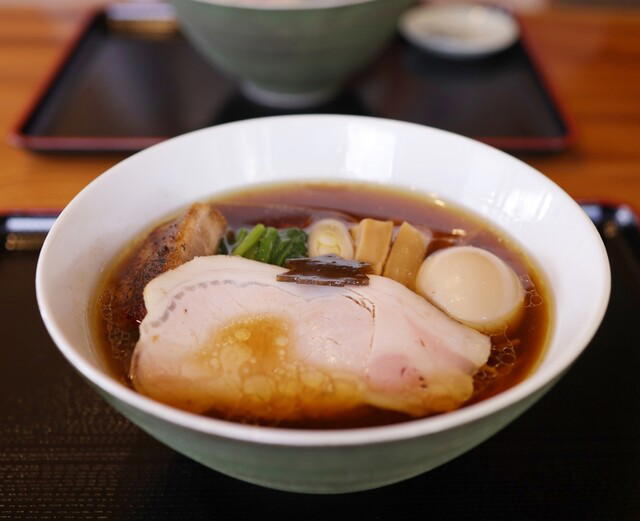
The approach to ramen in suburban Saitama has a different rhythm from central Tokyo’s counter culture. The room is smaller in ambition than a destination dining room, but the stakes are not smaller: steam, queue discipline, ticket-machine logic, and the quick turnover of bowls define a format where precision has to survive volume. In Kuki, that makes Jikitan Momiji less a detour for novelty than a useful marker of how serious ramen has spread beyond the capital’s familiar corridors.
Japan’s ramen culture has long rewarded shops that treat sourcing as structure rather than decoration. A bowl is built from decisions that rarely read as luxury signals: what bones or seafood are extracted, how tare is balanced, whether noodles are chosen for broth grip or chew, and how dipping noodles hold up after several minutes at the table. The category listed here, ramen and tsukemen, places the shop inside that technical conversation. Tsukemen in particular exposes weaknesses quickly because the noodles and broth are separated; temperature, concentration, and texture have to carry the meal without the cushioning effect of a standard hot bowl.
Saitama ramen outside the Tokyo gravity field
The stronger story in Kuki is regional confidence. Tokyo still draws the international ramen gaze, but Saitama’s commuter towns have developed their own serious addresses, often with lower pricing and fewer design theatrics than the capital’s headline shops. Jikitan Momiji’s selection for Tabelog Ramen EAST 100 in 2022, 2023, 2024, and 2025 gives that point measurable weight. It is not a Michelin-style fine-dining signal; it is a category-specific recognition within a platform where ramen obsessives compare bowls at close range.
That distinction matters for readers planning food-led travel in Japan. A restaurant can be inexpensive and still sit in a demanding competitive set. Here, the appeal is not a long tasting menu or a chef-led biography. It is the more Japanese form of seriousness: a concise menu category, a tight service window, and a narrow margin for error repeated across lunch service. For context within the wider city, Our full Kuki restaurants guide maps how this kind of specialist shop fits beside other local dining rooms, while Our full Kuki hotels guide, Our full Kuki bars guide, Our full Kuki wineries guide, and Our full Kuki experiences guide give the surrounding trip a broader shape.
What sourcing means in a ramen bowl
Ingredient sourcing in ramen is easy to romanticise and hard to fake. The diner may not see the procurement chain, but the bowl reveals the hierarchy of decisions: stock depth, seasoning clarity, noodle structure, and the way toppings support rather than distract from the broth. In the EAST ramen field, this is where suburban shops can compete with urban peers. Rent pressure is different, customer habits are different, and the audience often includes locals who return often enough to punish inconsistency.
Jikitan Momiji’s value sits in that equation. The publicly listed category is ramen and tsukemen, and the repeated regional recognition suggests a shop being judged on fundamentals rather than novelty. Nearby comparison venues show how broad the Saitama-adjacent bracket can be: Menya Mitsuba Kurobā honten is another specialist reference point for readers following noodles in the area, while Ryu no Ko, Wafu Ramen Yondaime Hinodeya, and Chuka Soba Yoshikawa Ageo ten sit in related price territory across the out-of-metro ramen map. The useful comparison is not décor or celebrity; it is whether a shop can make a low-ticket meal feel deliberate.
That same lens helps separate ramen tourism from checklist eating. The better move is to think in categories: ramen for broth integration, tsukemen for noodle strength and dipping-broth concentration, and local repeat custom as a pressure test. Kuki is not selling the density of Shinjuku or Ginza. It offers a slower, more functional version of food travel, where a single specialist counter can justify adjusting the day without turning the meal into a grand production.
How to place it in a Japan food itinerary
For travellers building a route around Japanese regional eating, this is a compact stop rather than an all-evening anchor. The format suits a day that also includes Saitama rail travel or a wider north-of-Tokyo itinerary. The payment and reservation style belongs to the practical ramen world rather than the concierge-dining world, so expectations should be set around efficiency, queue etiquette, and a meal centred on the bowl rather than lingering service.
It also belongs in a wider pattern across Japan: specialist restaurants with narrow categories often carry more editorial value than broader menus trying to satisfy every diner. That principle applies well beyond ramen, from -Grilled beef Sukiyaki- KAMAKURA TANUKIAN 鎌倉 たぬき庵 in Kamakura to. 鮪と炭火焼き うお炭 秋葉原店 in Tokyo.cafe in Osaka.know in Kumamoto, and (Shoku) Vietnam in Kawasaki. The cuisine changes; the editorial question stays consistent: is the venue using focus to sharpen the experience, or simply narrowing the offer?
On that measure, the restaurant is a confident Kuki choice for travellers who care about ramen as craft rather than content. It sits in the accessible end of Japanese dining, yet carries enough recognition to warrant attention from readers who normally build trips around higher-ticket restaurants. For a broader national contrast, compare the category discipline here with [Curry Senmon Ten] Maruyama Kyoju. in Sapporo, [ki:] in Kyoto, #肉といえば松田 奈良本店 in Kashihara, 1/3 HAMBURGER FACTORY in Kanazawa, and 1000 in Yokohama. Japanese food travel rewards these narrow formats because they expose intent quickly.
The international comparison is useful too. Los Angeles and Pasadena readers who know Japanese casual formats through Jōdo Saké Bar in Los Angeles or Onigiri Time in Pasadena will recognise the appeal of specialization, but the Kuki version is more tightly bound to everyday regional dining. The verdict is simple: come for the ramen discipline, not ceremony. In a city better known to outsiders as a transit point than a dining destination, that is exactly the argument worth making.
A Quick Peer Check
Comparable venues by cuisine and price in the same metro.
| Venue | Cuisine | Price | Notes |
|---|---|---|---|
| Jikitan Momiji | Modern ramen and tsukemen shop | $ | Kuki |
| Menya Mitsuba Kurobā honten | Ramen & Tsukemen Shop | $ | Minami Kurihashi |
| Syokudoh TANUKI (食堂たぬき) | Traditional Japanese Canteen | $ | Myoko City |
| Chuka Soba Kaoru | Ramen | $ | Sakaecho |
| Ramen Ogane | Traditional Sano-style ramen | $ | Ohashicho |
| Kaeru Shokudo | Japanese Curry Counter | $ | Toshima |
Recognition history
Dated appearances from independent guides and award organizations, with the underlying list record or original source where available.
Tabelog 100 #86 · No. 86
Tabelog · Tabelog 100 - Ramen - EAST - 2025






At a Glance
- Cozy
- Quiet
- Solo
- Casual Hangout
- Standalone
- Street Scene
A small, non-smoking ramen shop in a former soba restaurant, quietly set among rice fields on the outskirts of Kuki; the atmosphere is calm and understated, with a simple, cozy interior that contrasts with the visually striking, carefully plated ramen and tsukemen.