
Jikaseimen Tsukiyomi belongs to Osaka’s serious noodle circuit rather than the late-night ramen stereotype. The draw is a compact counter format, house-made noodle identity signalled by the name, tsukemen and ramen categories, and repeated selection for Tabelog Ramen OSAKA “Tabelog 100” in 2023, 2024, and 2025.
Pearl is the En Primeur Club membership app — saves, bookings, and concierge access live there. Same editors, same standards.
- Address
- 5 Chome-11-4 Hoshin, Higashiyodogawa Ward, Osaka, 533-0014, Japan
- Phone
- +81 6-6160-5151
- Website
- twitter.com
 Saves & bookings on Pearl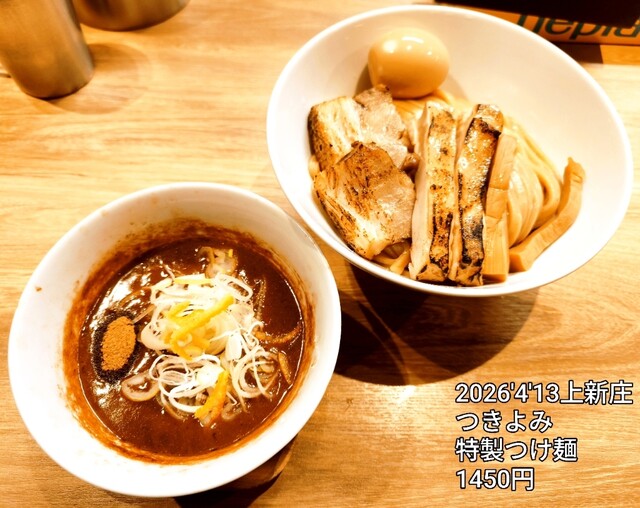
Approaching a 10-seat ramen counter in Higashiyodogawa changes the scale of Osaka dining. The city’s food reputation is often told through neon, market snacking, and station-basement abundance, but its noodle culture is more exacting than that shorthand suggests. In the small-shop ramen tier, capacity matters: ten counter seats create a rhythm closer to a workshop than a restaurant room, with the meal built around turnover, timing, and a bowl placed directly in front of the diner.
Jikaseimen Tsukiyomi sits in that compact Osaka category where the noodle itself carries editorial weight. The Japanese term “jikaseimen” signals house-made noodles, an important distinction in tsukemen because the noodles are not merely a carrier for broth. Tsukemen depends on texture, cooling rate, and the way wheat structure holds up when dipped, so noodle production becomes a central decision rather than a back-of-house footnote. That is the useful lens here: not chef theatre, not luxury ritual, but the discipline of a low-priced counter that treats noodle craft as the main event.
House-made noodles put this Osaka counter in the serious tsukemen lane
Osaka’s ramen scene has room for many formats: pork-bone shops, chicken-based bowls, niboshi-leaning broths, curry ramen, and tsukemen specialists. Tsukemen occupies a different eating logic from soup ramen. The noodles arrive as a defined portion to be dipped, which makes chew, surface, and temperature more visible. In that format, a shop with house-made noodle identity is making a clear claim: the wheat component deserves as much attention as the soup.
The listed categories, tsukemen, ramen, and dumpling, place Jikaseimen Tsukiyomi in a practical neighbourhood register rather than a tasting-menu register. That matters in Osaka, where serious food often avoids formal signals. A price range under JPY 999 keeps it within the everyday ramen economy, yet the recognition profile puts it above a casual convenience stop. Selection for Tabelog Ramen OSAKA “Tabelog 100” in 2023, 2024, and 2025 gives the counter a repeat signal in a crowded city field, and its Tabelog score is 3.71. For ramen in Japan, where ratings tend to be compressed, that score and repeat listing are more useful than generic praise.
Comparison also clarifies its position. Ramenya Akagi and NAKAGAWA Wazu occupy a similar sub-JPY 999 budget band, while KUCHE and Hakata Tonkotsu Tenjinki sit in a JPY 1,000 to JPY 1,999 bracket. Those are not luxury differences, but they do shape expectations: Jikaseimen Tsukiyomi belongs to the sharp-value group, where the test is whether the bowl has enough craft to justify a dedicated detour rather than merely solving lunch.
The Higashiyodogawa setting changes the Osaka ramen calculation
Higashiyodogawa is not the Osaka most visitors build around. The ward sits away from the usual eating routes of Namba, Umeda, and the central shopping corridors, which makes a noodle stop here a different kind of decision. The address in Hoshin, near Kami Shinjo Station, places the meal in a residential and commuter district rather than a tourist dining cluster. That context suits ramen: the format rewards repetition, local loyalty, and narrow specialization more than tablecloth polish.
The counter-only layout reinforces that reading. Ten seats mean the experience is governed by pace and proximity, not lingering. Reservations are unavailable, so the format belongs to walk-in ramen culture rather than appointment dining. The room is non-smoking, private rooms are unavailable, and private use is unavailable, all of which point toward a focused meal with few distractions. Children are welcome, a useful detail in a city where casual excellence often overlaps with family dining rather than excluding it.
There is also a payment detail worth treating as logistics rather than trivia: credit cards and electronic money are not accepted, while QR code payments are accepted. For international diners moving through Japan on cards and transit IC, that difference can decide whether a quick ramen stop stays quick. Parking is unavailable, with paid parking nearby, so the more natural approach is by rail and foot from Kami Shinjo.
How to place it within an Osaka eating itinerary
The restaurant works better as a targeted noodle stop than as the centrepiece of a long evening. The hours cover lunch and dinner daily, with a shorter second-Monday lunch-only pattern listed, so the useful move is to treat it as a focused meal around the ward rather than a flexible late-night fallback. The opening date, May 30, 2020, also places the shop among the newer generation of Osaka ramen counters that built reputations through speciality and online review culture rather than decades of nostalgia.
For a broader Osaka food map, use Our full Osaka restaurants guide to connect ramen with bakeries, cafés, and regional cooking across the city. Nearby editorial contrasts can be useful: .cafe and 52CHO-ME BAKERY show the city’s daytime casual side, while 551 Horai (551蓬莱) represents Osaka’s mass-market comfort-food muscle. For a different imported-carb register, 99 Pizza Napoletana Gourmet and a canto (Italian) show how the city absorbs Italian formats without losing its appetite for directness.
Travel planning around Osaka should not stop at restaurants. Our full Osaka hotels guide helps decide whether Higashiyodogawa is a quick rail excursion or part of a wider north-side day, while Our full Osaka bars guide, Our full Osaka wineries guide, and Our full Osaka experiences guide frame the city beyond bowls and counters.
Readers building a Japan-wide food file can compare Osaka’s noodle-counter directness with regional and overseas Japanese-adjacent formats: -Grilled beef Sukiyaki- KAMAKURA TANUKIAN 鎌倉 たぬき庵 in Kamakura. 鮪と炭火焼き うお炭 秋葉原店 in Tokyo.know in Kumamoto, (Shoku) Vietnam in Kawasaki, [Curry Senmon Ten] Maruyama Kyoju. in Sapporo, [ki:] in Kyoto, Jōdo Saké Bar in Los Angeles, and Onigiri Time in Pasadena. The point is not hierarchy; it is calibration. Osaka ramen at this level is inexpensive, compressed, and highly specific, and the restaurant earns attention because the format makes ingredient handling visible through the noodle itself.
Quick Comparison
Comparable venues side-by-side for orientation.
| Venue | Cuisine | Price | Notes |
|---|---|---|---|
| Jikaseimen TsukiyomiThis venue — the venue you are viewing | Japanese Ramen / Tsukemen | $$ | Not listed |
| Mensho Yashima | Traditional Osaka Udon Shop | $$ | Moriguchi |
| Yuni yumo | Modern Japanese Izakaya Counter | $$ | Kita |
| KURODARUMA | Creative Japanese standing bar (izakaya-style) | $$ | Chūō |
| Soba Kiri masa | Traditional Soba Noodle Shop | $$ | Nishi |
| Ramen Shuki | Japanese Ramen | $$ | Higashinari |
Recognition history
Dated appearances from independent guides and award organizations, with the underlying list record or original source where available.
Tabelog 100 #68 · No. 68
Tabelog · Tabelog 100 - Ramen - OSAKA - 2025
Continue exploring
More in Osaka
Restaurants in Osaka
Browse all →




Bars in Osaka
Browse all →

Hotels in Osaka
Browse all →



Wineries in Osaka
Browse all →
At a Glance
- Cozy
- Energetic
- Modern
- Solo
- Casual Hangout
- Family
- Standalone
- Open Kitchen
Current opening hours
- Monday
- 11:30 AM–3 PM, 6–10 PM
- Tuesday
- 11:30 AM–3 PM, 6–10 PM
- Wednesday
- 11:30 AM–3 PM, 6–10 PM
- Thursday
- 11:30 AM–3 PM, 6–10 PM
- Friday
- 11:30 AM–3 PM, 6–10 PM
- Saturday
- 11:30 AM–3 PM, 6–10 PM
- Sunday
- 11:30 AM–3 PM, 6–10 PM
Hours can change for holidays and private events. Last verified .
Compact, counter-seat ramen shop with a focused, bustling atmosphere centered on quick noodle service and limited seating.