
Winter is a sharp season for soba in Osaka, when buckwheat’s quiet discipline feels less like a side note and more like the point. Soba Kiri masa belongs to the city’s small serious-soba bracket, recognized in Tabelog 100 Soba WEST 2025 and 2024, with a compact room and a menu architecture built around buckwheat rather than spectacle.
Pearl is the En Primeur Club membership app — saves, bookings, and concierge access live there. Same editors, same standards.
- Address
- 1 Chome-16-12 Utsubohonmachi, Nishi Ward, Osaka, 550-0004, Japan
- Phone
- +81 6-6225-3030
- Website
- tabelog.com
 Saves & bookings on Pearl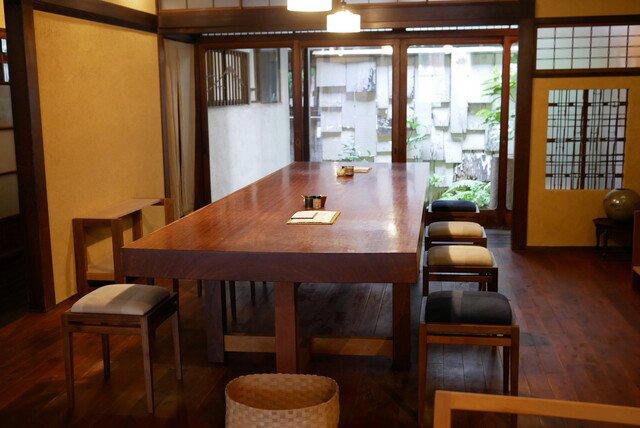
Utsubohonmachi moves to a different rhythm from Namba’s neon appetite or Umeda’s department-store polish. Near Utsubo Park, the streets feel lower, calmer, and more office-adjacent, which suits soba: a cuisine that rewards attention over volume. In Osaka, where wheat noodles, takoyaki counters, kushikatsu, and late-night ramen dominate many visitors’ mental map, serious buckwheat sits in a narrower lane. That is exactly where Soba Kiri masa makes sense.
The clue is not theatrical tasting or chef-led mythology, but menu restraint. Credible soba shops organize the meal by sequence, temperature, and accompaniment: cold noodles for texture and aroma, warm bowls for comfort, small side dishes to frame the grain, and a finish that returns attention to noodle water rather than dessert. Soba is not built for excess; it is built for contrast, with buckwheat as anchor and everything else in proportion.
Buckwheat in a city better known for wheat, broth, and street food
Osaka’s eating culture is often described through immediacy: batter on a griddle, pork buns in a queue, ramen at counter pace, café sweets folded into a shopping day. The soba specialist is an instructive counterpoint. Where many Osaka meals are social, sauced, and loud in texture, soba asks for quieter grammar. The noodle is judged by cut, spring, fragrance, and the relationship between dipping sauce and buckwheat. A heavy hand can flatten the experience.
Soba Kiri masa’s recognition in Tabelog 100 Soba WEST 2025 and 2024 places it in the regional conversation, not just the neighborhood one. That matters because Tabelog’s Hyakumeiten lists are category-specific: soba is measured against soba, not French tasting menus, ramen counters, or general Japanese dining rooms. In Osaka terms, the comparison helps. A French room such as Différence competes through course progression and cellar logic; Porta Nuova occupies a different Italian register; Tanaka no Chuka Soba speaks in ramen’s broth-and-noodle shorthand. Soba follows another discipline.
That distinction is easy to miss if Osaka is treated as one eating category. The city’s strength is range. A day can move from coffee at .cafe to bread at 52CHO-ME BAKERY, pork buns at 551 Horai (551蓬莱), Neapolitan dough at 99 Pizza Napoletana Gourmet, or Italian dining at a canto (Italian). Soba earns its place because it changes the tempo. It is a reset, not a snack stop.
The menu is built around restraint, not accumulation
The stronger soba rooms in Japan reveal themselves through editing. A broad menu can be less persuasive than a focused one if the noodle becomes only a carrier for toppings. Here, the useful reading is architectural: the category is soba, the room has 20 seats, and the restaurant is non-smoking, with no private rooms and no private-use format. These are not decorative details. They point to a meal designed around concentration, turnover, and a shared dining room rather than luxury enclosure.
For travelers used to omakase language, soba can feel understated. It does not announce value through rare ingredients in procession. Instead, it asks whether the kitchen can make simplicity carry weight. Cold soba usually tests noodle character most directly; warm soba folds that character into broth and heat. Side dishes, when present, should support rather than distract. The point is not to order widely for coverage, but to understand how the buckwheat is framed.
That is why the Tabelog 100 Soba WEST listing is a meaningful trust signal. It does not make the restaurant a trophy stop or soba a luxury category by default. It says the shop has been selected within a specialist field across western Japan, a more relevant credential than broad popularity. The listed Tabelog score of 3.54 also sits in a context where Japanese user ratings are typically compressed; the award selection carries more editorial weight than the number alone.
The house rules reinforce the format’s seriousness. Photography is prohibited inside the store, which changes the meal’s social behavior. In an era when noodle bowls often circulate online before they are eaten, a no-photo room returns focus to pace, sound, and the table. That is not nostalgia; it is a practical defense of a small dining environment.
How to place it within an Osaka itinerary
Soba Kiri masa is best read as a specialist lunch or early-evening anchor, not an all-purpose dinner recommendation. Its value lies in contrast: after market grazing, retail-heavy Umeda dining, or a run of fried and sauced dishes, buckwheat gives the palate a cleaner register. The format also suits travelers who want one meal that explains a Japanese tradition without the ceremony or cost structure of high-end sushi or kaiseki.
Practical constraints matter. The restaurant does not take reservations, accepts cash only, has no parking, and does not admit children under elementary school age. It is close to Hommachi Station, with the listed approach from Exit 28 on the Yotsubashi Line, so it folds into a central Osaka day rather than requiring a special cross-city detour. Arrive with flexibility, avoid treating the room as a photo set, and let the buckwheat-first menu set the pace.
For wider planning, use Our full Osaka restaurants guide alongside Our full Osaka hotels guide, Our full Osaka bars guide, Our full Osaka wineries guide, and Our full Osaka experiences guide. The broader Japan edit also connects useful contrasts, from -Grilled beef Sukiyaki- KAMAKURA TANUKIAN 鎌倉 たぬき庵 in Kamakura and. 鮪と炭火焼き うお炭 秋葉原店 in Tokyo to.know in Kumamoto, (Shoku) Vietnam in Kawasaki, [Curry Senmon Ten] Maruyama Kyoju. in Sapporo, and [ki:] in Kyoto. For Japanese food culture abroad, Jōdo Saké Bar in Los Angeles and Onigiri Time in Pasadena show how focused formats travel beyond Japan.
Peers You’d Cross-Shop
Comparable venues to place this listing in its category.
| Venue | Cuisine | Price | Notes |
|---|---|---|---|
| Soba Kiri masa | Traditional Soba Noodle Shop | $$ | Nishi |
| Osake to Gohan Taku | Tuna-focused Japanese Izakaya | $$ | Kita |
| Shuhari Tanimachi yonchome ten | Traditional handmade soba & tempura | $$ | Chūō |
| Miyabi Tei | Japanese Teppanyaki | $$ | Kita |
| Japoni | Modern izakaya | $$ | Kita |
| Okonomiyaki Chigusa | Traditional Osaka Okonomiyaki & Teppan Grill | $$ | Kita |
Recognition history
Dated appearances from independent guides and award organizations, with the underlying list record or original source where available.
Tabelog 100 #72 · No. 72
Tabelog · Tabelog 100 - Soba - WEST - 2025
Continue exploring
More in Osaka
Restaurants in Osaka
Browse all →




Bars in Osaka
Browse all →


Hotels in Osaka
Browse all →



Wineries in Osaka
Browse all →
At a Glance
- Minimalist
- Cozy
- After Work
- Casual Hangout
- Solo
- Group Dining
- Standalone
Current opening hours
- Monday
- Closed
- Tuesday
- 11:30 AM–2 PM, 6–9 PM
- Wednesday
- 11:30 AM–2 PM, 6–9 PM
- Thursday
- 11:30 AM–2 PM, 6–9 PM
- Friday
- 11:30 AM–2 PM, 6–9 PM
- Saturday
- 11:30 AM–2 PM, 6–9 PM
- Sunday
- 11:30 AM–2 PM
Hours can change for holidays and private events. Last verified .
Small, non-smoking ‘hideout’ with a relaxing, minimalist interior focused on the soba-making craft, better suited to adults and small parties than to families with young children.