
Tabelog 100 #35
Our verdict
Izaki is a small Shirokanedai counter working in Tokyo’s creative dining lane, with a menu framed around Chinese and Italian references rather than a single classical cuisine. Its inclusion in the Tabelog 100 Innovative / Creative cuisine selection for 2025 gives it a clear marker in a crowded category where format, pacing, and menu architecture matter as much as luxury ingredients.

Pearl is the En Primeur Club membership app, where members save venues, book tables and use the concierge.
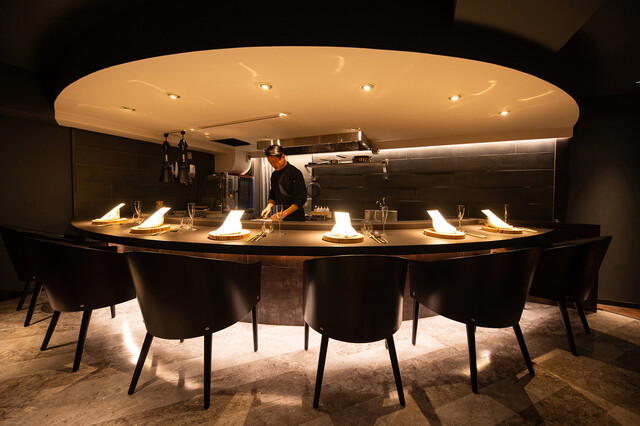
Tokyo sets a concentrated tempo for serious dining: polished, exacting, and highly competitive. That suits a restaurant where scale of ambition and focus matter before the first course. In this city, dinner can feel less like theatre than concentration: controlled pace, careful sequencing, and a menu that asks diners to follow an argument across courses rather than scan for familiar signatures.
Izaki sits in Tokyo’s newer creative-dining category, beyond straightforward genre labels. The clue is structure, not biography or manifesto: the meal is best read through texture, sauce work, aromatics, and sequencing. In Tokyo, innovative restaurants can become ingredient showcases with borrowed vocabulary or disciplined menus with a point of view. Izaki reads as the latter: high-intent, and built for diners attentive to how one course sets up the next.
A counter menu built around creative tension
Tokyo has long absorbed outside influences without treating them as fixed imports. French technique shaped the city’s luxury dining language for decades; Italian cooking became part of everyday urban life; Chinese food spans neighborhood comfort to banquet formality. Creative restaurants now use that fluency to control rhythm rather than sell novelty: acidity against fat, broth against starch, heat against drink pairing, fermentation against oil or richness.
That is the lens for reading Izaki. Its public recognition in the Innovative category tells diners to expect a menu assembled through contrast rather than a single orthodox template. In a focused dining setting, that architecture is especially visible. There is little room for distraction, so the sequence carries the weight. The experience depends on whether each course clarifies the next, rather than simply displaying a list of ideas.
The 2025 Tabelog Hyakumeiten recognition gives Izaki an external signal. Tabelog’s Hyakumeiten lists are not Michelin substitutes and work differently from global awards, but in Japan they matter because they reflect category-specific recognition within a dense domestic dining culture. For Izaki, appearing in that 2025 Innovative cohort places it inside a competitive Tokyo lane, not as a casual neighborhood curiosity.
That comparison set is broad. ShinoiS approaches Tokyo’s high-end dining conversation from another angle, while CIRPAS sits closer to contemporary fine dining. Tempura Ginya represents a more tradition-bound format, where mastery is judged through repetition and restraint. Izaki’s proposition is less about guarding one canon than making a creative menu speak in sequence. That is harder than it sounds: the meal must avoid becoming a tasting menu of references.
Tokyo gives the format room to stay focused
Location matters. Tokyo is dense with restaurant headlines, but its strongest restaurants often work best when diners arrive with intent rather than drift in casually. For a creative menu, that helps: the audience is prepared for a set progression, not a quick à la carte detour. Izaki benefits from being understood as part of that focused Tokyo dining culture.
The format changes the critical stakes. At larger tasting-menu restaurants, ambition can hide behind room design, service choreography, and a long wine list. In a more focused setting, the food has fewer places to retreat. Pacing, portion control, and transitions become the real craft. Tokyo diners are highly literate in close reading because sushi, tempura, kappo, and yakitori have trained the city to judge detail carefully. A creative restaurant inherits that scrutiny even when it is working outside a traditional template.
Izaki is therefore more interesting as menu architecture than as a simple novelty address. The category has matured. Diners need not be persuaded that different culinary ideas can coexist; the question is whether the kitchen makes that coexistence feel necessary course by course. In Tokyo’s current dining culture, creative restaurants either earn their place there or fade into cleverness.
Readers mapping the wider city should use Izaki as one marker in a much larger Tokyo field. For casual contrast, other Tokyo dining rooms show how varied the city’s everyday and specialist registers can be. The broader planning spine sits in Our full Tokyo restaurants guide, with parallel context in Our full Tokyo hotels guide, Our full Tokyo bars guide, Our full Tokyo wineries guide, and Our full Tokyo experiences guide.
Where it sits in a Japan dining itinerary
Izaki suits travelers who already understand Tokyo’s disciplined dining culture and want to see that discipline applied outside the most familiar formats. It is less suited to diners seeking a broad survey of Japanese classics in one sitting. The value is the narrower question: how far can a Tokyo restaurant push creative structure while keeping the meal coherent?
That question extends beyond Tokyo. Japan’s dining map now rewards specificity at every scale, from regional comfort cooking to polished urban dining rooms. For other points on that map, compare the format with other dining rooms across Japan, from casual specialists to more polished urban restaurants. Overseas, Japanese drinking and casual food formats can offer useful contrast, but Izaki is best understood within Tokyo’s density and its demanding dining culture.
The editorial case is clear: Izaki is a high-intent Tokyo restaurant whose interest lies in composition rather than spectacle. The Tabelog Hyakumeiten signal, Innovative category, and listed budget all point the same way. This is dinner for diners who want to read the menu as a sequence of decisions, not just a procession of courses.
Cost and Credentials
Comparable venues in the metro at similar price points.
| Venue | Cuisine | Price | Awards | Notes |
|---|---|---|---|---|
| IzakiThis venue (the venue you are viewing) | Chinese–Italian Omakase | $200–300 | Tabelog 100 #35 | Not listed |
| マス | Not listed | Not listed | Not listed | Chiyoda, Peruvian-Inspired Innovative Fine Dining |
| DENKUSHIFLORI デンクシフロリ | French-Japanese Fusion | $50–100 | Michelin Plate · Tabelog 100 #39 | Shibuya, Modern French-Japanese Skewer Fusion |
| the lounge by aman | International all-day lounge with Japanese influences | $50–100 | Tabelog 100 #83 | Chiyoda, International all-day lounge with Japanese influences |
| TWO ROOMS | Modern Grill Fusion | $100–150 | Not listed | Minato, Modern Grill Fusion |
| 鮨よしたけ | 3-Michelin-Star Omakase Sushi | $500+ | La Liste Top Restaurants · Tabelog Bronze #530 | Ginza, High-End Edomae Sushi Omakase |
Recognition history
Dated appearances from independent guides and award organizations, with the underlying list record or original source where available.
Tabelog 100 #35 · No. 35
Tabelog · Tabelog 100 - Innovative / Creative cuisine - 2025
Continue exploring
More in Tokyo
Restaurants in Tokyo
All restaurants in Tokyo →




Bars in Tokyo
All bars in Tokyo →





Details
- Intimate
- Modern
- Elegant
- Date Night
- Special Occasion
- Celebration
- Business Dinner
- Solo
- Chefs Counter
- Standalone
- Design Destination
- Open Kitchen
- Extensive Wine List
- Tasting Menu
- Omakase
- Counter Dining
- Set Menu
- Wine
- Beer
- Whiskey
Current opening hours
- Monday
- 6–10 PM
- Tuesday
- 6–10 PM
- Wednesday
- 6–10 PM
- Thursday
- 6–10 PM
- Friday
- 6–10 PM
- Saturday
- 6–10 PM
- Sunday
- Closed
Hours can change for holidays and private events. Hours as of .