Hon's Wun Tun House
On Kearny Street at the edge of San Francisco's Chinatown, Hon's Wun Tun House occupies a position in the city's Cantonese casual dining tradition that few comparable spots have held as consistently. Where the city's tasting-menu circuit at venues like Benu and Atelier Crenn pushes Chinese-influenced cuisine toward formal innovation, Hon's holds the other end of the register: direct, affordable, and rooted in a cooking style that predates California's fine-dining moment by decades.
Pearl is the En Primeur Club membership app — saves, bookings, and concierge access live there. Same editors, same standards.
- Address
- 648 Kearny St, San Francisco, CA 94108
- Phone
- (415) 433-3966
- Website
- honswuntunhouse.com
- Directions
- Get directions
 Saves & bookings on Pearl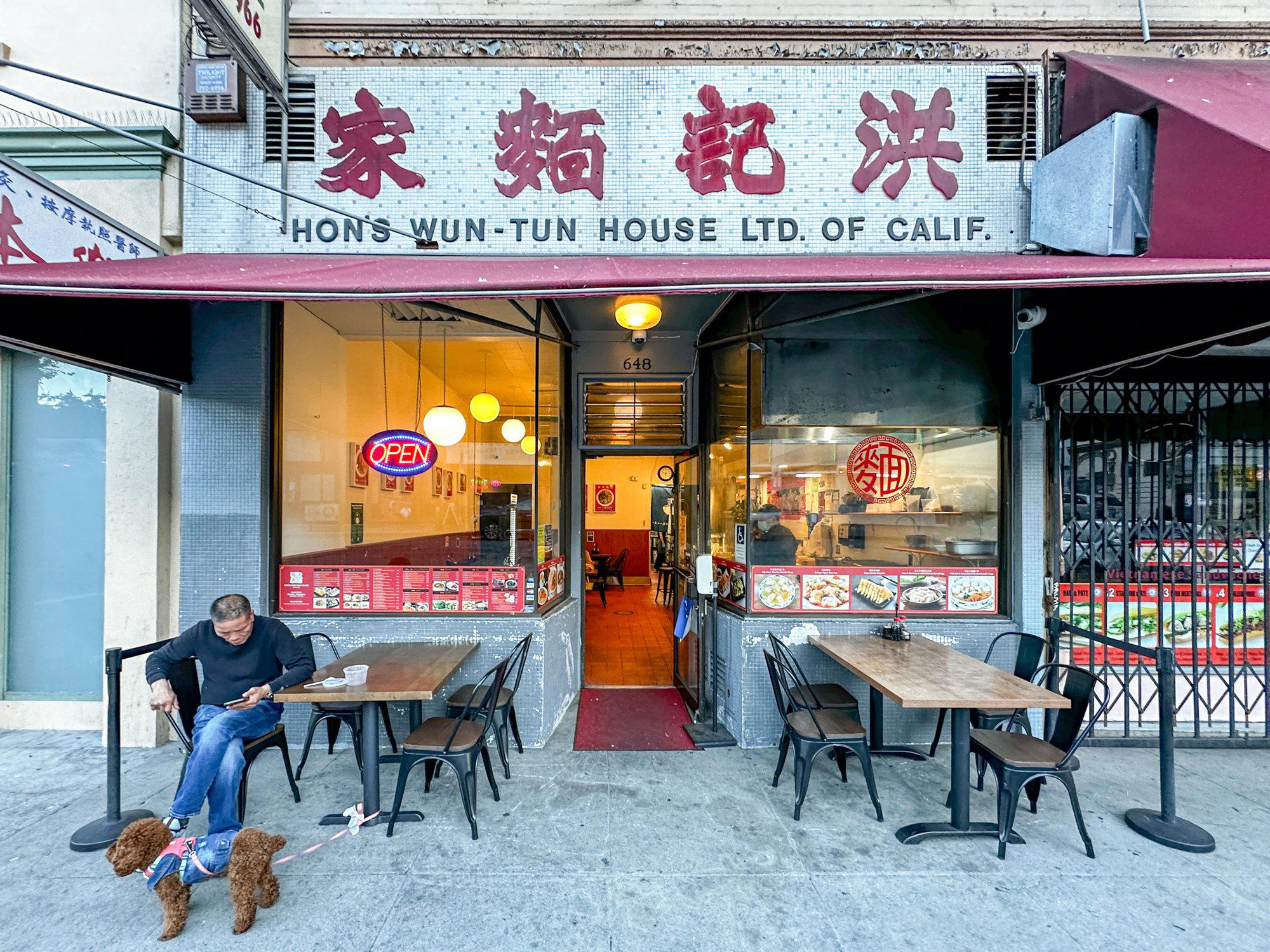
Kearny Street and the Cantonese Casual Counter
There is a version of San Francisco dining that exists entirely outside the tasting-menu economy. On Kearny Street, at the edge of Chinatown where the Financial District begins its approach, Hon's Wun Tun House occupies a counter position in that other dining culture. The room does not signal ambition through interior design. What it signals, instead, is continuity: a Cantonese casual format that has remained legible and consistent while the city around it has cycled through several waves of culinary reinvention.
San Francisco's broader restaurant scene now includes institutions like Lazy Bear and Saison at the Progressive American end, and Atelier Crenn representing the Modern French formal tier. At the opposite end of that spectrum, Chinatown's noodle and dumpling houses operate under entirely different terms: higher throughput, lower margins, and a customer base that is not chasing novelty. Hon's fits that second category, and understanding it requires framing it against Chinatown's dining logic rather than against the $$$$ tasting-menu comparable set.
The Cantonese Wonton Tradition in a California Context
Wonton soup is among the more geographically consistent dishes in the Cantonese diaspora. From Hong Kong's dai pai dongs to the noodle shops of Vancouver's Richmond district to San Francisco's Chinatown, the core logic remains the same: thin-skinned dumplings in a clear pork or shrimp broth, served with egg noodles or alone, eaten fast and without ceremony. The quality differential between a careful version and a perfunctory one is immediately detectable in the wrapper texture, the broth clarity, and the filling density. These are not dishes that benefit from elaborate technique so much as from disciplined repetition and quality sourcing.
San Francisco's Chinatown, the oldest in North America and continuously inhabited since the 1850s, has always sustained this kind of cooking. The neighborhood's culinary identity is not defined by restaurant weeks or critic cycles. It is defined by family operations that serve the same dishes across decades. Hon's Wun Tun House belongs to that lineage. Its address on Kearny Street places it at a navigable point between the dense core of Chinatown and the surrounding streets, making it accessible to both neighborhood regulars and to visitors arriving from the Financial District on foot.
Where Hon's Sits Against San Francisco's Chinese Dining Spectrum
San Francisco's Chinese restaurant scene now spans a wider price and format range than most American cities can claim. At the formal end, Benu holds three Michelin stars and applies Korean and Chinese culinary references through a French fine-dining structure, producing tasting menus that price well above $300 per person. That is a different conversation from what Chinatown's casual operators are doing, but the two ends of the spectrum serve as useful coordinates. Hon's is not competing with Benu any more than a Cantonese roast meat shop in Hong Kong competes with 8 1/2 Otto e Mezzo Bombana. The comparison is a category error.
Within the Chinatown noodle-and-dumpling tier, the relevant competition is other accessible, high-throughput Cantonese spots operating within the same postal code. Hon's consistent presence on that block gives it a degree of neighborhood authority that newer entrants lack. In American Chinatowns specifically, longevity functions as a trust signal in a way that accolades from national publications rarely do. The customer base that sustains these operations is not cross-referencing Michelin guides. They are cross-referencing personal experience and word of mouth over years of visits.
For broader context on where this fits in the national dining conversation, the contrast with formal American dining institutions is instructive. Venues like The French Laundry in Napa, Alinea in Chicago, or Le Bernardin in New York represent one axis of American dining ambition. The Chinatown casual counter represents an entirely different axis, one with a longer historical root in California specifically, given the role of Cantonese immigrants in the state's 19th-century labor and settlement history.
What the Format Delivers
The wonton house format is not a stripped-down version of something more complete. It is its own complete format, with its own internal standards. Soup-based dishes, roasted meats, congee, and pan-fried noodles each have defined preparation norms within Cantonese cooking, and the quality of a given restaurant in this category is assessed against those norms rather than against some universal fine-dining rubric. A diner arriving at Hon's from a reservation at Quince or Blue Hill at Stone Barns who applies the same evaluative criteria will simply be applying the wrong instrument.
The correct frame is the one Chinatown regulars apply: is the broth clear and savory without being cloying? Are the wonton skins thin enough to be delicate but sturdy enough to hold the filling through the soup? Is the bowl priced at a point that reflects the neighborhood's economic function? These are the operative questions. Visitors who arrive with those questions in mind will be able to assess the kitchen's execution accurately.
The Broader Chinatown Dining Pattern
San Francisco's Chinatown has been the subject of considerable attention from food writers, particularly as questions about displacement, rent pressure, and the survival of legacy operations have become more urgent. The neighborhood's older food businesses occupy a precarious position: they serve a price point that the surrounding real estate market no longer supports easily, and they depend on a customer base that has partially dispersed to the Sunset, the Richmond, and the South Bay. The ones that remain in the original Chinatown block structure do so through a combination of long-held leases and established customer loyalty.
This context matters for any honest assessment of what Hon's Wun Tun House represents. It is not simply a restaurant that makes noodle soup. It is a data point in the longer story of how immigrant food culture survives in one of the world's most expensive cities. That story connects directly to comparable dynamics in cities like New York, where Cantonese and Fujianese operations in Manhattan's Chinatown face analogous pressures, and in Los Angeles, where the San Gabriel Valley has largely absorbed the Chinese dining scene that once concentrated in downtown.
Restaurants like Providence in Los Angeles, Addison in San Diego, Atomix in New York, and Bacchanalia in Atlanta operate in a different economic and cultural register entirely. So do Single Thread Farm in Healdsburg, Emeril's in New Orleans, and The Inn at Little Washington. Placing Hon's in that company would misrepresent what it is. Placing it in the history of Cantonese food in California, however, gives it a context it can actually sustain.
Compact Comparison
Comparable venues nearby, for context on price, style, and recognition.
| Venue | Cuisine | Price | Notes |
|---|---|---|---|
| Hon's Wun Tun HouseThis venue — the venue you are viewing | Chinatown, Cantonese Wonton Noodle House | $ | Not listed |
| Hang Ah Tea Room | Chinatown, Cantonese Dim Sum | $ | Not listed |
| New Sun Hong Kong Restaurant | Chinatown, Cantonese Dim Sum | $ | Not listed |
| Dol Ho | Chinatown, Authentic Cantonese Dim Sum | $ | Not listed |
| Z & Y Peking Duck | Not listed | $$ | North Beach, Authentic Beijing Peking Duck & Dim Sum |
| Lucky Creation | Chinatown, Vegetarian Cantonese | $ | Not listed |
Continue exploring
More in San Francisco
Restaurants in San Francisco
Browse all →
Bars in San Francisco
Browse all →
Hotels in San Francisco
Browse all →


At a Glance
- Casual
- Cozy
- Casual Hangout
- Open Kitchen
Current opening hours
- Monday
- 11 AM–7:30 PM
- Tuesday
- 11 AM–7:30 PM
- Wednesday
- 11 AM–7:30 PM
- Thursday
- 11 AM–7:30 PM
- Friday
- 11 AM–7:30 PM
- Saturday
- 11 AM–7:30 PM
- Sunday
- Closed
Hours can change for holidays and private events. Last verified .
Clean, newly renovated space with casual, efficient atmosphere and open kitchen view.