Our verdict
In Mae On District, east of Chiang Mai city, Him Tang Pig's Blood Soup occupies a specific niche within northern Thailand's fermented and offal-forward cooking tradition. The bowl here is less a novelty than a regional staple, drawing locals who treat pig's blood soup as a weekly routine rather than an occasion. For visitors willing to travel the On Klang road, it represents a direct encounter with northern Thai ingredient logic at its most uncompromised.

Pearl is the En Primeur Club membership app — saves, bookings, and concierge access live there. Same editors, same standards.
- Address
- Q64X+72V, 1229, On Klang, Mae On District, Chiang Mai 50130, Thailand
- Hours
- Daily 10 AM–9 PM
- Directions
- Get directions
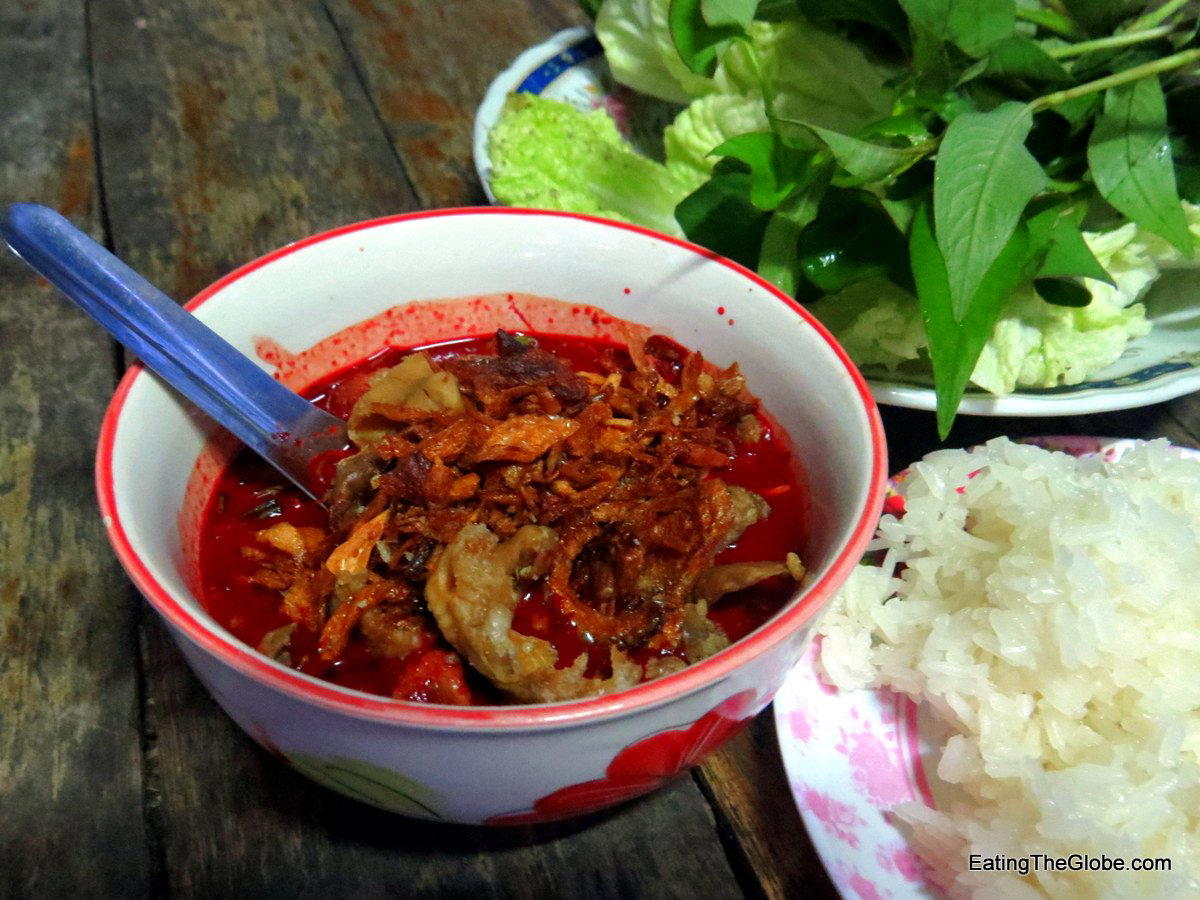
The menu
What to order
- Tom lueat muu
Where the Road Leads: Mae On's Local Food Culture
Mae On District sits roughly 25 kilometres east of Chiang Mai's old city, beyond the Mae Kuang river basin and into the quieter agricultural fringe of the province. The area is better known among Thais for weekend escapes — kayaking on the Mae Kuang reservoir, roadside grills, and the kind of eating that happens when a place has no reason to perform for tourists. That context matters when arriving at Him Tang Pig's Blood Soup at address 1229, On Klang. The surroundings are unremarkable in the way that only genuinely local eating places can be: no English signage directing you in, no curated aesthetic, nothing positioned for an audience beyond the district's own residents.
This is precisely the geography in which northern Thailand's older cooking traditions have survived most intact. While Chiang Mai's city centre has spent a decade calibrating its food offer toward international visitors, spots along the Mae On road operate on a different rhythm entirely. The benchmark here is not consistency with a global palate; it is fidelity to an ingredient set and a cooking method that predates tourist infrastructure by generations. For a broader map of what this province produces, our full Mae restaurants guide provides the wider context.
The Ingredient Argument: What Pig's Blood Soup Is Actually About
Pig's blood soup (known regionally as tom lueat muu) sits within a broader northern Thai cooking logic that treats the whole animal as the baseline, not as an adventurous departure from it. In the rural communities around Mae On, pork has historically been sourced locally, butchered in small quantities, and used without the selective trimming that characterises urban consumption. Blood, in this framework, is not a byproduct relegated to specialty preparation; it is among the primary ingredients, coagulated into soft blocks and simmered in a broth built from pork bone, lemongrass, galangal, and dried chillies.
The sourcing logic behind this dish reflects an economy of use that northern Thai cuisine has maintained far longer than its central Thai counterpart. Whereas Bangkok's contemporary fine-dining scene, represented by restaurants like Sorn in Bangkok, has reframed southern and Thai regional ingredient traditions through a premium lens, and farm-to-table frameworks like PRU in Phuket articulate sourcing as a selling point, places like Him Tang operate from a sourcing ethic that never required a selling point because it was simply how things were done. The pig comes from somewhere nearby. The herbs are regional. The blood is fresh. None of this is announced; it is assumed.
For Thai regional cooking enthusiasts who have worked through the northern repertoire elsewhere, this framing connects to what makes northern food distinct from the coconut-heavy richness of the south or the precise balance of Bangkok's central cuisine. Northern Thai food is frequently more fermented, more mineral, more anchored in preserved and blood-based preparations. AKKEE in Pak Kret and spots like Baan Chik Pork Noodles in Udon Thani represent different regional expressions of this same whole-animal, pork-centred tradition as it plays out across Thailand's north and northeast.
Atmosphere and Expectation
Arriving at Him Tang requires a degree of directional confidence. The address — Q64X+72V on the plus.code system, places it in a stretch of On Klang that is residential and semi-agricultural rather than commercial. The eating environment at places of this type in Mae On runs toward plastic chairs, fluorescent light, and table setups determined by function rather than any consideration of ambience. The atmosphere, if that word applies, is generated by the customers: local workers, families, regulars who have been coming long enough that ordering is a reflex.
This is a format with parallels across northern Thailand's district towns, from the noodle shops of Lamphun to the pork-heavy breakfast culture of Phrae, and it shares more with the working registers of Baan Heng in Khon Kaen or Chomjan in Ubon Ratchathani than with the considered design of resort dining. For a reader calibrated to the dining room formality of Le Bernardin in New York City or the theatrical structure of Lazy Bear in San Francisco, the adjustment is substantial. For a reader who has eaten at Thai wet markets or provincial road-stop restaurants, it is immediately legible.
Planning a Visit
Getting to Mae On from central Chiang Mai by car or motorbike takes between 35 and 50 minutes depending on traffic through the city's eastern corridor. The Mae On road is well-paved and direct; the challenge is locating the specific address, which the plus.code reference handles more reliably than street navigation in a stretch of road with limited formal signage. No website, phone number, or online booking system is recorded for Him Tang, which is consistent with the operational model of district-level local restaurants in Chiang Mai province: you arrive, you see whether it is open, and you order at the counter or from a staff member who passes the table. Visiting during morning or midday hours is the general convention for soup-based establishments of this type across northern Thailand, though hours have not been confirmed for this specific location. Arriving with a companion who reads Thai will ease the process, as menus at this tier of local restaurant are rarely in English.
Travellers building a broader picture of Thai provincial eating may find useful comparisons in the regional registers of Ayutthayarom in Phra Nakhon Si Ayutthaya, Banmai Chay Nam in Nakhon Ratchasima, and Baan Suan Lung Khai in Ko Samui, each of which operates within a distinct regional idiom but shares the same structural commitment to local sourcing and format conventions that do not require tourist traffic to survive. For those whose Thai itinerary extends further, Anuwat in Phang Nga, Banrimbung in Nakhon Pathom, Banya in Nonthaburi, Chom Tawan in Chon Buri, Day and Night in Surat Thani, and The Spa in Lamai Beach each represent the same instinct to eat where the locals eat, applied across different provinces and cooking traditions.
Frequently asked questions
Is Him Tang Pig's Blood Soup a family-friendly restaurant?
Him Tang operates as a local eatery in Mae On District, drawing the kind of neighbourhood crowd that includes families familiar with northern Thai whole-animal cooking. That said, the menu is built around tom lueat muu — pig's blood soup — which is a dish with a specific flavour profile that may not suit young children or first-time visitors unfamiliar with offal-based cooking. It is a working local spot, not a venue configured around international family dining expectations.
What should I expect atmosphere-wise at Him Tang Pig's Blood Soup?
Him Tang sits along On Klang road in Mae On District, roughly 25 kilometres east of Chiang Mai's old city, in an agricultural stretch with no urban signposting. The setting is functional and local — the kind of spot where the crowd is almost entirely Thai, the tables are practical, and the focus is entirely on the food. Visitors arriving from central Chiang Mai should expect a 35 to 50-minute drive and a place that operates on local time and local terms.
How far is Him Tang Pig's Blood Soup from central Chiang Mai, and how do you get there?
Him Tang is located in Mae On District, approximately 25 kilometres east of Chiang Mai's old city, accessed via the eastern corridor through the Mae Kuang river basin. The drive by car or motorbike takes between 35 and 50 minutes depending on city traffic. Navigation using the plus code Q64X+72V is the most direct way to locate the On Klang address, as the area lacks the street-level signage common in Chiang Mai's urban core.
What's the must-try dish at Him Tang Pig's Blood Soup?
The venue's name makes the answer clear: tom lueat muu, the northern Thai pig's blood soup, is the reason people make the trip out to Mae On. Within northern Thai cooking logic, this dish draws on a whole-animal tradition that treats blood as a functional, flavour-dense ingredient rather than a novelty. Order it as the anchor of the meal.
How do I find Him Tang Pig's Blood Soup?
Him Tang Pig's Blood Soup is located at Q64X+72V, 1229, On Klang, Mae On District, Chiang Mai 50130, Thailand, Mae.
What's the best way to book Him Tang Pig's Blood Soup?
No phone number or website is listed for Him Tang, which is consistent with the type of local, walk-in spot common in Mae On District. The most reliable approach is to arrive directly, using the plus code Q64X+72V to navigate to the On Klang address. Given it operates as a neighbourhood spot rather than a reservation-driven restaurant, turning up is the standard method.
What makes Him Tang Pig's Blood Soup worth seeking out?
Him Tang offers a specific dish — tom lueat muu — done within its proper regional context rather than adapted for tourist menus. Mae On District sits outside Chiang Mai's main food circuit, which means the cooking here answers to a local audience, not a visiting one. For anyone interested in northern Thai cooking as it actually functions in everyday life, that distinction matters.
Fast Comparison
| Venue | Cuisine | Price | Awards | Notes |
|---|---|---|---|---|
| Him Tang Pig's Blood SoupThis venue — the venue you are viewing | Northern Thai Pig's Blood Soup | $1–10 | Not listed | Not listed |
| Sorn | Fine Southern Thai | $200–300 | 3 Michelin Stars · World's 50 Best #12 | Southern Thai, ฿฿฿฿ |
| Baan Tepa | Creative Thai Fine Dining | $150–200 | 2 Michelin Stars · World's 50 Best #53 | Thai contemporary, ฿฿฿฿ |
| Côte by Mauro Colagreco | Riviera Mediterranean Fine Dining | $200–300 | 2 Michelin Stars · World's 50 Best #91 | Mediterranean, Modern Cuisine, ฿฿฿฿ |
| Gaa | Modern Indian Fine Dining with Thai Influences | $150–200 | 2 Michelin Stars · World's 50 Best #95 | Modern Indian, Indian, ฿฿฿฿ |
| Sühring | Modern German Fine Dining | $200–300 | 3 Michelin Stars · World's 50 Best #18 | German, ฿฿฿฿ |

Details
- Rustic
- Casual Hangout
- Standalone
- Beer Program
- Local Sourcing
- A La Carte
- Beer
Current opening hours
- Monday
- 10 AM–9 PM
- Tuesday
- 10 AM–9 PM
- Wednesday
- 10 AM–9 PM
- Thursday
- 10 AM–9 PM
- Friday
- 10 AM–9 PM
- Saturday
- 10 AM–9 PM
- Sunday
- 10 AM–9 PM
Hours can change for holidays and private events. Last verified .