Our verdict
Hai Chi Em brings modern Vietnamese cooking to Kingsway, one of Vancouver's most culturally layered corridors. The kitchen applies contemporary technique to familiar Southeast Asian flavour structures, positioning itself in a neighbourhood where mid-range dining punches with more confidence than the city's downtown core. It occupies a middle tier between casual pho houses and the premium end of Vancouver's Asian dining scene.

Pearl is the En Primeur Club membership app — saves, bookings, and concierge access live there. Same editors, same standards.
- Address
- 2172 Kingsway, Vancouver, BC V5N 2T5, Canada
- Phone
- (604) 213-0999
- Hours
- Mon 11 AM–9 PMTue ClosedWed–Thu 11 AM–9 PMFri–Sat 11 AM–11 PMSun 11 AM–9 PM
- Website
- haichiem.ca
- Directions
- Get directions
- Booking
- Book on OpenTable
The menu
What to order
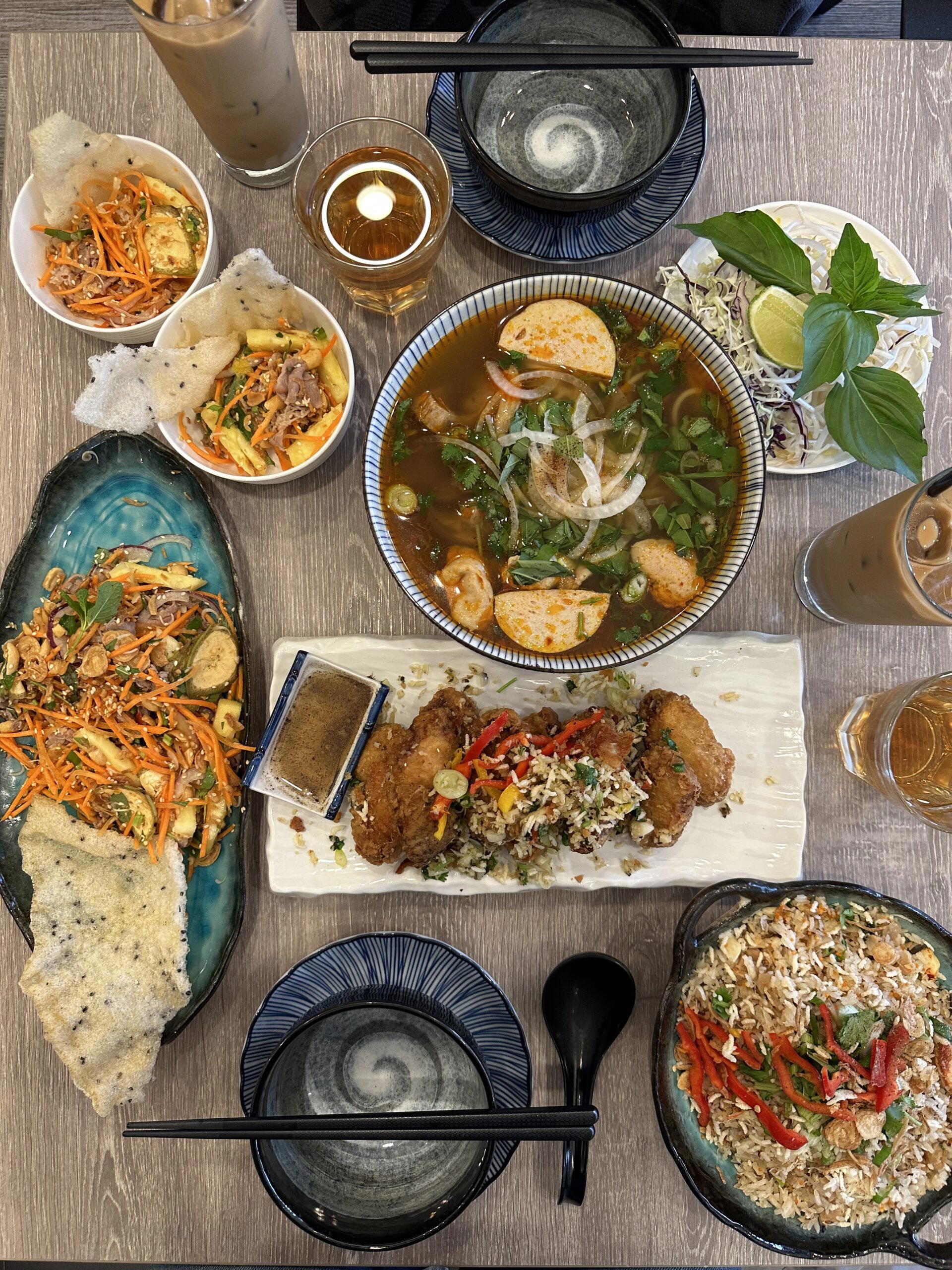
- Bún bò Huế
- Gỏi bưởi tôm thịt
- Deep fried squid
- Spicy beef short rib noodle soup
Kingsway and the Vietnamese Dining Tier It Sits In
Vancouver's Vietnamese restaurant scene has long been anchored by the Richmond corridor and the Commercial Drive pocket, where volume, value, and tradition define the category. Kingsway — running southeast from Main Street through the Collingwood and Renfrew neighbourhoods — represents something different: a stretch where first-generation community kitchens sit alongside a newer generation of operators who are reinterpreting the same cuisines with more editorial intention. Hai Chi Em Modern Vietnamese Cuisine operates on this stretch, at 2172 Kingsway, and its very name signals its positioning. The word "modern" is doing real work here, separating the kitchen from the neighbourhood's more traditional Vietnamese and pan-Asian peers.
In Vancouver's broader Asian dining picture, this matters. At the leading end, restaurants like Masayoshi ($$$$ · Japanese) and Kissa Tanto ($$$$ · Fusion) carry Michelin recognition and operate in an expensive, reservation-driven bracket. The contemporary Vietnamese category occupies a different tier entirely, one where technique and sourcing are increasingly serious, but the price point and atmosphere remain accessible. Hai Chi Em positions itself inside that middle register, where the competitive pressure comes from other modernist Southeast Asian kitchens rather than from omakase counters or tasting-menu rooms like AnnaLena ($$$$ · Contemporary) or Barbara ($$$$ · Contemporary).
The Lunch-to-Dinner Shift on Kingsway
One of the more instructive ways to read a neighbourhood restaurant's identity is to observe how its service rhythm changes between lunch and dinner. On a commercial arterial like Kingsway, the daytime crowd is a mix of local residents, tradespeople, and commuters, an audience that rewards speed, portion size, and price transparency over ceremony. By evening, the dynamic shifts: tables fill with diners who have chosen this address deliberately, often travelling from other parts of the city or the North Shore.
For Vietnamese kitchens operating in the modern register, this divide is particularly pronounced. A lunch service built around banh mi variations, rice plates, and noodle bowls does different editorial work than an evening menu that might foreground sharing plates, broth-based dishes designed for slower consumption, and a drinks list with some thought behind it. The lunch proposition at a restaurant like Hai Chi Em communicates value and neighbourhood anchoring; the dinner proposition communicates aspiration and culinary seriousness. In competitive Vietnamese markets, the kitchens that hold both audiences tend to be the ones with staying power, the lunch trade funds the ambition the dinner menu expresses.
This pattern plays out across Canadian cities where Vietnamese cuisine has moved beyond its first wave. In Montreal, the modern French-Vietnamese crossover has its own distinct vocabulary, visible at spots that share a sensibility with Jérôme Ferrer - Europea in Montreal's broader approach to European-influenced Canadian dining, even if the cuisines are entirely different. In Quebec City, the way Tanière³ in Quebec City interprets Canadian terroir through contemporary technique offers a structural parallel, the idea that traditional flavour memory can be renegotiated through technical refinement is not unique to any one cuisine or region.
What Modern Vietnamese Cooking Means in Practice
The "modern Vietnamese" label carries real meaning in North American dining contexts, and it is worth being precise about what it signals. It does not mean fusion in the casual sense, a spring roll on a platter with a dipping sauce labelled "Asian-inspired." It means, more specifically, that the kitchen is working with the classic Vietnamese flavour architecture, the balance of fish sauce salinity, fresh herb lift, chilli heat, and acid, and applying contemporary plating logic, sourcing discipline, and sometimes technique-led interventions to that foundation.
The reference points in this tradition are increasingly visible across North America. At Atomix in New York City, the Korean fine-dining model demonstrates how Asian culinary traditions can carry serious critical weight when framed through contemporary technique and restraint. That model has influenced how Vietnamese kitchens are read and positioned, even when the cuisine and price point differ substantially. The key variable is editorial clarity: does the kitchen know what argument it is making, and is the menu legible as a statement of that argument?
For Hai Chi Em, that argument is inscribed in the name and the address. The Kingsway location places it in a community with a substantial Southeast Asian population and the culinary literacy to assess whether modernist claims are earned. This is a more demanding audience than a downtown tourist-facing room would face, which, if the kitchen is meeting the brief, represents a meaningful trust signal of its own.
Where Hai Chi Em Sits in the Larger Canadian Dining Picture
Vancouver's restaurant scene is frequently read as a Pacific Rim city with one of North America's most competitive Chinese and Japanese dining markets. The Vietnamese category, particularly at the modern end, has historically received less critical attention than it deserves. Compared to the scrutiny applied to iDen & QuanJuDe Beijing Duck House ($$$$ · Chinese) or the Michelin coverage flowing toward the city's Japanese counters, modern Vietnamese kitchens operate with less institutional spotlight. This is partly a category bias in how guides and critics allocate attention, and partly a reflection of how recently the modern iteration of the cuisine has consolidated in the city.
Nationally, the structural comparison is illuminating. Ontario has developed a parallel track of modernist Asian dining, with Korean and Japanese formats attracting significant critical recognition. Destination restaurants like Alo in Toronto have demonstrated that Canadian cities can sustain genuinely ambitious dining at the top tier. At the opposite end of the discovery curve, places like Narval in Rimouski or The Pine in Creemore show how culinary seriousness operates far outside major metropolitan centres. Hai Chi Em fits neither the big-ticket destination category nor the rural-discovery narrative; it is something more quotidian and in some ways more representative: a neighbourhood-anchored kitchen making a case for its cuisine in a city that has the critical mass to appreciate the distinction.
For readers building a Vancouver dining itinerary, the restaurant occupies a logical slot between the city's top-tier Asian dining rooms and its casual ethnic-neighbourhood spots. It is not competing with the prix-fixe tasting rooms of Yaletown or Gastown; it is competing with other serious-minded mid-range kitchens in East Vancouver. See our full Vancouver restaurants guide for the wider context.
Planning Your Visit
Hai Chi Em is located at 2172 Kingsway, accessible from downtown Vancouver by the Millennium or Expo SkyTrain lines, with Nanaimo Station placing you roughly equidistant from the restaurant as King Edward Station, either works as an approach depending on which direction you are travelling. Kingsway is a busy arterial and the area has adequate street parking in the evening. For the lunch service, expect the neighbourhood's daytime rhythm: efficiency is the operating logic. For dinner, the pace opens up and the kitchen has more room to make its argument. That argument, based on what "modern Vietnamese" has come to mean across North American dining, is one worth arriving for with some attention to spare.
Frequently asked questions
Where exactly is Hai Chi Em Modern Vietnamese Cuisine?
Hai Chi Em Modern Vietnamese Cuisine is located at 2172 Kingsway, Vancouver, BC V5N 2T5, Canada, Vancouver.
How does Hai Chi Em fit into Vancouver's broader Vietnamese dining scene?
Vancouver's Vietnamese restaurant circuit is concentrated in Richmond and along Commercial Drive, where high-volume, traditional formats dominate. Hai Chi Em on Kingsway occupies a different position, operating under a modern Vietnamese identity that places it closer to the interpretive end of the spectrum rather than the heritage-focused end. For diners tracking the evolution of Vietnamese cooking in Canadian cities, the Kingsway address is a less-trafficked corridor worth monitoring.
What should I eat at Hai Chi Em Modern Vietnamese Cuisine?
Hai Chi Em positions itself in the modern Vietnamese category, which in a Vancouver context typically signals dishes that move beyond pho-and-banh-mi formats toward technique-driven preparations rooted in regional Vietnamese cooking. The kitchen at 2172 Kingsway sits in a neighbourhood that rewards restaurants with serious dinner menus rather than lunch-volume operations. For current dish specifics, checking directly with the restaurant on arrival will give you the most accurate read on what the kitchen is running.
What's the best way to book Hai Chi Em Modern Vietnamese Cuisine?
Hai Chi Em is located at 2172 Kingsway in Vancouver, and the most reliable booking approach is to visit in person or call ahead, as no online reservation platform or website is currently listed in public records. Kingsway neighbourhood restaurants at this tier tend to manage reservations through direct contact rather than third-party systems. Arriving during off-peak hours increases your chances of walk-in availability at dinner.
Cost Snapshot
Comparable venues nearby, for context on price, style, and recognition.
| Venue | Cuisine | Price | Notes |
|---|---|---|---|
| Hai Chi Em Modern Vietnamese CuisineThis venue — the venue you are viewing | Modern Vietnamese | $20–30 | Not listed |
| Linh Café | French & Vietnamese | $20–30 | Downtown, French & Vietnamese |
| Via Tevere Pizzeria Victoria Drive | Authentic Neapolitan Pizza | $20–30 | Grandview-Woodland, Authentic Neapolitan Pizza |
| Sing Sing Commercial | Fusion Beer Bar (Pho, Pizza & More) | Not listed | Commercial, Fusion Beer Bar (Pho, Pizza & More) |
| The Flamingo Room | Latin Contemporary | Not listed | Commercial, Latin Contemporary |
| The Ramen Butcher(Chinatown) | Hakata-Style Tonkotsu Ramen | $10–20 | Chinatown, Hakata-Style Tonkotsu Ramen |