Gyotaku - Pearl City
Our verdict
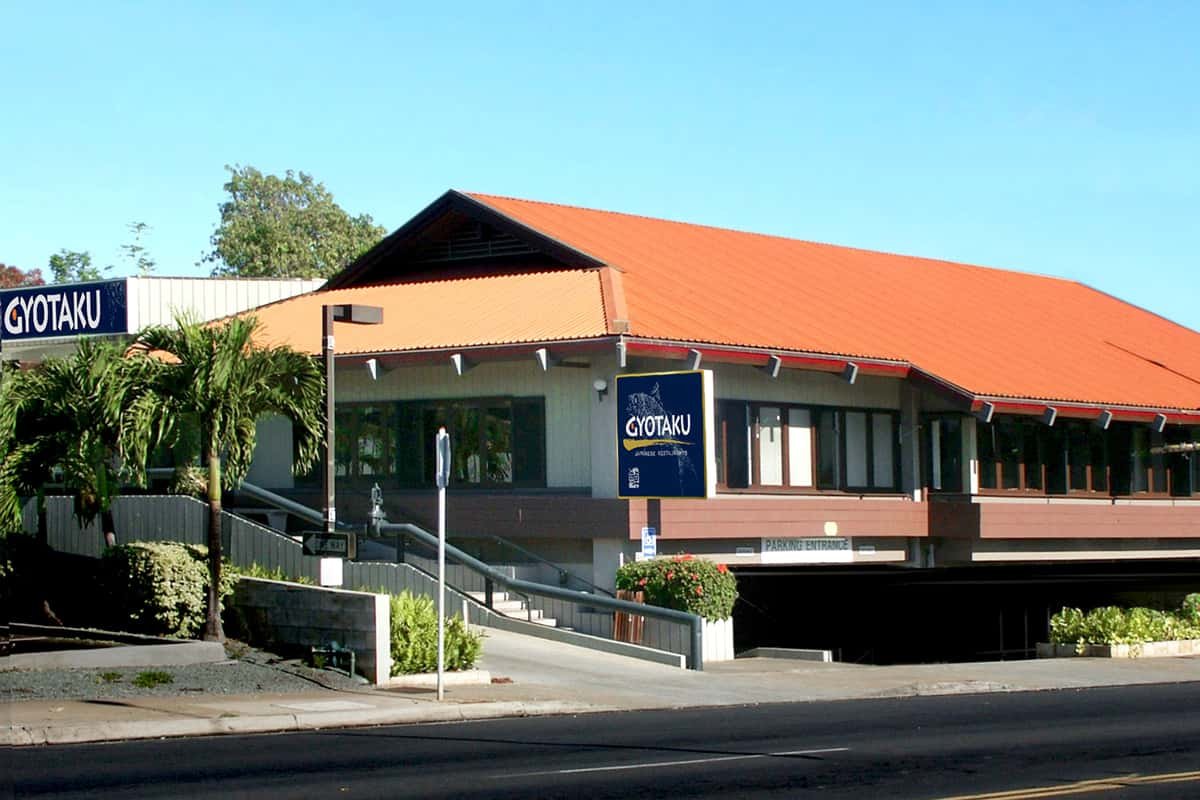
Gyotaku in Pearl City sits on Kaʻahumanu Street as one of Oʻahu's established Japanese-Hawaiian dining addresses, where the tradition of presenting fish as art meets the island's deep ties to Japanese immigrant culture. The restaurant draws from a culinary lineage rooted in post-war Hawaiʻi, when Japanese cooking vocabularies fused with local ingredients and became something distinctly their own.

Pearl is the En Primeur Club membership app — saves, bookings, and concierge access live there. Same editors, same standards.
The menu
What to order
- Ahi Poke Roll
- Ninja Roll
- Misoyaki Butterfish
Where Japanese Fishing Culture Meets Hawaiian Table
The name says everything about the tradition. Gyotaku is the Japanese art of pressing a fish against paper or fabric to produce an ink print — a practice developed by Meiji-era fishermen to record their catch with exactness before the days of photography. That a restaurant in Pearl City, Hawaiʻi carries this name is not incidental. It anchors the dining room in a specific cultural inheritance: the story of Japanese immigrants who arrived in the Hawaiian islands from the 1880s onward, brought their fishing techniques, their preservation methods, and their reverence for seafood, and gradually fused those traditions with the ingredients and rhythms of island life.
Pearl City itself sits in the urban corridor of Oʻahu's central district, a working residential area that rarely draws the kind of dining press that Honolulu's Chinatown or Kaimukī do. Yet it is precisely in neighborhoods like this one — away from hotel rows and tourist infrastructure, that the most durable expressions of Hawaiian-Japanese food culture tend to persist. Gyotaku at 98-1226 Kaʻahumanu Street operates inside that tradition, serving a community where Japanese culinary roots run three and four generations deep.
The Cultural Architecture of Japanese-Hawaiian Dining
To understand what a restaurant like Gyotaku represents, it helps to understand what happened to Japanese food culture when it arrived in Hawaiʻi. The plantation era created a unique laboratory: Japanese, Filipino, Korean, Portuguese, and Chinese workers lived in proximity, shared communal meals, and began trading ingredients and techniques across ethnic lines. The result, over decades, was a cuisine sometimes called local food, a hybridized vernacular that kept the structural logic of Japanese cooking (dashi-forward broths, careful fish preparation, pickled vegetables, rice as the gravitational center of any meal) while absorbing the seasonings and proteins of a broader Pacific pantry.
Oʻahu's Japanese restaurant scene today sits along a broad spectrum. At one end are the omakase counters in Honolulu that price against mainland fine dining and draw from Japanese-trained lineages. At the other are the family-style restaurants that have served local communities for decades, where the kitchen's fluency in Japanese technique shows not in theatrical presentation but in consistency, proportion, and an understanding of how to cook fish properly. Gyotaku belongs to the latter tradition, the kind of restaurant where the cultural knowledge is in the cooking itself, not in the staging around it.
For context on how different this register is from the top tier of American seafood restaurants, consider that the benchmark institutions in that space, Le Bernardin in New York City or Providence in Los Angeles, operate within a French technical framework applied to premium product, where the experience is structured around formality and occasion. The Japanese-Hawaiian family restaurant operates from an entirely different premise: the meal is communal, the fish knowledge is practical rather than theatrical, and the cultural continuity is in the repetition of trusted dishes across generations of the same family coming back to the same table.
Pearl City's Dining Position on Oʻahu
Pearl City's restaurant community functions largely for its own residents, which means the competitive set is defined differently than it would be in a visitor-facing district. The area has a range of local dining options, Little Joe's Steakhouse Pearl City represents the American steakhouse side of that offering, while The Pearl occupies a different position within the neighborhood. Gyotaku fits the Japanese family dining tier: a format that Oʻahu has sustained for longer than most American cities have had Japanese restaurants at all.
This matters for how the restaurant should be approached. Unlike the progressive American dining rooms that have defined national critical attention in recent years, from Lazy Bear in San Francisco to Alinea in Chicago to Brutø in Denver, the value proposition here is not novelty or technique-as-performance. It is reliability within a vernacular tradition, in a neighborhood that has sustained that tradition as part of daily life rather than as a special occasion marker.
The broader EP Club guide to this part of Oʻahu covers the full picture: see our full Pearl City restaurants guide for how Gyotaku fits within the area's dining range.
What the Gyotaku Tradition Signals at the Table
Japanese-Hawaiian restaurants of this type tend to anchor their menus around a few consistent categories: teishoku sets (a main protein with rice, miso soup, and pickles), combination plates that reflect the local appetite for mixing Japanese and non-Japanese elements, and fish preparations that draw on both Japanese technique and Hawaiian proximity to Pacific species. The gyotaku art form in its original context was about precise documentation, the fish pressed to paper recorded not just its species but its exact dimensions, the curve of its fins, the specifics of its biology. Applied to a restaurant name, it implies an orientation toward the fish itself: its sourcing, its preparation, its presentation as the central act.
Hawaii's access to Pacific species, mahi-mahi, ono, opakapaka, ahi, gives Japanese-trained kitchens a different raw material than their counterparts on the mainland work with. The fusion of Japanese cutting and seasoning techniques with these local fish is one of the genuinely distinctive features of Hawaiian dining culture, and it separates a well-executed Hawaiian-Japanese restaurant from Japanese restaurants elsewhere in the United States that rely on imported or farmed product.
Planning a Visit
Gyotaku's Pearl City location is at 98-1226 Kaʻahumanu Street in Pearl City, HI 96782. The restaurant sits in a residential commercial zone that is most easily reached by car, Pearl City is accessible from the H-1 freeway and is approximately a half-hour from Waikīkī under typical traffic conditions. Visitors coming from Honolulu's dining districts should treat this as a deliberate trip into a local neighborhood rather than a central district stop. The restaurant does not appear in the major awards circuits, no Michelin recognition, no James Beard nods, which places it squarely in the community dining tier rather than the destination fine dining category. That positioning is itself informative: this is a restaurant that has persisted because it serves its neighborhood well, not because it has sought external validation.
For broader reference on what excellent seafood-focused dining looks like at the national award level, the EP Club covers destinations including Single Thread Farm in Healdsburg, The French Laundry in Napa, Addison in San Diego, Blue Hill at Stone Barns in Tarrytown, The Inn at Little Washington, Bacchanalia in Atlanta, Causa in Washington, D.C., Atomix in New York City, Emeril's in New Orleans, and 8 1/2 Otto e Mezzo Bombana in Hong Kong, a range that illustrates how wide the spectrum of serious dining runs, and how different the community restaurant tradition is from the high-occasion end of that spectrum.
Frequently asked questions
Where is Gyotaku - Pearl City in Pearl City?
Gyotaku - Pearl City is located at 98-1226 Kaʻahumanu St, Pearl City, HI 96782, Pearl City.
Is Gyotaku Pearl City a good option for families dining in the ʻEwa and Pearl City corridor on Oʻahu?
Gyotaku Pearl City, at 98-1226 Kaʻahumanu Street, is positioned in a residential commercial area that functions primarily for its surrounding community — which includes a significant number of local families. The teishoku and plate-style format common to Japanese-Hawaiian restaurants of this type translates well to group dining, with set meals that simplify ordering for mixed-age tables. For families based in or passing through the Pearl City and ʻEwa corridor rather than staying in Waikīkī, this is the kind of neighbourhood restaurant worth knowing.
What do people recommend at Gyotaku - Pearl City?
Gyotaku's format is rooted in Japanese-Hawaiian tradition, so the menu anchors around teishoku sets — a main protein served with rice, miso soup, and sides — along with plate lunch-style combinations that reflect the fusion of Japanese cooking with Hawaiian table culture. These composed set meals are the category the restaurant is known for. Specific current menu items are best confirmed directly at the Pearl City location on Kaʻahumanu Street.
Do they take walk-ins at Gyotaku - Pearl City?
Gyotaku Pearl City sits in a residential commercial zone that draws primarily from the surrounding community, which means seating demand tends to follow local rhythms rather than tourist surges. Walk-in availability is generally more accessible here than at Honolulu-area destination restaurants. Checking ahead is advisable for weekend lunch and dinner periods when family dining traffic peaks.
What makes Gyotaku - Pearl City worth seeking out?
The restaurant occupies a specific cultural position: it carries the gyotaku name, referencing the Japanese tradition of fish-print art and a deep connection to fishing culture, and translates that into a dining context shaped by over a century of Japanese immigration to Hawaiʻi. Pearl City's location at 98-1226 Kaʻahumanu Street means the clientele is largely local, which keeps the menu grounded in the everyday Japanese-Hawaiian cooking that tourist-facing spots rarely prioritize.
Can Gyotaku - Pearl City handle vegetarian requests?
Japanese-Hawaiian restaurants structured around teishoku sets and seafood-forward menus can be limiting for strict vegetarians, though miso soup, rice, and vegetable side components are typically part of the format.
Pricing, Compared
Comparable venues nearby, for context on price, style, and recognition.
| Venue | Cuisine | Price | Notes |
|---|---|---|---|
| Gyotaku - Pearl CityThis venue — the venue you are viewing | Authentic Japanese Sushi and Tenpura | $20–30 | Not listed |
| The Pearl | Contemporary American Fine Dining | $20–30 | Pearl City, Contemporary American Fine Dining |
| Little Joe's Steakhouse Pearl City | Classic American Steakhouse | Not listed | Pearl City, Classic American Steakhouse |
| Akasaka | Traditional Japanese Sushi | $30–50 | Waikiki, Traditional Japanese Sushi |
| Jimbo Restaurant | Traditional Japanese Udon | Not listed | McCully-Moiliili, Traditional Japanese Udon |
| Pork Tamago Onigiri | Okinawan Pork Tamago Onigiri | $10–20 | Waikiki, Okinawan Pork Tamago Onigiri |
Continue exploring
More in Pearl City
Restaurants in Pearl City
All restaurants in Pearl City →
Bars in Pearl City
Browse all →
Details
- Family
- Casual Hangout
- Sake Program
- A La Carte
- Sake
- Vegetarian Friendly
Current opening hours
- Monday
- 11 AM–8 PM
- Tuesday
- 11 AM–8 PM
- Wednesday
- 11 AM–8 PM
- Thursday
- 11 AM–8 PM
- Friday
- 11 AM–8 PM
- Saturday
- 11 AM–8 PM
- Sunday
- 11 AM–8 PM
Hours can change for holidays and private events. Last verified .
Family-friendly casual atmosphere with focus on authentic Japanese dining.