Tabelog 100 #18
Our verdict
Grill Sakura belongs to Tokyo’s old-school yoshoku tradition, where Western forms are filtered through Japanese dining habits rather than copied wholesale. Its Tabelog 100 Yoshoku EAST 2025 selection, 16-seat format, and Asakusa setting make it a compact choice for low-key occasion dining rather than ceremony-heavy fine dining.

Pearl is the En Primeur Club membership app, where members save venues, book tables and use the concierge.
The menu
What to order
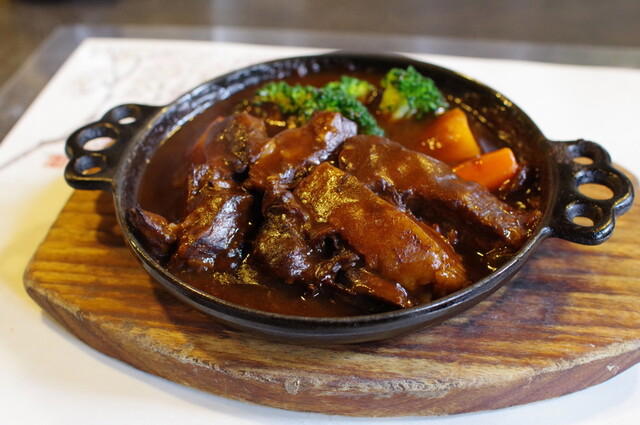
- Beef stew
- Hamburg steak
- Fried shrimp
- Menchi katsu
Tokyo shifts quickly once daytime crowds thin: shutters, modest frontages, dining rooms with their own pace, and restaurants quiet enough not to announce themselves. Here, yoshoku makes sense: not simply Western food in Tokyo, but a Japanese urban tradition of familiar restaurant formats, sauces, rice plates, grills, and compact-kitchen discipline. Grill Sakura sits in that lineage, a Tokyo restaurant where category identity, familiarity, and cooking that rewards regulars as much as occasion diners carry the appeal.
Tokyo occasion dining is often framed through sushi counters, kaiseki rooms, and hotel restaurants, but the city also has a quieter tier for birthdays, family catch-ups, and meals where formality would feel overworked. Yoshoku fits that lane: comforting without becoming fast-casual, built for appetite, and judged in stronger rooms on restraint: sauce balance, frying discipline, rice, pacing, and making familiar formats feel cared for rather than nostalgic by default.
Tokyo yoshoku for occasions that do not need ceremony
The comparison is not Ginza omakase or tasting-menu French, but Tokyo’s established everyday-special restaurants, where reputation builds through repeat meals, category focus, and a rhythm that feels local rather than staged. Grill Sakura’s selection for Tabelog 100 Yoshoku EAST 2025 places it in a public benchmark for Japanese-style Western restaurants drawing serious local attention despite modest price positioning. Its Tabelog score of 3.72 adds another signal: not luxury-room dining, but a restaurant judged in a competitive local field where execution differences show.
For travelers planning a celebratory meal in Tokyo, that distinction matters. A yoshoku dinner in Tokyo reads differently from a hotel dining room or counter-only sushi booking: more conversational, less performative, and easier to fold into a city day. The category works across generations. Sandwiches and Japanese-style Western plates offer comfort and clarity, while Tabelog recognition gives enough editorial weight to make the meal a planned stop, not a fallback.
Tokyo has an advantage newer dining districts cannot fake: memory. Its food culture includes old confectioners, tempura houses, soba rooms, kissaten, casual grills, and tourist-facing snacks, but stronger addresses tend to be specific. A yoshoku restaurant can feel more relevant here than a larger concept. The format can suit milestone meals where the table should feel anchored rather than processed.
Where yoshoku sits in Tokyo's serious dining map
Yoshoku is often misread by visitors as retro comfort food. In Japan, it is its own grammar: Western-derived forms adapted over decades into a domestic restaurant language. Its appeal lies in translation, not imitation. A good yoshoku meal is not replicating Paris, Milan, or New York; it belongs to Tokyo’s lunch-and-dinner culture, where sauces, rice, sandwiches, fried items, grills, and stews are familiar anchors. Better rooms are judged by precision within those frames.
That makes Grill Sakura’s award context useful. Tabelog’s Hyakumeiten lists reward depth within categories rather than spectacle across all restaurants, so a 2025 Yoshoku EAST selection identifies its competitive conversation. It is not positioned against sushi counters such as Sushi Kanesho, where price, product access, and counter technique define comparison. It sits closer to Tokyo’s yoshoku tradition, where grill GRAND and グリル グランド signal the same orbit, and where an apparently simple meal can reveal more than a longer menu built for display.
The occasion angle is practical. Not every celebration in Tokyo needs a hushed room or long progression. For friends, couples, or family meals, the better decision may be a restaurant with clear identity, manageable price positioning, and enough recognition to feel intentional. The value is not theatrical luxury, but a format that lets conversation carry the evening while food remains the reason everyone came.
Travelers can use this as a counterweight to more specialized bookings: yoshoku in Tokyo, yakitori in another part of the city, curry in a smaller specialist shop, and sushi or cocktail bars elsewhere, rather than stacking only high-formality meals. For nearby and citywide context, EP Club’s Tokyo restaurant coverage includes other Tokyo dining rooms across several genres, with the wider city index at Our full Tokyo restaurants guide.
How to place it in a Tokyo itinerary
The strongest use case is a planned, low-friction meal in Tokyo. The city can be crowded by day, especially around major sightseeing routes and shopping streets, but evening dining often settles into a more local rhythm. A yoshoku restaurant suits that transition: enough structure for a special meal, not so much choreography that it dominates the night. For travelers pairing restaurants with hotels, bars, and cultural planning, EP Club’s city guides also cover Our full Tokyo hotels guide, Our full Tokyo bars guide, Our full Tokyo wineries guide, and Our full Tokyo experiences guide.
The modest price bracket shapes the decision. This is not framed as a luxury blowout or a formal banquet. It better suits diners who value category depth, Tokyo context, and a meal grounded in local dining culture. The appeal points to familiarity rather than event production, making it sharper for a birthday dinner with one or two close companions than for a high-ceremony occasion.
It also belongs in a wider Japanese dining itinerary beyond Tokyo. Travelers comparing regional comfort-food formats might look at other dining rooms around Japan in similarly familiar categories, from grilled beef and café cooking to curry, casual set meals, and contemporary small restaurants. For Japanese food culture abroad, comparable examples show how differently familiar formats travel once they leave Japan.
The critical read is simple: Grill Sakura is compelling because it makes a modest genre worth scheduling. Its strength is not scale, glamour, or menu maximalism, but the convergence of Tokyo context, yoshoku specificity, Tabelog 100 recognition, and a price point suited to meals with personal weight. For travelers who understand that Tokyo’s serious dining culture extends beyond tasting menus, this is a persuasive occasion restaurant.
Frequently asked questions
What's the pricing like at Grill Sakura?
Pricing at Grill Sakura is listed as JPY 2,000 - JPY 2,999 for both lunch and dinner.
What's the address for Grill Sakura?
Grill Sakura is located in Tokyo.
What days is Grill Sakura closed?
Published closure details are not provided here. Check the venue's official channels for the latest schedule before visiting.
What makes Grill Sakura worth seeking out?
Grill Sakura has been selected for Tabelog 100 Yoshoku EAST 2025 and has a Tabelog score of 3.72. That puts it in the category of Tokyo dining that people can plan around, not just a casual fallback.
Do they accommodate allergies at Grill Sakura?
Those details are not published. Grill Sakura is listed for yoshoku and sandwiches, so guests with specific allergies should plan to clarify ingredients before ordering. Check the venue's official channels for the latest details.
Is Grill Sakura good for families?
Its yoshoku and sandwich categories can make it approachable for a family meal, especially for lunch or dinner in Tokyo. The listed lunch and dinner budget of JPY 2,000–JPY 2,999 also keeps it in a practical bracket for mixed-age groups.
Accolades, Compared
Comparable venues by cuisine and price in the same metro.
| Venue | Cuisine | Price | Awards | Notes |
|---|---|---|---|---|
| Grill SakuraThis venue (the venue you are viewing) | Classic Yoshoku (Japanese‑style Western) | $20–30 | Tabelog 100 #18 | Not listed |
| Coffee Tengoku | Retro Japanese Pancake Cafe | $10–20 | Tabelog 100 | Asakusa |
| Kibun Zushi | Traditional Edomae Sushi in Asakusa | $50–100 | Tabelog 100 #72 | Taitō |
| Shinsuke | Traditional Japanese Izakaya | $30–50 | Tabelog 100 #56 | Bunkyō |
| Nezu Kamachiku | Traditional Udon in Historic Stone Warehouse | $20–30 | Tabelog 100 #13 | Bunkyō |
| Amanoya | Traditional Japanese sweets café & okonomiyaki | $20–30 | Tabelog 100 | Chiyoda |
Recognition history
Dated appearances from independent guides and award organizations, with the underlying list record or original source where available.
Tabelog 100 #18 · No. 18
Tabelog · Tabelog 100 - Yoshoku - EAST - 2025