Fresco Italian Restaurant
Our verdict
Fresco Italian Restaurant sits on the second floor of Rainbow Bazaar inside the Hilton Hawaiian Village complex on Kālia Road, placing it at the intersection of resort dining and Italian-leaning cuisine in Honolulu's Waikīkī corridor. For visitors staying along the beach strip or residents looking for a familiar European format amid the Pacific, Fresco occupies a distinct position in a neighborhood dominated by Asian-Pacific and Hawaiian plates.

Pearl is the En Primeur Club membership app, where members save venues, book tables and use the concierge.

The menu
What to order
- Linguine All'Aragosta E Granchio
- Hawaiian Cioppino
- Fresco Loco Moco
Italian in the Pacific: What Resort-Strip Dining Looks Like in Honolulu
Waikīkī's dining corridor runs on a predictable logic: hotel-anchored restaurants absorb the foot traffic, local spots hold the loyalty of residents, and a thin layer of independent operators competes for the attention of travelers who want something beyond the buffet. Fresco Italian Restaurant sits within the first of those categories, positioned on the second floor of Rainbow Bazaar inside the Hilton Hawaiian Village complex at 2005 Kālia Road. The setting matters because it shapes everything from the clientele mix to the ambient pace of the room. Resort bazaar dining in Honolulu tends to draw a broad cross-section: families mid-vacation, couples looking for a break from the beach, and visitors who find the familiarity of Italian formats reassuring after days of navigating an unfamiliar city.
That familiarity is a deliberate position in a market where Italian cuisine competes not just with other Western formats but with the deep local pull of Hawaiian plates, Japanese izakayas, and the kind of French-Japanese hybrids found at places like Fête (New American) and 3660 On the Rise. The Italian format in a Pacific city is not a neutral choice; it stakes out a position for diners who want wine-friendly, pasta-anchored meals in a room that reads as conventionally upscale without requiring the ceremony of Honolulu's more formal waterfront addresses like 53 By The Sea.
The Rainbow Bazaar Address and What It Signals
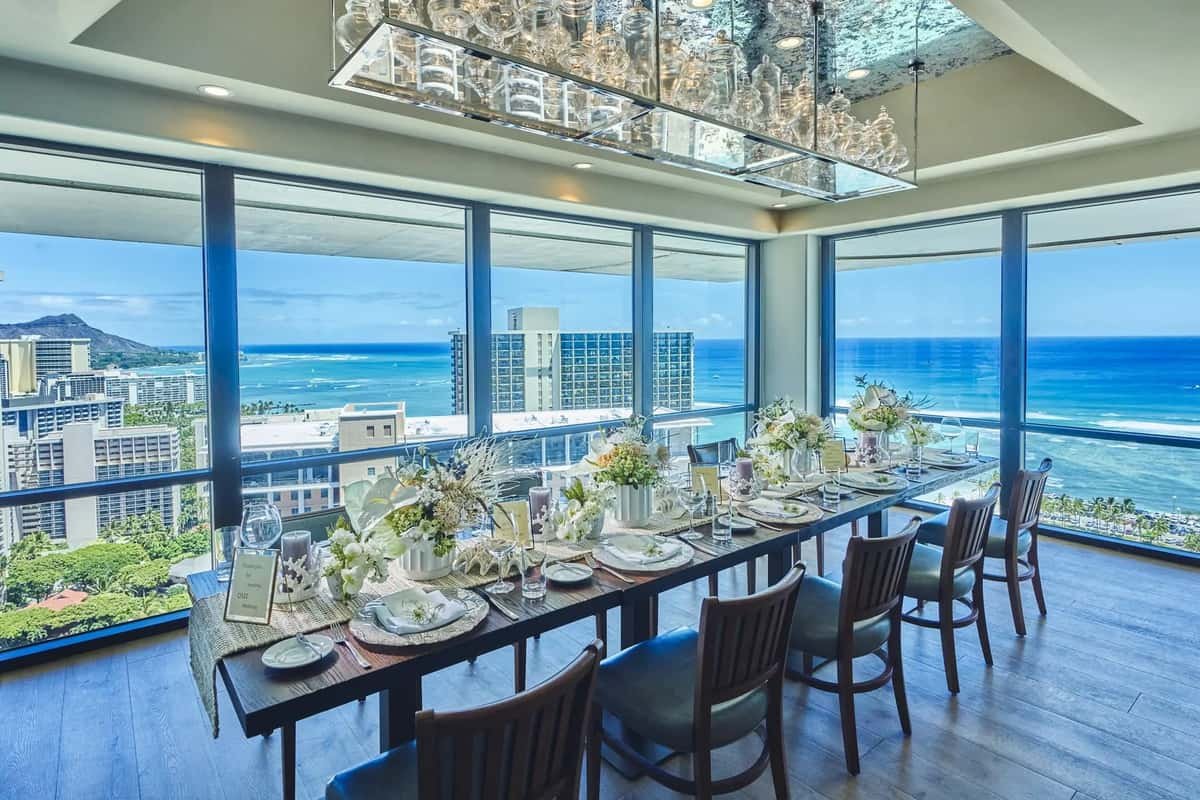
Rainbow Bazaar is not a destination in the way that a standalone restaurant on a named street might be. It is a curated retail and dining precinct embedded within one of Waikīkī's largest resort footprints. Arriving at Fresco means moving through that resort logic first: past the pools, the lobby retail, and the open-air walkways that define the Hilton Hawaiian Village's scale. The second-floor placement gives the restaurant a degree of separation from the ground-level activity, which in practice means a slightly quieter room and a view orientation that looks inward over the complex rather than outward to the beach.
This is a familiar format across resort destinations globally. The question for any Italian restaurant in this position is whether it finds a way to connect its menu to place, or whether it operates as a fully portable European template dropped into a Pacific setting. The more interesting operators in the Hawaiian market, including some of the ceremony-focused luau formats like Ahaaina Luau, have found ways to make location integral to the experience. Italian cuisine presents a harder case for that kind of integration, though the sourcing question is where the opportunity exists.
Sustainability as a Structural Question, Not a Marketing Layer
The most meaningful pressure on resort-anchored Italian restaurants in Hawaii right now is not competition from other Italian tables; it is the sustainability question that runs through every serious food conversation on the islands. Hawaii's geographic isolation means that imported ingredients carry a carbon footprint that is impossible to ignore at the scale a resort restaurant operates. The most thoughtful responses to this in the US dining market have not come from Italian-format restaurants specifically, but from farm-integrated concepts like Single Thread Farm in Healdsburg and Blue Hill at Stone Barns in Tarrytown, where the sourcing infrastructure is built into the operating model, not added as a footnote.
For an Italian restaurant in Honolulu, the equivalent conversation involves the question of which ingredients can be sourced from Hawaii's own farms and fisheries, and which are irreducibly imported. Hawaiian seafood, some vegetables, and certain proteins can replace imported equivalents without compromising the format. The harder choices involve staples: pasta flour, cured meats, aged cheeses. These are not easy substitutions. But the direction of travel in serious dining, from the ethical-sourcing programs at Addison in San Diego to the waste-reduction frameworks documented at Smyth in Chicago, points toward operators who treat sourcing as a structural commitment rather than a seasonal feature.
Resort-format restaurants face an additional constraint: consistency at scale. A 40-seat independent in Kaimuki can pivot its menu around what the farmers' market offers that week. A restaurant embedded in a major hotel complex operates under different supply chain pressures. That constraint does not make the sustainability question less relevant; it makes it harder and more interesting. The operators who have found genuine answers, including European models like Atelier Moessmer Norbert Niederkofler in Brunico, which has built its entire identity around Alpine sourcing, have typically done so by redesigning the supply relationship rather than optimizing within an inherited one.
Honolulu's Italian Tier and Where Fresco Sits
Honolulu does not have a deep Italian restaurant tier. The city's dining identity is shaped primarily by Japanese, Hawaiian, and Pacific Rim formats, with a strong local culture around plate lunch, ramen, and izakaya. Italian cuisine occupies a smaller footprint, and within that footprint, the resort-adjacent addresses differ meaningfully from neighborhood independents. The neighborhood independents tend to attract a repeat-customer base and operate on tighter margins with more menu flexibility. The resort addresses have larger audiences, more consistent covers, and a guest profile skewed toward first-time visitors rather than regulars.
That structural difference shapes what Fresco is and what it is not. It is not competing with the Italian-inflected fine dining found at American reference points like Le Bernardin in New York City or the seasonally driven tasting formats at The French Laundry in Napa. It operates in a different register: accessible, familiar, designed for a guest who wants a reliable meal in a comfortable room. That is a legitimate and well-occupied market position in any resort city. The question is whether it is executed with enough local specificity to distinguish itself from generic Italian resort dining, or whether it reads as interchangeable with the same format in a different city entirely. For more on how Honolulu's broader restaurant scene positions itself across cuisine categories and price tiers, the full Honolulu restaurants guide maps the competitive field in detail.
Planning Your Visit
Fresco is located on the second floor of Rainbow Bazaar within the Hilton Hawaiian Village at 2005 Kālia Road, placing it in walking distance of the western end of Waikīkī Beach and accessible to guests staying anywhere along the resort corridor. Visitors to the broader Waikīkī area looking for other anchors in the dining scene should consider the contrast between the resort-adjacent format here and the more locally rooted experiences at places like 855-ALOHA, which represents a different entry point into Honolulu's food culture.
Frequently asked questions
Can I bring kids to Fresco Italian Restaurant?
Fresco sits inside Rainbow Bazaar at the Hilton Hawaiian Village, a resort complex that draws families as its primary audience. The second-floor location within a hotel retail precinct suggests an environment accustomed to mixed-age groups. Italian formats generally translate well for younger diners, though confirming current menu options directly with the restaurant before visiting is advisable.
What should I expect atmosphere-wise at Fresco Italian Restaurant?
Fresco occupies the second floor of Rainbow Bazaar inside the Hilton Hawaiian Village on Kālia Road, which frames the setting as resort-integrated rather than standalone neighborhood dining. The Waikīkī hotel corridor tends to run at a relaxed pace compared to a city-center restaurant, with foot traffic drawn from the wider resort complex. Expect a room calibrated to hotel guests as much as destination diners.
Is Fresco Italian Restaurant a good option for dinner after a day in Waikīkī?
Fresco's second-floor location in Rainbow Bazaar at the Hilton Hawaiian Village on Kālia Road places it within the Waikīkī resort strip, making it a convenient post-beach dinner option without requiring a car or taxi. In a city where Italian dining is a limited category alongside the dominant Japanese and Hawaiian formats, Fresco represents one of the more accessible Italian tables in the area. Current hours should be confirmed directly with the venue before planning around it.
What do regulars order at Fresco Italian Restaurant?
For the most accurate picture of what the kitchen is currently running, checking directly with the restaurant on arrival or by phone is the reliable approach. The Italian format in a Honolulu resort context typically anchors around pasta and protein-led mains.
Where do I go for Fresco Italian Restaurant?
Fresco Italian Restaurant is located at Rainbow Bazaar, Hilton Hawaiian Village Village, 2005 Kālia Rd #2F, Honolulu, HI 96815, Honolulu.
What's the best way to book Fresco Italian Restaurant?
Fresco is located at 2005 Kālia Road on the second floor of Rainbow Bazaar within the Hilton Hawaiian Village. Guests staying at the hotel have an obvious advantage in making arrangements on-site.
What's the standout thing about Fresco Italian Restaurant?
In Honolulu, where the dining identity is built around Japanese, Hawaiian, and Pacific Rim formats, Italian restaurants occupy a thin tier. Fresco's position inside the Hilton Hawaiian Village gives it consistent visibility that most of that thin tier lacks. Its Rainbow Bazaar address in Waikīkī puts it in one of the highest-footfall resort precincts on the island, which is a structural advantage independent of what's on the plate.
Cuisine and Awards Snapshot
Comparable venues nearby, for context on price, style, and recognition.
| Venue | Cuisine | Price | Awards | Notes |
|---|---|---|---|---|
| Fresco Italian RestaurantThis venue (the venue you are viewing) | Italian with Hawaiian Fusion | $30–50 | Not listed | Not listed |
| Giovedi | Italian with Asian Fusion | $50–100 | James Beard Award Semi Finalist · Bon Appétit The 20 Best New Restaurants #15 | Chinatown |
| La Cucina Ristorante Italiano | Homestyle Italian Trattoria | $30–50 | Not listed | Capitol District |
| Arancino Beachwalk | Modern Italian Pasta & Pizza | $20–30 | Not listed | Waikiki |
| La Pizza Rina | Authentic Italian Pizza & Pasta | Not listed | Not listed | Makiki Ako |
| Dean & Deluca Hawaii, The Artisan Loft | Contemporary French Bistro with Hawaiian Influences | $50–100 | Not listed | Waikiki |