Ah Ter Teochew Fishball Noodles
At Maxwell Food Centre, Ah Ter Teochew Fishball Noodles represents a strand of Singapore hawker cooking that traces directly to the Teochew immigrant communities of the twentieth century. The stall operates within one of the city's most storied hawker centres, where queue culture and ingredient discipline define the standard. For anyone mapping Downtown Core's food heritage, this is a reference point for the fishball noodle tradition.
Pearl is the En Primeur Club membership app — saves, bookings, and concierge access live there. Same editors, same standards.
- Address
- 7 Maxwell Rd, #01-14, Singapore 069112
- Phone
- +18008387971
- Website
- business.site
- Directions
- Get directions
 Saves & bookings on Pearl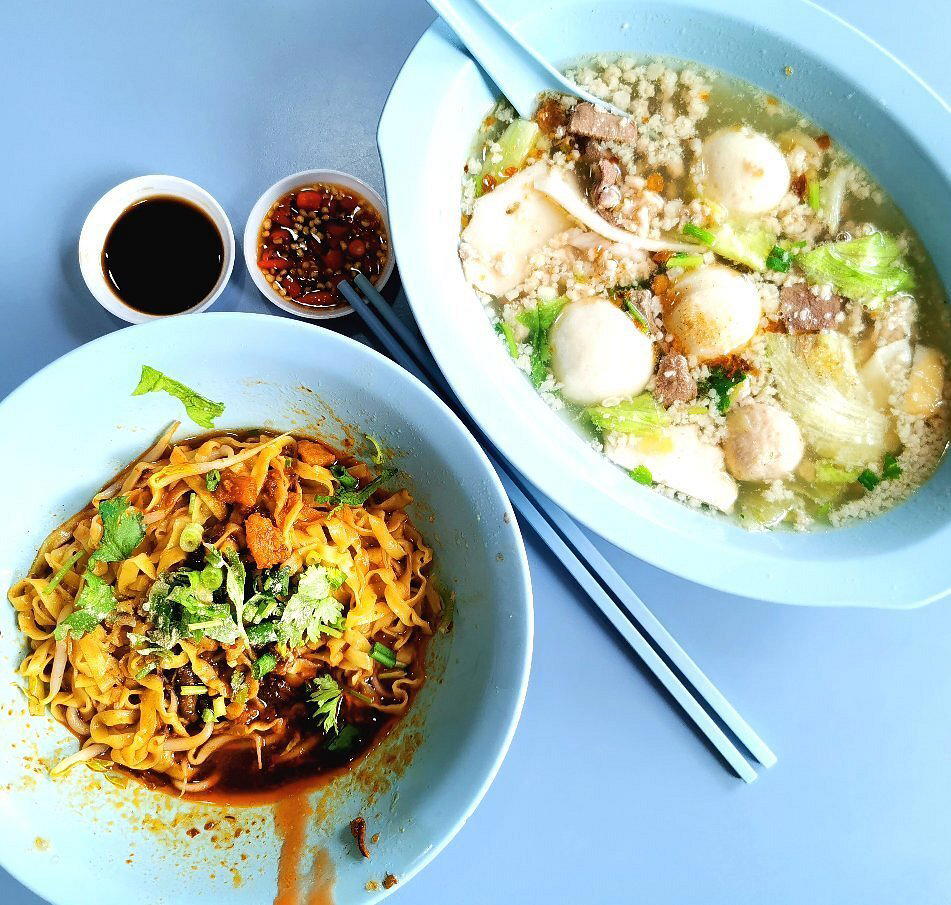
Maxwell Food Centre and the Fishball Noodle Tradition
The approach to Maxwell Food Centre on a weekday morning tells you something about how Singapore organises its food culture. The 1949-era building on Maxwell Road sits at the edge of the Tanjong Pagar conservation district, where colonial-era shophouses give way to the glass towers of the CBD. Inside, the air carries the mineral sharpness of fishball broth, the sweetness of char siew fat rendering in the back of neighbouring stalls, and the particular low hum of a crowd that knows exactly what it came for. This is not a tourist set piece. It is a working institution, and the queues at the more established stalls operate on a logic that has nothing to do with marketing.
Within that context, Ah Ter Teochew Fishball Noodles at stall #01-14 holds a position that reflects the broader story of Teochew food culture in Singapore. The Teochew diaspora, which settled across Southeast Asia from the late nineteenth century onward, carried with it a set of culinary priorities: clean broth, fish-forward flavour, and a preference for technique over spice. Fishball noodles became one of the clearest expressions of those priorities, a dish where the quality of the fishball itself, its bounce, its seasoning, its fish content, functions as the entire argument.
What the Fishball Actually Tells You
The fishball noodle category in Singapore now spans an enormous range, from frozen-ball operations at the bottom end to stalls like Ah Ter where the fishballs are hand-made from fresh fish paste. That distinction matters more than it might appear from the outside. A hand-made fishball uses a higher percentage of actual fish, typically yellow croaker, wolf herring, or a combination of local fish species, ground to a paste and shaped by hand before poaching. The result is a firmer, more complex product with a texture closer to fresh fish than to processed protein. The bounce in a well-made fishball, what Singaporeans call the QQ texture, comes from the myosin in the fish muscle binding correctly during the mixing process. You cannot fake it with starch alone, and you cannot achieve it with fish that has already degraded.
This is what the ingredient sourcing angle reveals about stalls operating at this level: the product quality is determined almost entirely upstream, before the cook touches it. The broth, typically made from dried flounder and pork bones, functions as a frame rather than a mask. At hawker stalls that take the fishball seriously, the broth is deliberately restrained so it doesn't compete with the fish. That restraint is a technical choice, not a limitation.
Singapore's hawker ecosystem broadly, and Maxwell Food Centre specifically, has preserved this standard partly through generational transmission and partly through competitive proximity. When a dozen stalls operate within fifty metres of each other, quality regression is punished immediately and publicly. The queue dynamics at Maxwell are not sentimental, they are a real-time quality signal.
Downtown Core's Hawker Position
Maxwell Food Centre sits in a district that also contains some of Singapore's most formal dining. Cherry Garden and Golden Peony represent the Cantonese fine dining tier in the same neighbourhood, while Imperial Treasure Fine Chinese Cuisine operates in the premium Chinese restaurant category. Nutmeg & Clove and TWG TEA occupy different tiers again. The range is part of what makes Downtown Core worth mapping carefully, see the full Downtown Core restaurants guide for a more complete picture of how these tiers sit alongside each other.
What Ah Ter represents within that spread is not a cheaper alternative to fine dining. It represents a different tradition entirely, one that predates the hotel restaurants and the Michelin-chasing formats by several decades. The hawker stall model, formalized through Singapore's government resettlement programs in the 1970s, took street food vendors who had been operating from pushcarts and gave them fixed addresses inside covered centres. The formalization preserved the food but changed the economics: stall leases, electricity costs, and the absence of foot traffic from moving operations all shifted the calculus. Stalls that survived that transition and remained occupied by their founding families or trained successors tend to be the ones worth tracking.
For context on how Singapore's hawker culture sits alongside the city's full dining range, Les Amis in Singapore represents the French fine dining pole, while operations like Bugis Street Ah Huat Hainanese Chicken Rice in Changi Airport and KTMW chicken rice tea-cafe in Bedok show how hawker formats translate across different parts of the island. The fishball noodle tradition fits into the same cultural register as chicken rice or char kway teow: dishes defined by community origin, technique fidelity, and a price point that has historically kept them accessible across income levels.
Across Singapore's wider restaurant scene, you'll also find interesting contrasts with venues like Béni in Orchard, Cicheti in Rochor, Etna Restaurant in Outram, Little Italy - Katong in Marine Parade, Du Du Shou Shi in Jurong West, Haidilao Hot Pot @Sun Plaza in Sembawang, Asian Twist by 365 Food in Queenstown, and internationally, Lazy Bear in San Francisco or Le Bernardin in New York City. The distance between those formats and a Maxwell hawker stall is not a hierarchy, it is a map of entirely different dining systems operating in parallel.
Planning Your Visit
Maxwell Food Centre is located at 1 Kadayanallah Road, though Ah Ter Teochew Fishball Noodles occupies stall #01-14 at the 7 Maxwell Road address. The centre is within walking distance of Tanjong Pagar MRT on the East-West Line and Maxwell MRT on the Thomson-East Coast Line, placing it squarely within reach of the CBD lunch crowd. That crowd is the variable that most affects your visit: midday on a weekday, particularly between 12pm and 1.30pm, brings significant queue pressure across the popular stalls. Arriving before 11.30am or after 2pm tends to mean shorter waits. Maxwell operates as a cash-dominant environment at most stalls, and the format is counter-service with communal seating. No reservation system exists, and no dress code applies. Pricing sits at the hawker end of the spectrum, among the more accessible in the Downtown Core area by a considerable margin.
A Quick Peer Check
Comparable venues nearby, for context on price, style, and recognition.
| Venue | Cuisine | Price | Notes |
|---|---|---|---|
| Ah Ter Teochew Fishball NoodlesThis venue — the venue you are viewing | Teochew Fish Ball Noodles | $ | Not listed |
| Nutmeg & Clove | Modern Singapore Cuisine with Progressive Cocktails | $$ | Bugis |
| TWG TEA | Luxury Tea Salon | $$$ | Downtown Core |
| Cherry Garden | Modern Cantonese | $$$$ | Marina Centre |
| Golden Peony | Modern Cantonese | $$$$ | Downtown Core |
| Imperial Treasure Fine Chinese Cuisine | Fine Cantonese Chinese Cuisine | $$$$ | Downtown Core |
Continue exploring
More in Downtown Core
Restaurants in Downtown Core
Browse all →
Bars in Downtown Core
Browse all →
At a Glance
- Lively
- Casual Hangout
- Standalone
Current opening hours
- Monday
- 7 AM–2 PM
- Tuesday
- 7 AM–2 PM
- Wednesday
- 7 AM–2 PM
- Thursday
- 7 AM–2 PM
- Friday
- 7 AM–2 PM
- Saturday
- 7 AM–3 PM
- Sunday
- 7 AM–3 PM
Hours can change for holidays and private events. Last verified .
Bustling hawker centre atmosphere with authentic, no-frills stall vibe amid long lunch queues.