Bugis Street Ah Huat Hainanese Chicken Rice
At Changi Airport's Terminal 2, Bugis Street Ah Huat Hainanese Chicken Rice delivers one of Singapore's most practiced hawker traditions to travellers mid-transit. Poached chicken and fragrant rice cooked in chicken stock form the core of a dish that traces its method back to Hainanese immigrants of the early twentieth century. It is among the few airport food stops where the cuisine itself carries genuine cultural weight.
Pearl is the En Primeur Club membership app — saves, bookings, and concierge access live there. Same editors, same standards.
- Address
- Changi Airport T2
- Directions
- Get directions
 Saves & bookings on Pearl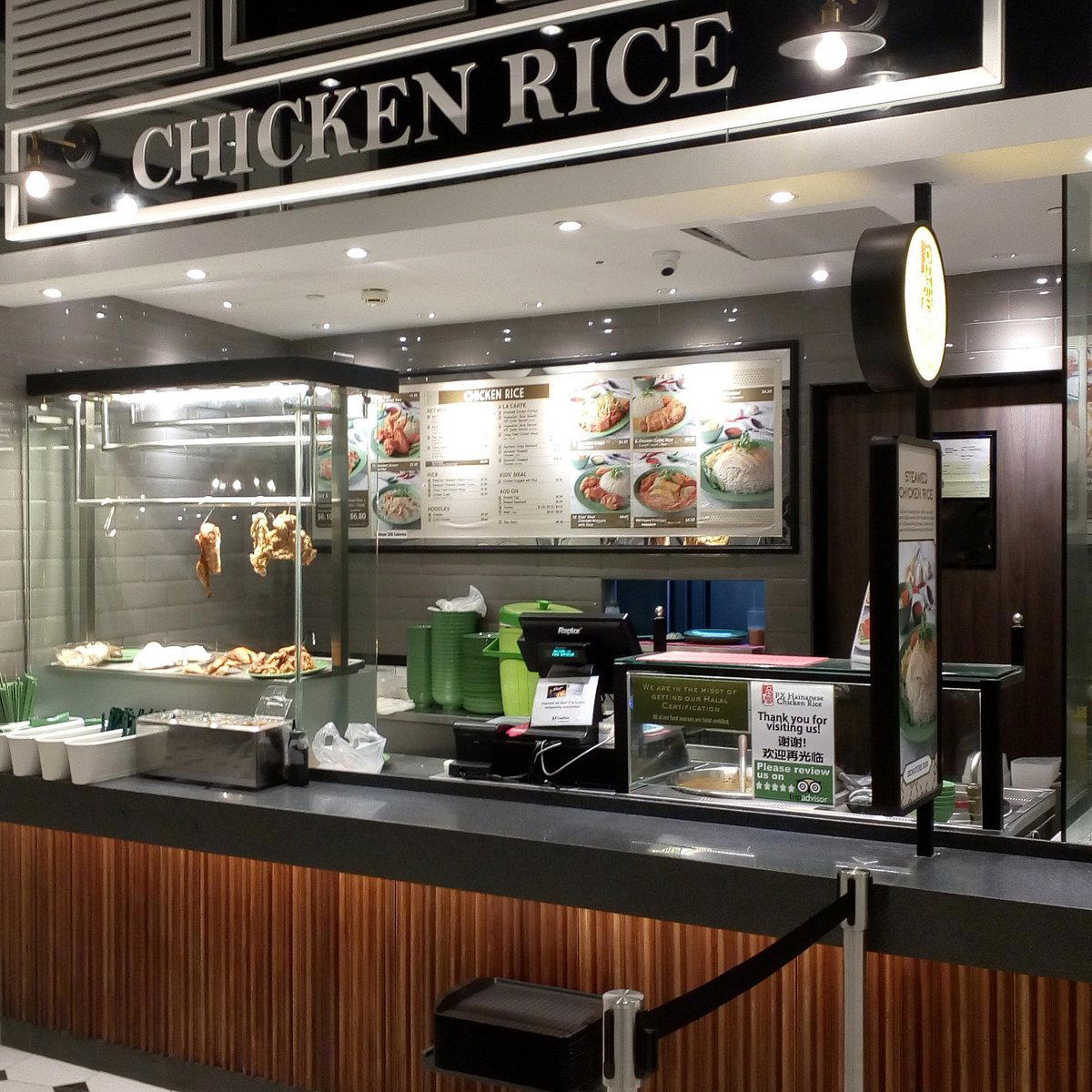
Chicken Rice at 30,000 Feet Below: What Airport Food Can Still Mean
The food court at Changi Airport Terminal 2 operates in a register most international airports have given up trying to reach. Between flights, with rolling luggage parked against plastic chairs, passengers eat bowls of laksa and plates of char kway teow with the focused attention that serious hawker food demands. Bugis Street Ah Huat Hainanese Chicken Rice occupies a position within that environment that is worth understanding before you dismiss it as convenience dining. Hainanese chicken rice is not a dish you eat because it happens to be available. In Singapore, it is a dish people argue about, return to, and measure against memory.
The physical setting is airport food court standard: bright lighting, trays, communal tables, the ambient noise of rolling cases and departure announcements. None of that changes what arrives on the plate. The discipline of the dish is in its sourcing logic and technique, both of which predate any airport context by several generations. For travellers passing through one of the world's most connected transit hubs, this is one direct point of contact with a Singaporean culinary tradition that has survived precisely because it resists simplification. If you want a broader sense of what the airport dining offer looks like across terminals, our full Changi Airport restaurants guide maps the range.
The Sourcing Logic Behind a Simple Plate
Hainanese chicken rice looks modest. A plate of sliced poached chicken, a mound of rice cooked in chicken stock, a bowl of clear broth, and three dipping sauces: chilli, ginger, and dark soy. The apparent simplicity is a function of the dish's sourcing sensitivity, not its ambition. The quality of the chicken determines everything. Hainanese immigrants who brought the dish to Singapore in the early twentieth century were working with birds of a specific age and feed profile, and the method of poaching at sub-boiling temperatures was developed to preserve the texture of birds that had been raised slowly. A fast-grown commodity chicken produces a fundamentally different result.
The rice carries equal weight in the sourcing equation. Fragrant long-grain rice, typically jasmine, is toasted in rendered chicken fat before being cooked in the poaching stock. The fat comes from the bird. The stock comes from the bird. The dish is, in that sense, a closed loop: every component either is the chicken or is derived from the process of cooking it. This is why practitioners of the dish place so much emphasis on the quality and provenance of their poultry. It is not a dish where a poor-quality protein can be rescued by a strong sauce.
That sourcing logic is what distinguishes chicken rice from other hawker staples and explains why it became one of Singapore's de facto national dishes. Among comparable hawker-tradition rice dishes across Southeast Asia, few are as transparent about the quality of their main ingredient. The chicken has nowhere to hide. Across Singapore, this transparency has sorted chicken rice stalls into tiers that locals navigate by reputation and by queuing time. Vendors worth visiting tend to generate queues that justify themselves. For another chicken rice reference point operating in a different neighbourhood register, KTMW chicken rice tea-cafe in Bedok is worth comparing.
Where This Fits in Singapore's Hawker Tradition
Hawker culture in Singapore was formally recognised by UNESCO in 2020, added to the Representative List of the Intangible Cultural Heritage of Humanity. That recognition was not for any single dish or stall but for the social practice: the communal eating centres, the multigenerational trade, the diversity of dialect-group cuisines coexisting in a shared infrastructure. Hainanese chicken rice sits at the centre of that tradition as one of its most replicated and most contested formats.
The Bugis Street name references one of Singapore's historically significant commercial districts, associated with street markets and hawker activity from the mid-twentieth century. That provenance matters as a positioning signal: it connects the Terminal 2 operation to a specific hawker lineage rather than presenting itself as a generic airport food concept. Singapore's airport dining has long been deliberate about importing credible local food operators, which is why Changi ranks among the few airports globally where eating in the terminal does not require lowering expectations categorically.
For context on where chicken rice sits within Singapore's broader dining range: at the opposite end of the price and format spectrum, restaurants like Les Amis in Singapore operate in a completely different register. The distance between a hawker plate and a fine dining tasting menu in Singapore is not a statement about which matters more; it reflects a food culture where both formats have serious practitioners and serious audiences. Other Singapore spots worth knowing for different meal occasions include Béni in Orchard, Cicheti in Rochor, Etna Restaurant in Outram, Ah Ter Teochew Fishball Noodles in Downtown Core, and Asian Twist by 365 Food in Queenstown. For reference points further afield, Le Bernardin in New York City, Lazy Bear in San Francisco, and Emeril's in New Orleans each represent their own regional traditions at a different scale entirely.
Planning Your Visit
Bugis Street Ah Huat Hainanese Chicken Rice is located in Terminal 2 at Changi Airport, accessible to both departing passengers post-security and, depending on current terminal configuration, to arrivals and meeters in the public areas. No reservation is possible or necessary: this is a walk-up hawker format, and the practical question is timing rather than booking. Airport food courts at Changi operate across extended hours to cover early departures and late arrivals, making this a viable option for travellers on unusual schedules. Pricing sits in the hawker-plate range standard for Singapore airport food courts, making it accessible for families and solo travellers equally. Payment by cashless methods is standard across Changi's dining operations. Carry-on meal planning around a Changi layover is one of the more rewarding exercises in airport transit; chicken rice is a logical anchor for it.
Side-by-Side Snapshot
Comparable venues nearby, for context on price, style, and recognition.
| Venue | Cuisine | Price | Notes |
|---|---|---|---|
| Bugis Street Ah Huat Hainanese Chicken RiceThis venue — the venue you are viewing | Hainanese Chicken Rice | $$ | Not listed |
| Bee Cheng Hiang | Bakkwa Fusion Grillery | $$ | Bendemeer |
| Yum Cha Restaurant | Best Dim Sum in Chinatown | Authentic Cantonese Dim Sum | $$ | CHINATOWN |
| 545 Whampoa Prawn Noodle | Traditional Singapore Prawn Noodles | $ | BALESTIER |
| Minh Jiang at One-north | Sichuan & Cantonese | $$$ | ONE NORTH |
| San Yuan 汕源潮州粿条面 | Traditional Chinese Fishball Noodles | $ | Kallang |
Continue exploring
More in Changi Airport
Restaurants in Changi Airport
Browse all →
Bars in Changi Airport
Browse all →
At a Glance
- Casual Hangout
- Standalone
Casual hawker-style atmosphere typical of quick-service chicken rice stalls.