Forsterbräu sits on Via Goethe in the heart of Bolzano's old town, where the city's German-speaking heritage and Italian sensibility meet most openly. A traditional Südtirol brewery tavern in a city that occupies a genuine cultural borderland, it represents the kind of no-ceremony eating that defines Bolzano's everyday social fabric rather than its fine-dining ambitions.
Pearl is the En Primeur Club membership app — saves, bookings, and concierge access live there. Same editors, same standards.
- Address
- Via Goethe, 6, 39100 Bolzano BZ, Italy
- Phone
- +39471977243
- Website
- forst.it
- Directions
- Get directions
 Saves & bookings on Pearl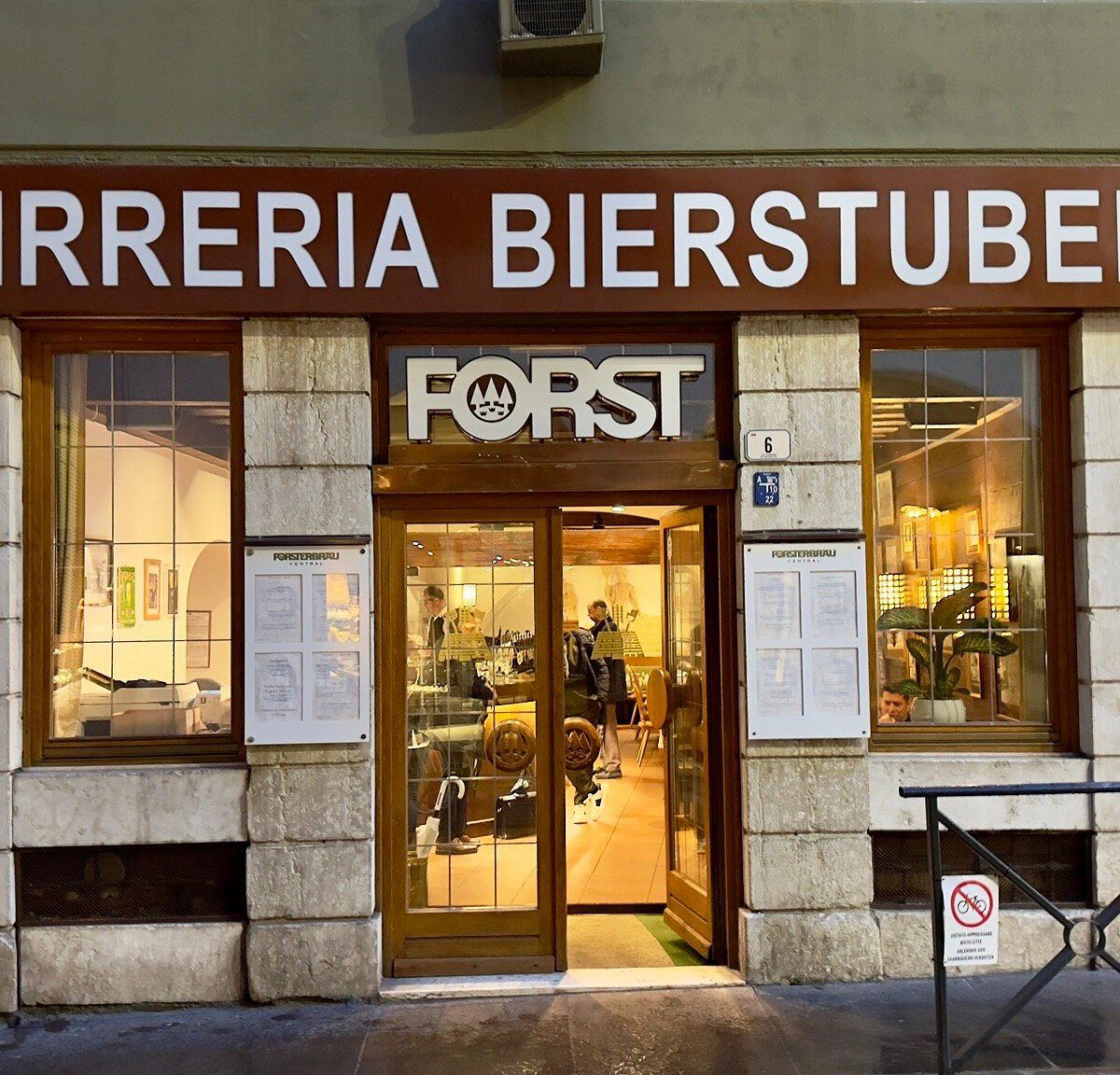
Where the Borderland Drinks
Via Goethe, the narrow artery threading through Bolzano's old town, is named after the German poet who passed through this territory on his Italian journey in 1786, and the address tells you something essential about the city itself. Bolzano is not quite Italian and not quite Austrian; it is a place that absorbed two centuries of shifting sovereignty and produced a food and drink culture that runs on both registers simultaneously. The arcaded streets carry southern warmth in the architecture while the menus announce themselves in German first. Forsterbräu sits directly inside that friction, on a street whose name signals the city's double identity.
In Bolzano's drinking culture, the traditional Brauhaus or brewery tavern occupies a different social role than the enoteca or the aperitivo bar. These are not destination venues calibrated for tourists seeking atmosphere; they are functional institutions where locals move between German-style lager and local Südtiroler wine without much ceremony. The brewery tavern tradition here descends from the South Tyrolean Gasthaus model, where the food exists to accompany the drink and the space is designed for long, unhurried occupation rather than rapid table turns. Forsterbräu is a restaurant in Bolzano serving traditional South Tyrolean and Austrian brewery fare, at Via Goethe, 6, 39100 Bolzano BZ, Italy.
The Old Town Context
Bolzano's historic centre arranges itself around Piazza Walther and the Gothic cathedral, with the covered arcades of Via dei Portici forming the commercial spine. Via Goethe runs parallel to that energy, quieter and more residential in character, which means that eating or drinking there carries a neighbourhood quality that the main piazza does not. The city's dining scene has bifurcated over the past decade: on one side, the fine-dining and modern Alpine cooking that has drawn international attention, partly through proximity to the broader Alto Adige restaurant moment, and on the other, the unpretentious tavern and osteria tier where the city's actual daily life is conducted. Forsterbräu belongs to the latter cohort.
For context on how that bifurcation works in practice: the Alto Adige region has produced some of Italy's most discussed mountain cooking, with Atelier Moessmer Norbert Niederkofler in Brunico representing the apex of the region's fine-dining reach. Bolzano itself contains options across several price registers, from the creative end represented by venues like aLMa9 and Castel Flavon - Haselburg to the mid-tier regional cooking at places like Bogen and Bamboo. The brewery tavern tier, where Forsterbräu sits, is less visible in international travel coverage but more representative of how the city actually functions.
What the Brewery Tavern Format Means
The South Tyrolean brewery tavern format has particular characteristics that distinguish it from both the Viennese Beisl and the Italian trattoria, even though it borrows gestures from each. The emphasis on house beer, the wooden interior conventions, the serving of substantial cold cuts and warm dishes alongside the drink, these are the functional grammar of the form. In cities like Bolzano where the brewing tradition connects directly to a named regional brewery, the house pour carries local identity in a way that a generic tap does not. Forst is among the more established brewery names in the region, and a venue operating under that banner is positioning itself within a specific lineage of South Tyrolean hospitality rather than the broader Italian restaurant tradition.
That positioning matters when you compare it to the other tavern-format options in the city centre. Batzen Häusl is one directly comparable in format and tradition, also operating in the old town with a strong brewery connection. The two venues serve a similar function in the city's social fabric, though they draw slightly different crowds and occupy different architectural settings. Bogen occupies a more modern register within the same general neighbourhood. The comparable set comparison matters because it illustrates how Bolzano has maintained a genuine density of traditional drinking establishments in its centre rather than allowing them to be replaced wholesale by the international café and aperitivo formats that have dominated many comparable Italian cities.
Eating and Drinking in Bolzano's German Quarter
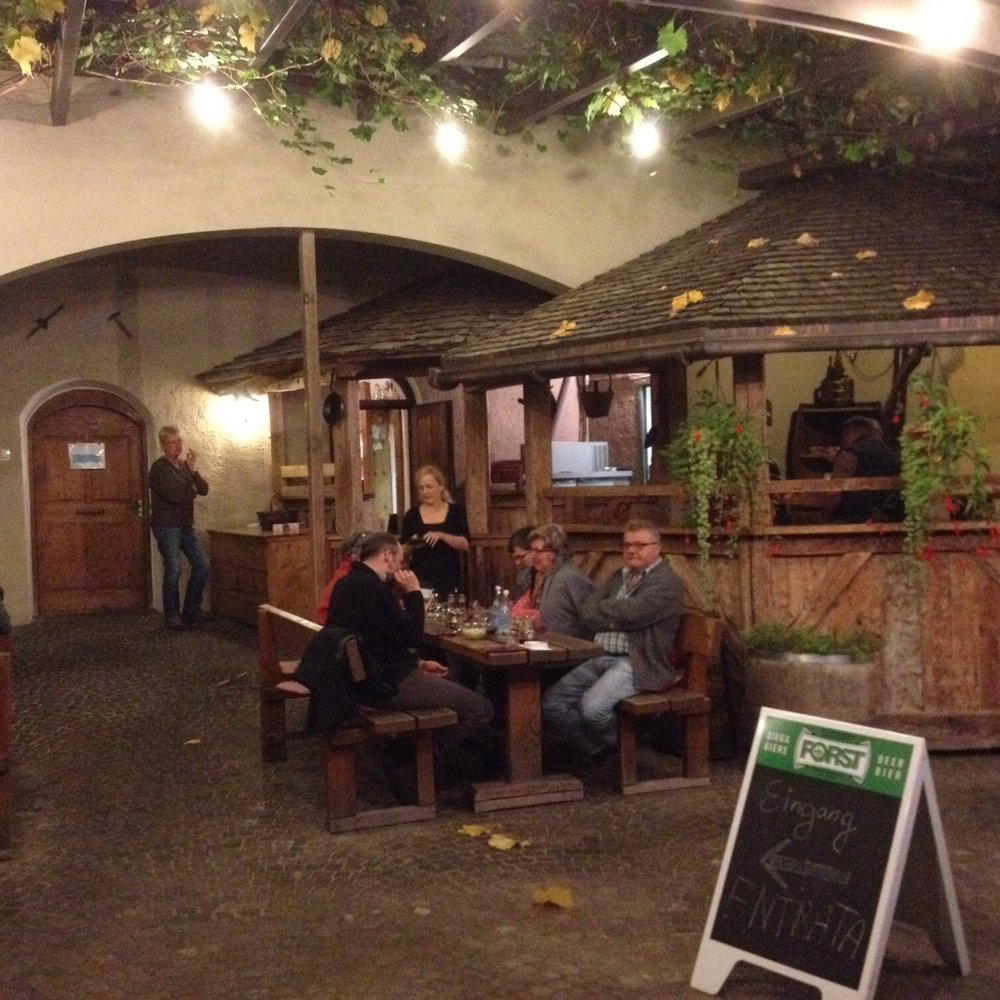
The area around Via Goethe and the old town's northern streets carries one concentrated expression of Bolzano's German-speaking identity. The food that circulates through this neighbourhood reflects that: Speck, Knödel, Schlutzkrapfen, and Gulasch appear alongside the Italian pasta formats that the region has absorbed over decades of cohabitation. Beer is ordered in Mass or half-litre formats that track Bavarian convention more than Italian custom. The spatial logic of the Brauhaus, long communal tables, high ceilings, the smell of malt and wood, creates an atmosphere that makes individual dining feel slightly out of register; these are rooms built for groups and extended occupation.
Visitors arriving in Bolzano for the first time are often surprised by how completely the German-speaking civic identity persists in the old town, despite the city's formal status as an Italian regional capital. The street signage is bilingual, the newspapers at the kiosks run in German, and the social rituals of the drinking establishments follow a Central European rhythm. Forsterbräu on Via Goethe is one of the addresses where that rhythm is clearest.
The contrast with Italy's broader fine-dining geography is instructive. The restaurants that have drawn sustained critical attention in the country, Osteria Francescana in Modena, Enoteca Pinchiorri in Florence, Enrico Bartolini in Milan, Piazza Duomo in Alba, operate in a register defined by tasting menus, significant wine lists, and serious investment per cover. The brewery tavern tradition that Forsterbräu represents is structurally opposed to all of that: the point is accessibility, volume, and civic function rather than destination dining. Both modes are legitimate and serve different needs; the mistake is applying fine-dining evaluation criteria to a venue whose purpose is explicitly communal and casual.
Planning a Visit
Via Goethe 6 places Forsterbräu within easy walking distance of the cathedral and Piazza Walther, making it a natural stop in any circuit of Bolzano's old town. The brewery tavern format suggests an unhurried visit, best suited to a late lunch or early evening drink. Bolzano's old town is compact enough that Forsterbräu can sit alongside visits to Zur Kaiserkron-tier dining or the city's wine bars without requiring much navigation.
The Minimal Set
Comparable venues nearby, for context on price, style, and recognition.
| Venue | Price | Notes |
|---|---|---|
| ForsterbräuThis venue — the venue you are viewing | $$ | Not listed |
| Batzen Häusl | $$ | Bolzano, South Tyrolean Brewpub & German Gasthaus |
| Franziskanerstuben | $$ | historic center, Traditional South Tyrolean / Tyrolean |
| Bogen | $$ | Centre / Old Town, Italian Bistro |
| Meta | $$$ | Piazza Walther, Modern International Fine Dining |
| PICCERÈ | $$ | near historic center, Neapolitan Pizza & Fritti |
Continue exploring
More in Bolzano
Restaurants in Bolzano
Browse all →
Bars in Bolzano
Browse all →
Hotels in Bolzano
Browse all →
At a Glance
- Classic
- Rustic
- Lively
- Casual Hangout
- After Work
- Group Dining
- Standalone
- Beer Program
- Local Sourcing
Current opening hours
- Monday
- 9 AM–1 AM
- Tuesday
- 9 AM–1 AM
- Wednesday
- 9 AM–1 AM
- Thursday
- 9 AM–1 AM
- Friday
- 9 AM–1 AM
- Saturday
- 9 AM–1 AM
- Sunday
- Closed
Hours can change for holidays and private events. Last verified .
Traditional brewery atmosphere in the city center, likely casual and lively, with a focus on regional food and beer.