



One of Melbourne's most enduring Cantonese restaurants, Flower Drum has held a place in the city's serious dining conversation since long before Australian fine dining attracted international attention. The ruby-carpeted dining room on Market Lane trades in ceremony as much as cuisine, with a produce-led menu anchored by tableside Peking duck carving and a wine list that has earned White Star recognition from Star Wine List.
Pearl is the En Primeur Club membership app — saves, bookings, and concierge access live there. Same editors, same standards.
- Address
- 17 Market Ln, Melbourne VIC 3000, Australia
- Phone
- +61 3 9662 3655
- Website
- flowerdrum.melbourne
- Directions
- Get directions
 Saves & bookings on Pearl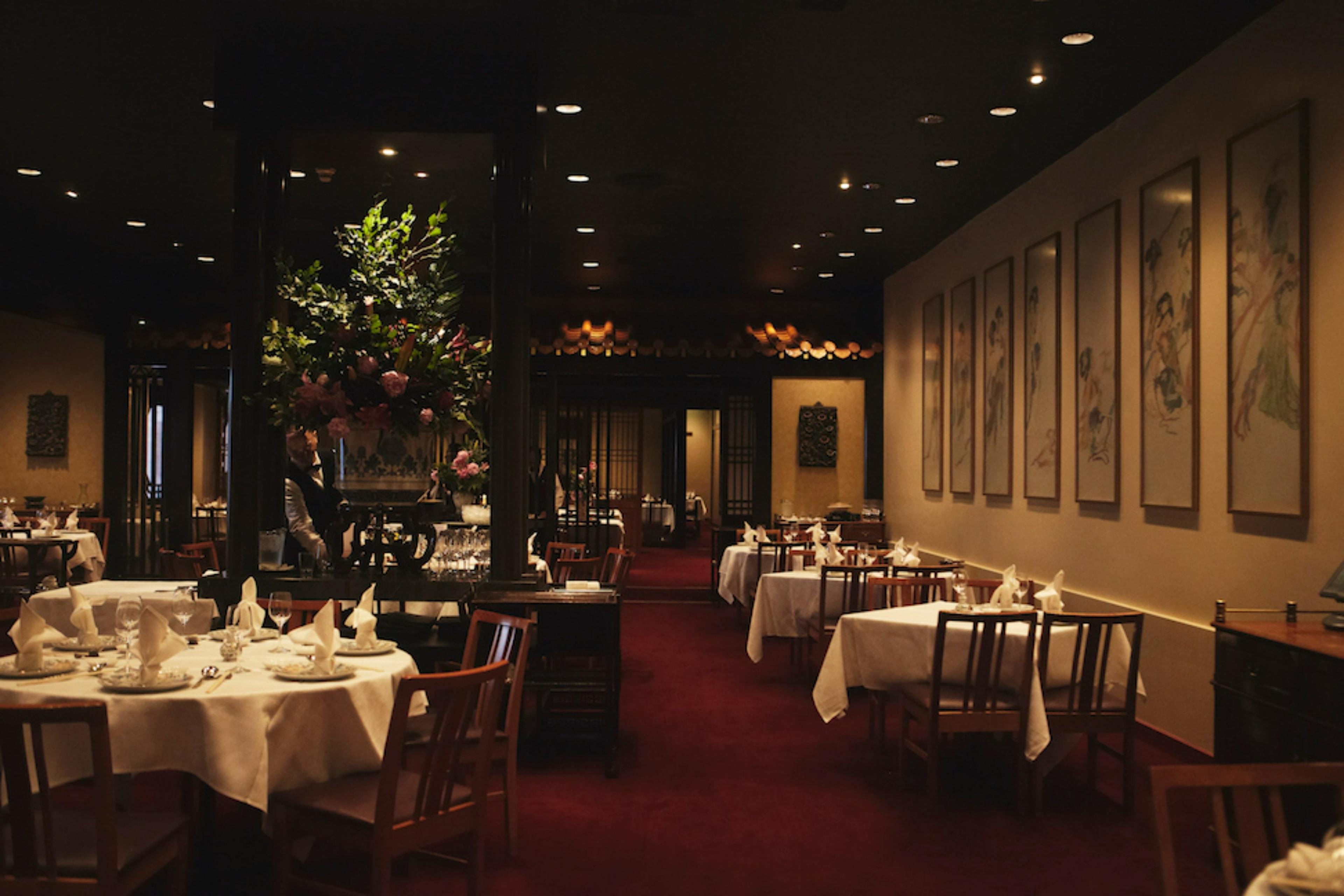
Market Lane and the Weight of Ceremony
There is a particular kind of restaurant that earns its reputation not through reinvention but through discipline. Flower Drum is a Cantonese restaurant at 17 Market Ln, Melbourne VIC 3000, Australia. Melbourne's Chinatown precinct, concentrated along Little Bourke Street and threading into the lanes off Swanston, houses dozens of Cantonese and regional Chinese operations across every price tier. Flower Drum, on Market Lane, occupies a different bracket entirely. The dining room announces this immediately: ruby carpets, panels of Chinese art, and lighting that softens the space without dimming the sense of occasion. Arriving here feels less like entering a restaurant and more like walking into a considered ritual that the city has been performing for decades.
Cantonese cuisine, at its most precise, is a discipline of restraint and quality sourcing. The cooking tradition prizes the natural character of premium ingredients over aggressive seasoning, which places enormous pressure on the supply chain and the kitchen's technical control. Flower Drum operates within this framework, with a menu structured around produce-led sharing plates that allow the quality of individual ingredients to carry the meal. For diners accustomed to the more theatrical end of Melbourne's modern Australian scene, places like Attica or Florentino, Flower Drum offers a different register entirely: quieter, more formal, and calibrated to a tradition that predates Melbourne's current fine dining moment by centuries.
Four Appearances on the World's 50 Best Restaurants List
To understand where the restaurant sits in the wider dining conversation, the historical record is useful. The restaurant appeared on the World's 50 Best Restaurants list four consecutive times between 2002 and 2005, reaching as high as number 20 in 2004. These placements came at a time when Australian restaurants were beginning to register internationally, and the restaurant's presence on that list alongside European and Japanese institutions made a specific argument: that serious Cantonese cooking in Melbourne deserved to be measured against the same standards applied to any fine dining tradition anywhere in the world.
By 2025, the restaurant's recognition sits within a competitive field that now includes a much broader range of Chinese regional cooking across Hong Kong, Shanghai, and Singapore. The Star Wine List White Star designation, awarded in December 2021, reflects the seriousness of the wine program, which is discussed further below.4 across 1,424 reviews suggests that the restaurant's standing with its dining public has remained consistent across the years. For context, peer properties in the city with comparable price positioning and service ambition, venues like Charrd or the more casual end of the Melbourne dining spectrum represented by Chin Chin, occupy entirely different tiers in terms of service philosophy and ceremony.
Tea at the Table: What It Signals About the Kitchen
The editorial angle most illuminating about the restaurant is not the wine list, though it is substantial, but rather what the role of tea at a Cantonese table communicates about the meal's structure and philosophy. Traditional Cantonese dining assigns tea a function that goes well beyond a welcome drink. The choice of tea, and the point at which it is poured and replenished, signals the pacing of the meal and acts as a palate-clearing counterpoint to the richer preparations moving through the kitchen.
In a produce-led Cantonese room where the kitchen is working with premium proteins and careful technique, tea becomes the thread connecting courses rather than wine alone performing that function. Jasmine, pu-erh, and chrysanthemum each interact differently with the flavour compounds in classic Cantonese preparations: the earthiness of pu-erh cuts through fat and richness, while lighter floral teas serve dishes where the ingredient's natural sweetness is the point. A serious Cantonese kitchen treats this pairing relationship with the same attention that a European fine dining kitchen applies to sauce work.
The tableside Peking duck service at the restaurant is one of the more instructive examples of this principle in practice. The duck arrives carved at the table, a format that functions as dinner theatre but also as a technical demonstration. The interaction between a well-chosen tea and the lacquered skin and rendered fat of a properly roasted Peking duck is not incidental. In formal Cantonese dining culture, the tea service is as deliberate a hospitality signal as the tableware or the pace of service, and the restaurant's long-serving staff carry that institutional knowledge in the way they move through the dining room.
The Wine Program and the White Star
The Star Wine List White Star recognition places the restaurant in a distinct category among Melbourne's Chinese restaurants, where wine programs vary considerably in depth and curation. The award signals a list that has been built to complement food, with selection depth, provenance transparency, and service knowledge all factored into the assessment. This matters in the context of a Cantonese menu because the conventional pairing logic applied in French or Italian fine dining does not map directly onto the flavour profiles and textures of Cantonese cooking. Building a wine list that genuinely works across a produce-led Chinese menu requires a different set of decisions than stocking a cellar to accompany European cuisine.
That the restaurant has managed to earn this recognition while maintaining its identity as a Chinese fine dining operation, rather than a fusion format that softens Cantonese flavours toward European wine-friendly profiles, is the more interesting editorial point. The list is curated to complement the course of dishes, which implies structural integration rather than a standalone trophy cellar. For diners who bring serious wine interests to the table alongside serious food interests, this matters. For comparison, the broader Australian fine dining scene, which includes long-form wine programs at venues like Brae in Birregurra and Rockpool in Sydney, treats the wine list as a core editorial statement. The restaurant makes a comparable argument from within a Chinese culinary tradition.
Cantonese Fine Dining Across the Region
The restaurant's historical positioning and current credentials place it in a specific conversation about what Cantonese fine dining looks like outside Hong Kong and mainland China. The tradition it represents has close parallels in venues like 102 House in Shanghai and Chef Tam's Seasons in Macau, both of which operate within the same premium Cantonese register. What distinguishes the Melbourne context is that restaurant has built its reputation in a city where the reference frame for serious dining has historically been European, and where the Cantonese tradition it represents has had to make its case against that default. The World's 50 Best placements from 2002 to 2005 were not just restaurant rankings; they were an argument about what counted as serious cuisine in Australia, and the restaurant made that argument at a time when few Australian Chinese restaurants were positioned to do so.
Under chef Wong Wing-Cheong, the kitchen's approach reflects the Cantonese premise that produce quality is the irreducible foundation. This places the restaurant's sourcing decisions and technical standards under the same scrutiny applied to the premium Australian Modern kitchens it has coexisted with across Melbourne's serious dining tier, including Amaru in Armadale.
Planning a Visit
The restaurant is located at 17 Market Lane in Melbourne's CBD, within the Chinatown precinct and close to the theatre and arts district. The formality of the space and the service style set expectations that differ substantially from the more casual end of Melbourne dining, venues like 48h Pizza e Gnocchi Bar or 400 Gradi in Brunswick East. For those extending their trip interstate, comparable fine dining conversations are happening at Bacchus in Brisbane and Botanic in Adelaide.
Peers You’d Cross-Shop
Comparable venues nearby, for context on price, style, and recognition.
| Venue | Cuisine | Price | Notes |
|---|---|---|---|
| Flower DrumThis venue — the venue you are viewing | Cantonese | Not listed | Not listed |
| Attica | Modern Australian Indigenous Fine Dining | $$$$ | Ripponlea |
| Sama at Grandview Hotel | Modern Lebanese | $$ | Fairfield |
| Sergio’s | Italian Pizza Bistro | $$ | Ashburton |
| Smith & Deli | Modern Vegan Deli | $$ | Collingwood |
| Charrd | Charcoal-Grilled Burgers | $$ | Brunswick East |
Recognition history
Dated appearances from independent guides and award organizations, with the underlying list record or original source where available.
Star Wine List
Star Wine List
Opinionated About Dining Top Restaurants in Asia Ranked #325
Opinionated About Dining
Tatler Listed in Best Restaurants Asia-Pacific
Tatler
World's 50 Best Best Restaurants #33
World's 50 Best
World's 50 Best Best Restaurants #20
World's 50 Best
World's 50 Best Best Restaurants #41
World's 50 Best
World's 50 Best Best Restaurants #27
World's 50 Best
Continue exploring
More in Melbourne
Restaurants in Melbourne
Browse all →
Bars in Melbourne
Browse all →
Hotels in Melbourne
Browse all →
At a Glance
- Elegant
- Classic
- Well Known
- Sophisticated
- Special Occasion
- Business Dinner
- Celebration
- Group Dining
- Date Night
- Private Dining
- Standalone
- Extensive Wine List
Current opening hours
- Monday
- 12–3 PM, 6–11 PM
- Tuesday
- 12–3 PM, 6–11 PM
- Wednesday
- 12–3 PM, 6–11 PM
- Thursday
- 12–3 PM, 6–11 PM
- Friday
- 12–3 PM, 6–11 PM
- Saturday
- 12–3 PM, 6–11 PM
- Sunday
- 6–10:30 PM
Hours can change for holidays and private events. Last verified .
Refined and elegant, with a classic fine-dining atmosphere and attentive, formal service.