Fish house W. Obst
Fish house W. Obst sits at Carlsplatz in Düsseldorf's Altstadt, positioning itself within the city's established seafood dining tradition. The address places it steps from one of Germany's most active open-air markets, where provenance and freshness have long shaped the local appetite for fish. For occasions that call for more than a casual plate, it occupies a middle ground between neighbourhood institution and dedicated seafood house.
Pearl is the En Primeur Club membership app — saves, bookings, and concierge access live there. Same editors, same standards.
- Address
- Carlspl. A1, 40213 Düsseldorf, Germany
- Phone
- +49 211 324401
- Website
- fischhaus-obst.de
- Directions
- Get directions
 Saves & bookings on Pearl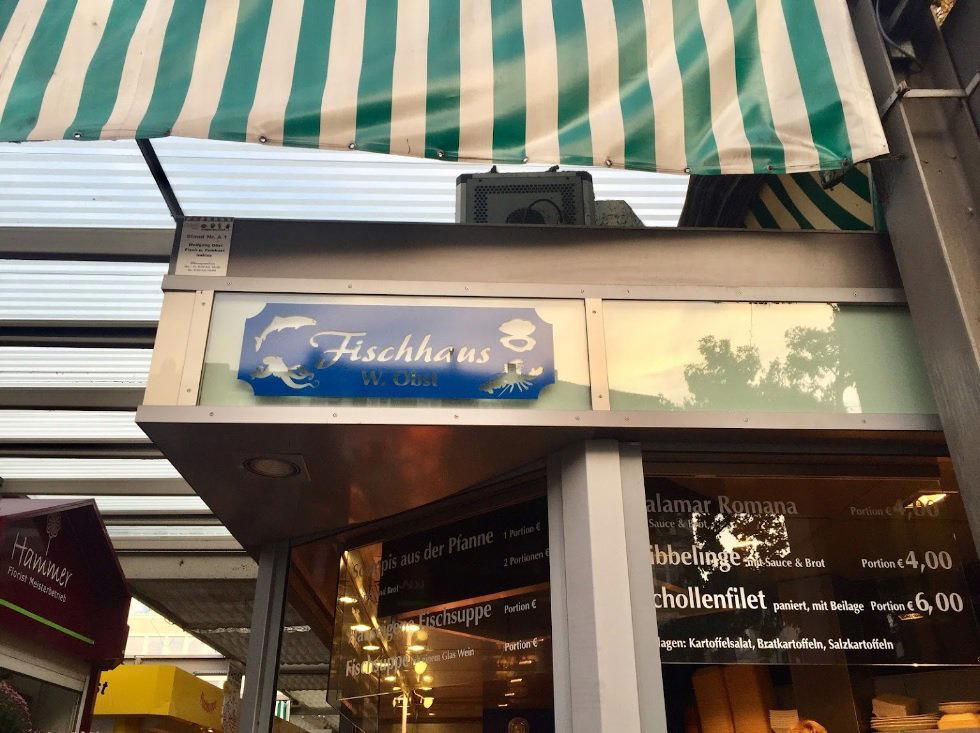
Carlsplatz and the Düsseldorf Seafood Tradition
Düsseldorf's relationship with serious seafood dining has always been shaped by geography rather than coastline. The city sits on the Rhine, not the North Sea, which means its fish restaurants have historically depended on supply chains, market relationships, and the kind of institutional knowledge that takes decades to build. Carlsplatz, the open-air market square in the heart of the Altstadt where Fish house W. Obst is addressed, has been the anchor for that knowledge for well over a century. The market traders who set up here each morning create a context that rewards restaurants willing to work closely with what arrives fresh that day, rather than relying on fixed menus sourced from distant distribution centres.
That market proximity is more than atmospheric detail. In cities like Hamburg or Munich, the top-tier seafood houses sit apart from their supply sources, insulated by logistics and reputation. At Carlsplatz, the physical closeness of producer and plate is part of the offer. Visitors arriving via the U-Bahn Heinrichstraße stop, a short walk from the address at Carlspl. A1, pass the market stalls before they reach the door. The approach sets expectations: this is a dining environment shaped by what the city's traders bring in, not by a static kitchen programme.
Occasion Dining in the Altstadt
The Altstadt is Düsseldorf's most concentrated dining district, running the spectrum from the late-night sausage stands on Bolkerstraße to white-tablecloth addresses that draw guests from across North Rhine-Westphalia. Within that range, a dedicated seafood house occupies a specific niche. Celebrations built around a meaningful meal tend to gravitate toward restaurants with a clear identity, and few identities are as legible as a serious fish house: the menu signals intent, the format signals effort, and the category itself carries associations with coastal tradition and considered sourcing.
For milestone occasions, that clarity of identity matters as much as the food itself. A dinner at a place like Fish house W. Obst communicates something to the guests at the table: that the host has chosen specificity over generality, and a point of view over safe versatility. Across Germany's fine dining circuit, from Schwarzwaldstube in Baiersbronn to Aqua in Wolfsburg, the restaurants that hold long-term authority are almost always defined by category commitment rather than broad appeal. Fish house W. Obst operates within that same logic at a neighbourhood scale.
The Carlsplatz location also gives it a different rhythm from the Altstadt's more tourist-facing addresses. The square draws a local morning crowd, and restaurants in this zone tend to serve a clientele that returns regularly rather than passing through once. That repeat-visitor culture rewards consistency in a way that purely tourist-dependent addresses do not, and it creates a more reliable baseline for special occasion meals where familiarity with quality is part of what guests are paying for.
Where It Sits in Düsseldorf's Dining Spectrum
Düsseldorf's restaurant scene has diversified considerably over the past decade. The city's Japanese community, centred around Immermannstraße, supports one of Europe's most concentrated clusters of authentic Japanese restaurants, which has created sophisticated demand for precision sourcing across other categories. That broader culture of provenance-consciousness has raised the floor for what serious diners expect from any restaurant in the city, including seafood houses.
Fish house W. Obst sits in a different competitive set from the city's Japanese-influenced fish bars or its contemporary European fine dining rooms. Its address at Carlsplatz places it alongside the kind of institutional Düsseldorf hospitality that predates the current wave of concept-led openings. That positioning carries weight with a particular guest profile: those who want the authority of an established address rather than the novelty of a recent launch. For a comparison of the wider Düsseldorf offer, the full Düsseldorf restaurants guide maps the city's current dining range across neighbourhoods and categories.
At the other end of the city's casual register, addresses like Alanya Döner and 3h's burger & chicken serve an entirely different occasion function. For wine-led evenings or cheese-focused gatherings, Amuni Wein- und Käsebar occupies the specialist bar tier. Mediterranean options around the Altstadt, including Anfora and Arca Alacati, cover the warmer-register end of the market. A dedicated seafood house at Carlsplatz addresses a gap in that range: the occasion-ready, category-specific dinner that the other addresses do not attempt.
Germany's Seafood Fine Dining Context
At the top of Germany's seafood-focused dining, the benchmark is set by a handful of multi-Michelin-starred addresses. Restaurant Haerlin in Hamburg operates from a grand hotel context with a full fine dining framework, while JAN in Munich and Vendôme in Bergisch Gladbach represent the broader refined European tradition in which seafood appears as part of a wider tasting menu architecture. Further afield, Victor's Fine Dining by Christian Bau in Perl, ES:SENZ in Grassau, Schanz in Piesport, and Waldhotel Sonnora in Dreis represent Germany's deep regional fine dining infrastructure, much of it heavily seafood-influenced at the top of the menu. Internationally, Le Bernardin in New York City remains the reference point for the dedicated fine-dining fish house format, while Lazy Bear in San Francisco and CODA Dessert Dining in Berlin show the range of what specialist-format restaurants can achieve when category commitment drives the entire experience.
Fish house W. Obst does not operate in that Michelin-starred tier, but the broader tradition it draws on, the neighbourhood seafood house with market-adjacent supply and a loyal local clientele, has its own durability. In Düsseldorf, that durability is part of the Carlsplatz identity.
Planning a Visit
The Carlspl. A1 address in Düsseldorf's Altstadt puts Fish house W. Obst within walking distance of the city's central hotel cluster and the U-Bahn network. For groups planning an occasion meal, the market square setting means the area is more active during morning and midday hours, and quieter by evening, which suits a dinner booking. Given the occasion-dining context, booking in advance rather than walking in is the practical approach, particularly on weekends when the Altstadt draws its highest footfall.
Continue exploring
More in Düsseldorf
Restaurants in Düsseldorf
Browse all →
Bars in Düsseldorf
Browse all →
Hotels in Düsseldorf
Browse all →
Wineries in Düsseldorf
Browse all →
At a Glance
- Classic
- Cozy
- Date Night
- Casual Hangout
- Historic Building
- Sustainable Seafood
- Street Scene
Current opening hours
- Monday
- 8:30 AM–4 PM
- Tuesday
- 8:30 AM–5:30 PM
- Wednesday
- 8:30 AM–5:30 PM
- Thursday
- Closed
- Friday
- 8:30 AM–5:30 PM
- Saturday
- 8:30 AM–4 PM
- Sunday
- Closed
Hours can change for holidays and private events. Last verified .
Charming bistro-like atmosphere in a historic building in Düsseldorf's lively Old Town.
Know Before You Go
- Getting there
- Carlspl. A1, 40213 Düsseldorf, Germany