El Glop Gaudí sits on Carrer de València in the Eixample grid, where Barcelona's appetite for honest Catalan cooking meets one of the city's most recognisable addresses. Positioned well below the tasting-menu tier occupied by the likes of Disfrutar or Lasarte, it draws a crowd that wants regional food without the ceremony. The menu reads as a direct argument for tradition over innovation.
Pearl is the En Primeur Club membership app — saves, bookings, and concierge access live there. Same editors, same standards.
- Address
- Carrer de València, 443, Eixample, 08013 Barcelona, Spain
- Phone
- +34 934 87 00 97
- Website
- elglop.com
- Directions
- Get directions
 Saves & bookings on Pearl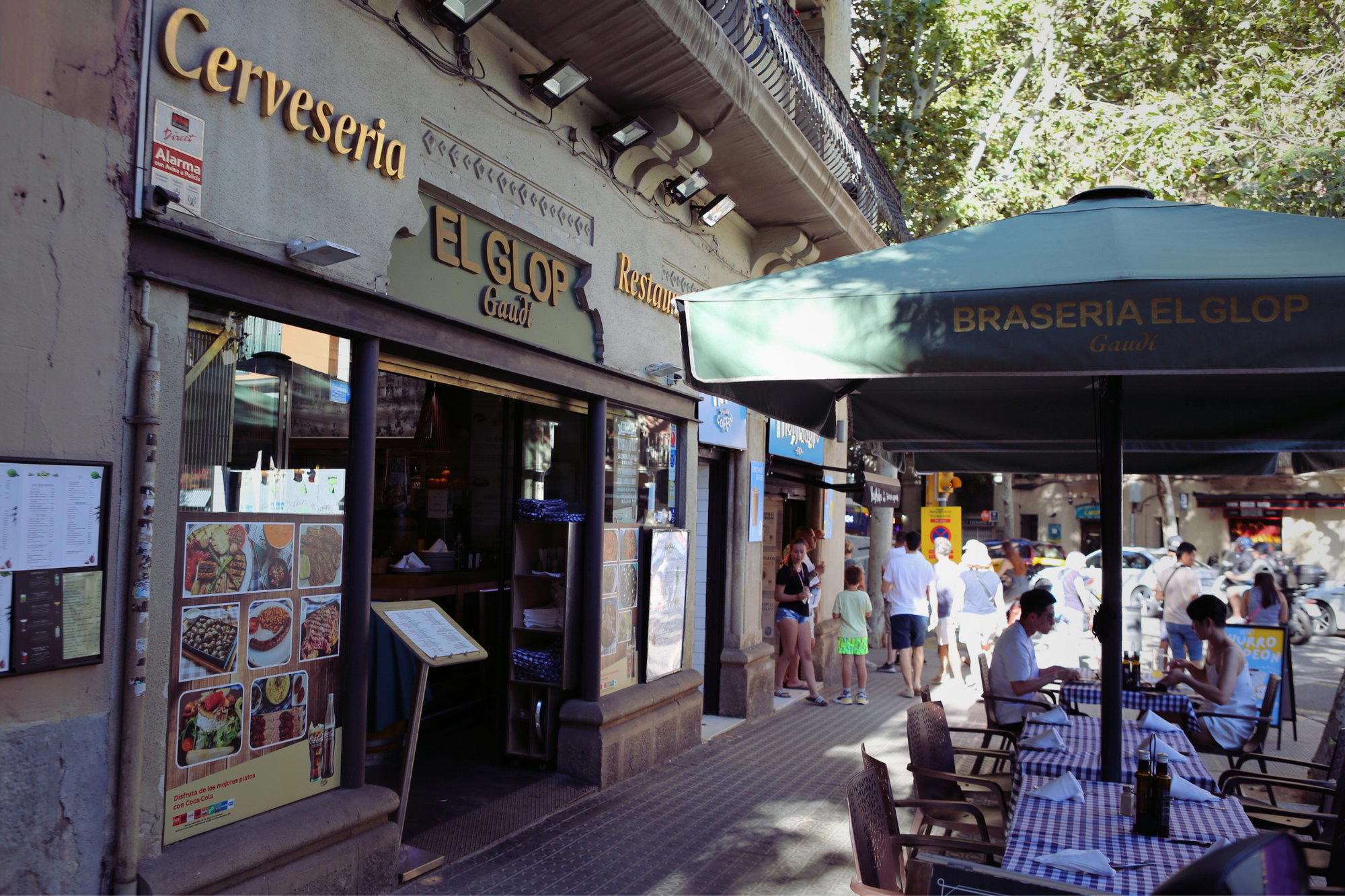
Where the Eixample Grid Meets the Catalan Table
Carrer de València cuts through the Eixample with the geometric confidence of Cerdà's 19th-century urban plan, and the buildings along it shift between modernista facades and the kind of ground-floor commercial space that has housed neighbourhood restaurants for generations. El Glop Gaudí occupies one of those spaces at number 443, a stretch of the street close enough to Sagrada Família to pull tourist footfall but embedded in a residential and commercial block that also serves the people who actually live here. That dual audience shapes the atmosphere before you look at a single dish: this is not a destination address engineered for out-of-towners, nor a strictly local cantina that ignores the wider city.
In Barcelona, the restaurant scene has fractured sharply along lines of ambition and price. At one end sit the multi-Michelin tasting-menu houses: Disfrutar, Cocina Hermanos Torres, ABaC, Lasarte, and Enigma, all operating at the €€€€ tier with fixed formats, advance booking requirements, and a kitchen vocabulary borrowed from the avant-garde tradition that Catalunya helped define. At the other end sit the tapas bars and pinxos spots that line the Born and the Gothic. El Glop Gaudí occupies a middle register that the Eixample does particularly well: a sit-down restaurant with a structured menu, priced accessibly, built around the Catalan canon rather than departures from it.
How the Menu Is Organised, and What That Tells You
The architecture of a menu is one of the clearest signals a restaurant sends about its intentions. Tasting menus at the high end of Barcelona's creative scene, like those at Disfrutar or Enigma, are sequential and fixed: the kitchen controls the pacing, the progression, and the narrative. El Glop Gaudí operates on a different logic. A traditional Catalan à la carte or set-menu structure, where diners select from categories built around starters, mains, and desserts, is a statement of hospitality rather than theatre. It restores agency to the table and positions the kitchen as a craftsperson rather than a storyteller.
This structural choice matters in the context of broader Spanish fine dining. Across Spain, from El Celler de Can Roca in Girona to Mugaritz in Errenteria and Quique Dacosta in Dénia, the prestige tier has largely committed to the chef-directed format. Restaurants that maintain traditional menu structures are making an implicit counter-argument: that the craft of Catalan cooking, with its foundations in escudella, pa amb tomàquet, suquet, and botifarra, does not require a conceptual frame to justify it. The Eixample has a number of such places, and the restaurant is among the more prominent addresses in that category on the eastern side of the district.
The Catalan culinary tradition that a menu like this draws on is specific and geographically anchored. It connects mountain and coast: salt cod preparations, bean stews, seafood with alioli, grilled meats with romesco. These are not simplifications of a more complex cuisine; they are the cuisine. The interest lies in sourcing, timing, and execution rather than transformation. When a kitchen signals this through menu structure, it is asking to be judged on entirely different terms than the creative tasting-menu tier, and that requires a different kind of attention from the diner.
The Eixample Address in Context
The Eixample is Barcelona's most legible neighbourhood for restaurant-hunting: the grid makes addresses easy to find, public transport converges on it from every direction, and the density of options means that a meal here rarely requires more than ten minutes of walking between the pre-dinner drink and the table. Carrer de València runs the full east-west width of the district, and the stretch near Sagrada Família has seen significant visitor traffic increase since the basilica's interior was completed and its attendance numbers grew. For the restaurant, the proximity to that landmark is a locational fact rather than a programming choice, though it does place the restaurant in a position where managing the mix of local and tourist clientele is a daily operational reality.
Compared with Barcelona's other mid-tier Catalan addresses, the Eixample location gives the restaurant advantages in visibility and accessibility that a Born or Barceloneta equivalent would not automatically have. It is also notably removed from the premium creative cluster: Cocina Hermanos Torres and ABaC are not nearby, which means the competitive frame here is not the multi-Michelin tier but rather the broader population of neighbourhood restaurants serving honest regional food across the city.
For context on how this fits within Spain's wider dining map, the distance between the restaurant's register and the country's most decorated kitchens is substantial. Arzak in San Sebastián, Azurmendi in Larrabetzu, Martin Berasategui in Lasarte-Oria, Aponiente in El Puerto de Santa María, DiverXO in Madrid, Ricard Camarena in València, and Atrio in Cáceres all operate in a different tier, both in terms of format and ambition. That distance is not a criticism of the restaurant; it is a clarification of where it sits and what kind of meal it is designed to deliver.
Planning Your Visit
| Venue | Format | Price Tier | Booking Lead Time |
|---|---|---|---|
| The restaurant | Traditional Catalan, à la carte or set menu | Mid-range | Short, often same-week |
| Disfrutar | Fixed tasting menu, creative | €€€€ | Months in advance |
| Lasarte | Tasting menu and à la carte, creative | €€€€ | Several weeks minimum |
| Cocina Hermanos Torres | Tasting menu, creative | €€€€ | Several weeks minimum |
Le Bernardin and Lazy Bear in San Francisco occupy different positions within their own city's restaurant spectrum, illustrating how format choices always signal intent.
The Minimal Set
Comparable venues nearby, for context on price, style, and recognition.
| Venue | Cuisine | Price | Notes |
|---|---|---|---|
| El Glop GaudíThis venue — the venue you are viewing | la Sagrada Familia, Traditional Catalan | $$ | Not listed |
| Maysi Restaurant Barcelona | Not listed | $$ | l'Antiga Esquerra de l'Eixample, Mediterranean & Spanish Cuisine |
| Tramendu El caliu de la brasa | la Bordeta, Traditional Catalan Grill | $$ | Not listed |
| Can Martí Restaurant | Not listed | $$ | Vallvidrera, el Tibidabo i les Planes, Traditional Catalan Grill |
| La Taberna De La Ronda | Not listed | $$ | la Dreta de l'Eixample, Authentic Spanish Tapas & Paella |
| Tapes La Bona Sort | Not listed | $$ | Sant Pere, Santa Caterina i la Ribera, Modern Catalan Tapas |
Continue exploring
More in Barcelona
Restaurants in Barcelona
Browse all →
Bars in Barcelona
Browse all →
Hotels in Barcelona
Browse all →

At a Glance
- Cozy
- Classic
- Rustic
- Group Dining
- Casual Hangout
- Family
- Historic Building
- Street Scene
Current opening hours
- Monday
- 8 AM–12 AM
- Tuesday
- 8 AM–12 AM
- Wednesday
- 8 AM–12 AM
- Thursday
- 8 AM–12 AM
- Friday
- 8 AM–12 AM
- Saturday
- 12 PM–12 AM
- Sunday
- 12 PM–12 AM
Hours can change for holidays and private events. Last verified .
Cozy and charming with a laid-back, authentic local vibe across multiple rooms.