Eisenberg's Sandwich Shop
Eisenberg's Sandwich Shop at 174 Fifth Avenue has occupied the same Flatiron address since 1929, making it one of New York City's longest-running lunch counters. The narrow room, original soda fountain, and spinning stools tell the story of a dining format that Manhattan's fine-dining surge never displaced. For anyone tracking what the city actually ate for most of the twentieth century, this is primary source material.
Pearl is the En Primeur Club membership app — saves, bookings, and concierge access live there. Same editors, same standards.
- Address
- 174 5th Ave, New York, NY 10010
- Website
- eisenbergssandwichshop.shop
- Directions
- Get directions
 Saves & bookings on Pearl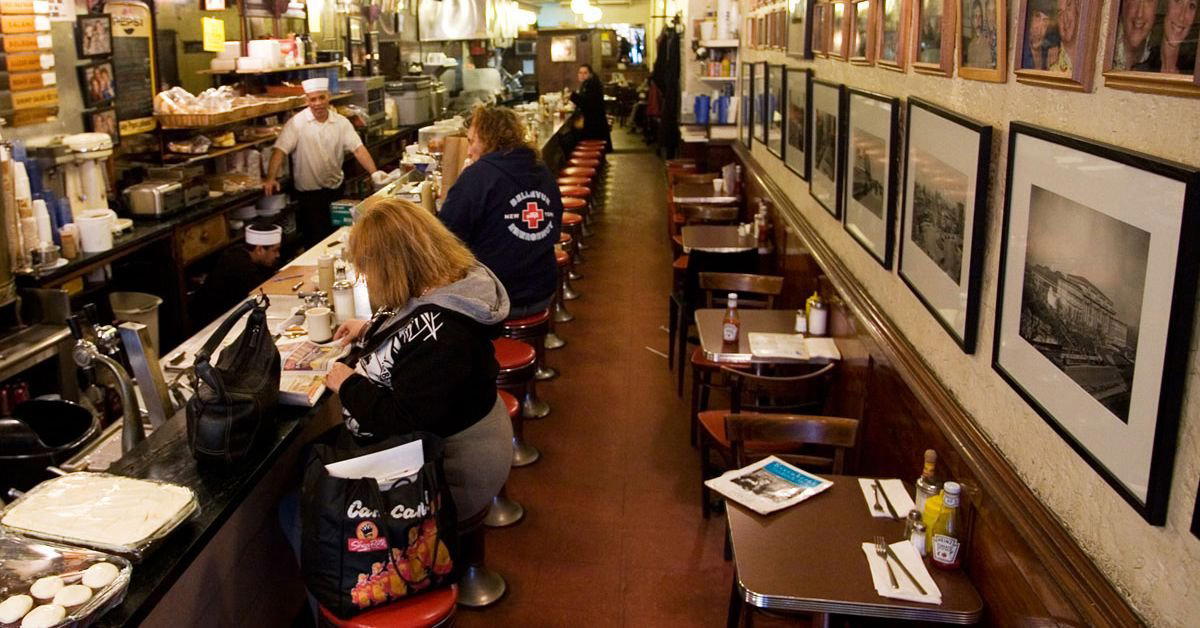
A Counter That Predates the City Around It
Fifth Avenue in the Flatiron district reads today as a corridor of tech offices, co-working spaces, and ground-floor retail that turns over every few years. Against that backdrop, Eisenberg's Sandwich Shop at 174 Fifth Avenue operates as something closer to a geological record than a restaurant. The shop has served New York City since 1929, which means it predates the Second World War, the interstate highway system, and every major wave of New York dining fashion from nouvelle cuisine to farm-to-table. The physical room has not kept pace with those fashions, and that is entirely the point.
New York's lunch counter tradition belongs to a specific mid-century urban typology: narrow storefronts, counter seating along one wall, a short menu built around sandwiches and egg preparations, and a pace calibrated to the office worker's thirty-minute break. That format was once standard across Midtown and Lower Manhattan. Most of it is gone. The real estate economics of the past two decades have replaced the genre with fast-casual chains and delivery-only ghost kitchens. Eisenberg's survival at the same address across nearly a century makes it an almost documentary example of what the format looked like before it disappeared.
The Physical Room as the Argument
The interior design at Eisenberg's is not a restoration or a heritage-themed retrofit. It is simply the original room, aged in place. The counter runs the length of the narrow space, with spinning stools that have the slight wobble of furniture that has absorbed decades of daily use. The soda fountain equipment visible behind the counter belongs to the same era as the building's signage. Pendant lighting, tiled floors, and a menu board rendered in the kind of hand-lettered style that predates digital signage collectively produce an environment that would require considerable effort and expense to reproduce accurately in a new venue.
This matters editorially because New York's dining scene has spent considerable energy over the past decade trying to simulate exactly this kind of patina. Restaurants across the city have invested in distressed finishes, reclaimed materials, and vintage serviceware to suggest a rootedness they cannot actually claim. Eisenberg's does not simulate anything. The wear on the counter, the fixtures, and the layout represent actual time, and experienced diners read the difference. In the same city where Eleven Madison Park operates at the opposite end of the price and formality spectrum, and where Le Bernardin has held its position as a benchmark for French seafood, Eisenberg's occupies a different axis entirely: it earns its authority through duration rather than decoration.
What the Format Represents in the Current City
The lunch counter as a dining category has largely split into two surviving forms in American cities. The first is the diner, which scaled up in physical size and menu length, often suburbanizing in the process. The second is the specialty counter, which narrowed its focus and moved upmarket, surfacing in the form of omakase bars, raw bars, and chef's counter formats at places like Masa or Atomix. The mid-century working lunch counter, which was neither a diner nor a fine-dining destination but something specifically urban and specifically functional, has few living representatives.
That context places Eisenberg's in a comparable set that is defined more by absence than competition. The relevant comparison is not to Per Se or to the tasting-menu formats that now dominate fine-dining coverage. Dining formats that survive this long without substantive change are studied by food historians as much as reviewed by critics, and Eisenberg's has been the subject of both. For our full context on where this fits within the city's broader dining picture, see our New York City restaurants guide.
Eisenberg's sits apart from contemporary formats, which is what makes it worth discussing separately.
The Sandwich as the Primary Text
The menu at Eisenberg's is built around sandwiches and diner staples rather than seasonal tasting formats. In a city where menus at Blue Hill at Stone Barns rotate around what the farm produces each week, and where destination dining at properties like The French Laundry, Single Thread Farm, or Providence is framed through elaborate multi-course structures, a short, stable menu of sandwiches reads as a deliberate counter-argument. The format is not a failure of ambition. It is a different set of values entirely: speed, familiarity, and consistency over novelty.
The tuna melt and egg salad sandwich are the orders that recur most consistently in public accounts of the shop. These are not dishes that require introduction or explanation. They belong to a category of food that New Yorkers of a certain generation ate at counters like this one throughout the middle of the century, and the ability to order them in a room that looks more or less as it did then carries a value that sits outside conventional quality metrics. Venues like Addison in San Diego, Frasca Food and Wine in Boulder, or The Inn at Little Washington are evaluated against a different set of ambitions, and the comparison is not instructive in either direction.
Know Before You Go
- Address: 174 Fifth Avenue, New York, NY 10010 (Flatiron district)
- Format: Counter-service lunch spot with stool seating; not a table-service restaurant
- Booking: Walk-in only; no reservations taken
- Pace: The room operates at lunch-counter speed, expect fast turnover and a working atmosphere, particularly at midday
- Children: The counter format and stool seating are manageable for older children; the environment is casual and informal, with no dress expectations
- Price tier: About $15 per person; casual, walk-in friendly
Reputation Context
Comparable venues nearby, for context on price, style, and recognition.
| Venue | Cuisine | Price | Notes |
|---|---|---|---|
| Eisenberg's Sandwich ShopThis venue — the venue you are viewing | Classic New York Deli | $$ | Not listed |
| The Cannibal Beer & Butcher | New American Gastropub | $$ | Murray Hill |
| MUD | American Cafe with Coffee and Brunch | $$ | East Village |
| Hill and Bay | American Comfort Brasserie | $$ | Murray Hill-Kips Bay |
| Beatnic Vegan Restaurant - West Village | Vegan Fast Casual | $$ | Greenwich Village |
| Cafe Skye | Polished American Bar Food | $$ | Lower East Side |
Continue exploring
More in New York City
Restaurants in New York City
Browse all →
Bars in New York City
Browse all →
Hotels in New York City
Browse all →




At a Glance
- Classic
- Well Known
- Casual
- Casual Hangout
- Solo
- Historic Building
Current opening hours
- Monday
- 8 AM–5 PM
- Tuesday
- 8 AM–5 PM
- Wednesday
- 8 AM–5 PM
- Thursday
- 8 AM–5 PM
- Friday
- 8 AM–5 PM
- Saturday
- 9 AM–5 PM
- Sunday
- 9 AM–5 PM
Hours can change for holidays and private events. Last verified .
Old-school lunch counter atmosphere with vintage charm and nostalgic New York character; casual, bustling environment where generations have gathered.