Distrito Burger operates out of Arganzuela, one of Madrid's more grounded working-class districts, where the burger format has been refined through the same precision-led thinking that defines the city's broader culinary shift. It sits at the intersection of global technique and local sensibility, offering an alternative entry point to Madrid's serious food culture without the formality of the city's tasting-menu circuit.
Pearl is the En Primeur Club membership app — saves, bookings, and concierge access live there. Same editors, same standards.
- Address
- C. del Ferrocarril, 32, Arganzuela, 28045 Madrid, Spain
- Phone
- +34910604143
- Website
- distritoburger.com
- Directions
- Get directions
 Saves & bookings on Pearl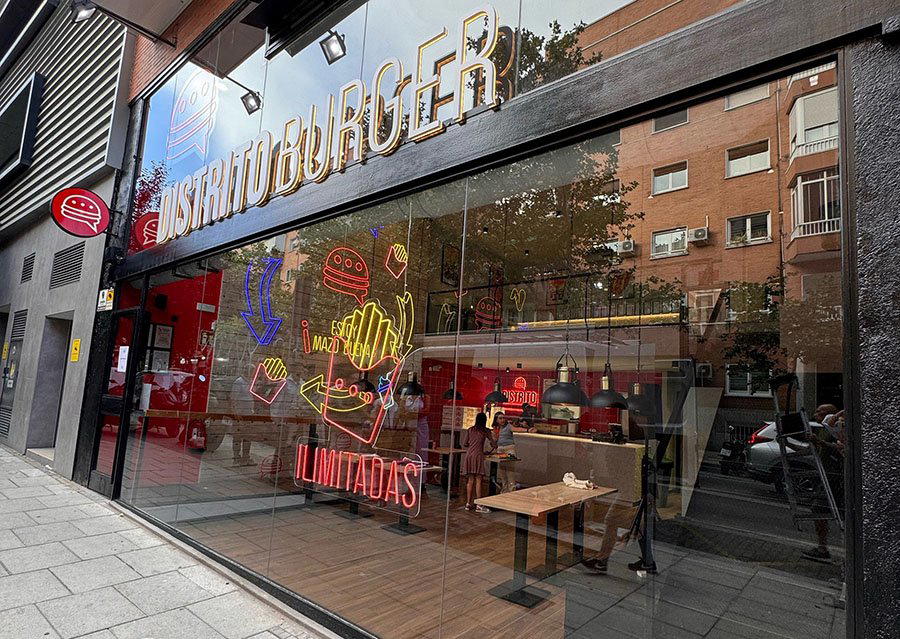
Arganzuela's Approach to the Burger
Distrito Burger is a casual American gourmet burger restaurant in Arganzuela, Madrid, at C. Madrid's food culture has spent the past decade pulling in two directions at once. At one end, the city has consolidated a cluster of multi-Michelin-starred kitchens, from the progressive Asian-inflected tasting menus of DiverXO to the technically rigorous Spanish creativity of Coque and DSTAgE. At the other, a quieter movement has been applying the same standards of sourcing and construction to formats that don't require a reservation booked months in advance or a jacket at the table. Distrito Burger belongs to that second current, positioned in Arganzuela, a district south of the city centre more associated with rail infrastructure than restaurant culture.
That address is part of the point. The burger format, as it has evolved across European cities serious about food, is no longer a concession to informality, it is a test of ingredient discipline. When you strip a dish to its components (meat quality, fat ratio, bun structure, condiment balance), there is nowhere to hide behind a complex sauce or a theatrically plated garnish. The kitchens that have taken the burger seriously in recent years have done so precisely because the format demands honesty.
Local Ingredients, Global Construction Logic
Spain's beef tradition is not primarily defined by burger culture, but the raw material is there. The Iberian peninsula produces some of Europe's most characterful cattle, and the logic of applying precision grinding, controlled fat blending, and careful temperature management to Spanish beef follows naturally from what serious food professionals across the country have been doing to other formats for years. The same rigor that Aponiente brings to marine protein or that Ricard Camarena applies to Valencian produce finds a lower-register expression in the burger kitchens that have opened across Madrid's less tourist-facing neighbourhoods.
The editorial angle that frames Distrito Burger most accurately is not nostalgia for American diner culture but rather the intersection of imported construction methods and local product sourcing. That intersection has been productive across Spanish gastronomy more broadly: Mugaritz in the Basque Country and El Celler de Can Roca in Girona both built their identities partly on applying technique absorbed from French tradition to Iberian ingredients. The burger is simply a more democratic format in which the same logic operates.
For readers who want to trace the full spectrum of what Spain's food culture is doing right now, from the experimental end of Quique Dacosta in Dénia or Martin Berasategui in Lasarte-Oria to the focused informality of Arganzuela, there is a coherent story in all of it. The commitment to product quality doesn't switch off when the format changes.
Arganzuela as a Dining District
The Arganzuela district occupies the southern edge of central Madrid, bounded by the Manzanares river corridor to the west and the railway approaches to Atocha to the east. It is not a neighbourhood that appears in most city food guides, which tend to cluster recommendations around Malasaña, Chueca, and the streets around the Prado. That relative absence from the editorial circuit has kept Arganzuela's food scene genuinely local in character, oriented toward residents rather than visitors.
The address on Calle del Ferrocarril reflects that context. The street name translates directly as Railway Street, and the neighbourhood's identity still carries the functional, working character of its industrial past. For food operators, this kind of location often enables a focus on what comes out of the kitchen rather than on the room itself. Rents in areas like Arganzuela have historically allowed kitchens to concentrate resources on product rather than décor, which tends to suit concept-led formats like serious burger operations.
Madrid's broader restaurant geography rewards readers who are willing to move beyond the tourist circuit. The same principle that makes Paco Roncero and Deessa worth the effort of navigating their respective formats applies here at a different price point and register.
How Distrito Burger Sits in a Wider European Context
The serious burger as a category has evolved differently across European cities. In London, it moved through a craft-burger phase in the early 2010s and has since stratified into fast-casual chains and a smaller number of product-focused independents. In Paris, the format acquired its own culinary self-consciousness relatively late but has since produced operations that treat the grind and the bake with the same attention given to a bistro's main course. Madrid has followed its own timeline, with the burger format emerging as a serious proposition more recently and largely in neighbourhoods off the main tourist axis.
The comparison with cities outside Spain is also instructive. Operations like Lazy Bear in San Francisco, while operating at a different price tier and formality level, represent the same underlying logic: a technically ambitious kitchen applying fine-dining construction thinking to a format that doesn't require it. The gap between those two poles is where the restaurant operates. It is not attempting to be a fine-dining experience, but it operates in a cultural context where fine-dining standards of sourcing and precision have become reference points even for informal formats. Le Bernardin in New York and the Spanish three-star cohort represent one end of the seriousness spectrum; the better Madrid burger operations represent a different point on the same line.
Spain's multi-star restaurants, including Azurmendi, Arzak, and Cocina Hermanos Torres, and Atrio in Cáceres, collectively define a national culinary standard that filters into every tier of the country's food culture. That standard is part of why the better informal operations in Madrid are worth attention.
Planning Your Visit
| Venue | Category | Price Tier | Booking Lead Time | Format |
|---|---|---|---|---|
| The restaurant | Burger / Informal | €-€€ (est.) | Walk-in friendly | Casual, counter or table |
| DiverXO | Progressive-Asian, Creative | €€€€ | Months in advance | Tasting menu |
| Coque | Spanish, Creative | €€€€ | Weeks in advance | Tasting menu |
| Paco Roncero | Creative | €€€€ | Weeks in advance | Tasting menu |
| Smoked Room | Progressive Asador | €€€€ | Weeks in advance | Counter / tasting |
The restaurant is located at C. del Ferrocarril, 32, in the Arganzuela district of Madrid (28045).
Standing Among Peers
Comparable venues nearby, for context on price, style, and recognition.
| Venue | Cuisine | Price | Notes |
|---|---|---|---|
| Distrito BurgerThis venue — the venue you are viewing | American Gourmet Burgers | $$ | Not listed |
| Alfredo's Barbacoa | American Barbecue & Burgers | $$ | Recoletos |
| Muy Burgmet | Burgers | $$ | Prosperidad |
| PORNEAT Daroca | Smash Burgers | $$ | Ventas |
| Cesar's burgers | Modern American Smash Burgers | $ | Atocha |
| Galipán Cuatro Caminos | Venezuelan-Style Hot Dogs | $$$ | Bellas Vistas |
At a Glance
- Lively
- Trendy
- Casual
- Casual Hangout
- Group Dining
- After Work
- Late Night
- Open Kitchen
Current opening hours
- Monday
- 1–11 PM
- Tuesday
- 1–11 PM
- Wednesday
- 1–11 PM
- Thursday
- 1–11:30 PM
- Friday
- 1–11:30 PM
- Saturday
- 1–11:30 PM
- Sunday
- 1–11 PM
Hours can change for holidays and private events. Last verified .
Casual and energetic atmosphere with friendly staff, welcoming environment ideal for quick meals and social dining.