Damascus Bite
"This is the well-suited way to end the night, say, after clubbing at The Soho House. The kebab is wonderfully moist, the garlic sauce is unlike any other, and the falafel is super fresh. The restaurant is located on Brick Lane and offers comfy seating, and nice homespun Middle-Eastern touches."
Pearl is the En Primeur Club membership app — saves, bookings, and concierge access live there. Same editors, same standards.
- Address
- 119-121 Brick Ln, London E1 6SE, United Kingdom
- Phone
- +44 7380 438370
- Website
- damascusbite.com
- Directions
- Get directions
 Saves & bookings on Pearl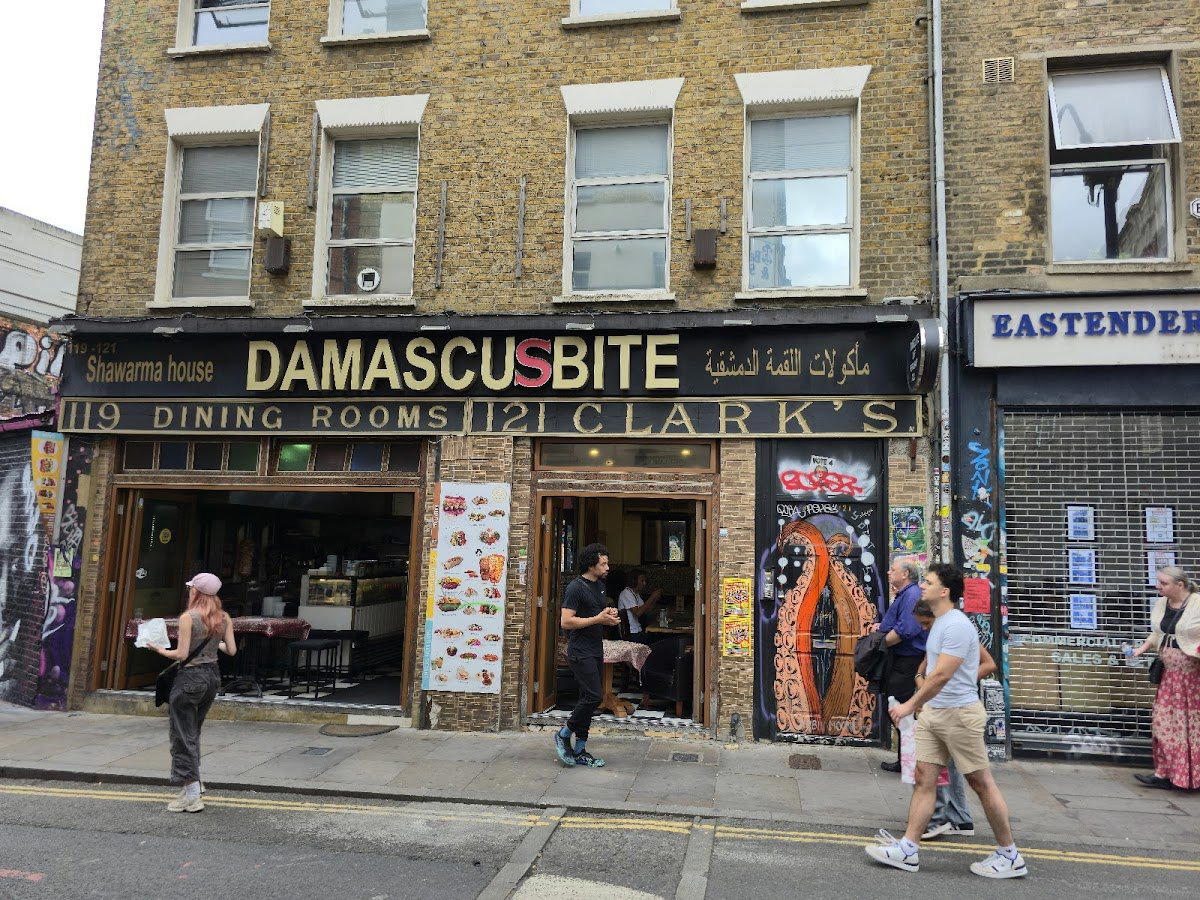
Brick Lane and the Syrian Kitchen
Brick Lane arrives on you in layers. The smell of cumin and charred bread drifts from doorways. The pavement outside the E1 stretch fills early on weekend afternoons, a mix of students, market browsers, and long-time East End residents who treat this corridor as a reliable Saturday routine. Within that context, Damascus Bite at 119-121 Brick Lane sits inside a dining tradition that London has historically underserved: the Syrian kitchen, which is not the same thing as generic Middle Eastern cooking and deserves to be treated on its own terms.
Syrian cuisine draws from a geography that has shaped it for centuries. Aleppo gives you its pepper, fruity and moderate in heat, used in ways that distinguish a dish from anything Levantine but non-Syrian. Damascus brings the sweet-sour balance, the use of pomegranate molasses, the long-braised lamb cuts that carry fat into acidity. These are not interchangeable reference points. Brick Lane, which built its food identity on Bengali restaurants from the 1970s onwards, has in recent years absorbed a broader range of diaspora kitchens, and Syrian addresses are part of that gradual expansion.
The Brick Lane Context
Understanding where Damascus Bite sits requires understanding what Brick Lane has become. The Bengali restaurants that defined the street for decades have thinned out as the neighbourhood has gentrified eastward into Shoreditch and northward toward Bethnal Green. What replaced them is a less coherent mix: Bangladeshi holdovers, falafel counters, a handful of newer addresses covering Iranian, Turkish, and Syrian food. The market end of the street, near Cheshire Street and Sclater Street, pulls the weekend crowd that fills the pavement; the southern stretch, where Damascus Bite sits, runs quieter and more local.
That quieter register matters for what kind of experience this is. Brick Lane's southern end, closer to Whitechapel Road, does not perform for tourists in the way the market end does. The clientele at this stretch tends toward residents and regular visitors rather than first-timers looking for a selfie-ready experience. For a Syrian kitchen operating in this part of the street, the competitive pressure is different from, say, a restaurant launching in Soho or Fitzrovia. The bar is set by consistent value and familiarity rather than by occasion dining.
London's fine-dining tier, represented by addresses like CORE by Clare Smyth, Restaurant Gordon Ramsay, Sketch, The Lecture Room and Library, The Ledbury, and Dinner by Heston Blumenthal, operates in a different register entirely, with tasting menus, formal service, and price points that place those meals in the occasion category. Damascus Bite occupies a different position in the city's dining spectrum, one that is no less valid: the neighbourhood address where the cooking is the point, not the ceremony around it.
The Syrian Sensory Register
Syrian cooking at its leading works through accumulation of aromatics rather than single dominant flavours. A well-prepared kibbeh carries pine nuts and allspice inside a bulgur shell, the inside braised and yielding against the outer crust. Fattet, a dish rarely seen on London menus, layers fried bread, chickpeas, yoghurt, and sometimes lamb, finishing with pomegranate seeds and toasted nuts. The temperature contrast in fattet, warm chickpeas against cold yoghurt, is a specific pleasure that no amount of description substitutes for. Muhammara, the Aleppan red pepper and walnut paste, has a deeper, more resinous quality than hummus and works well with bread that has real char from a hot oven.
These are the kinds of dishes that define whether a Syrian kitchen is operating from genuine reference points or from a simplified menu designed for unfamiliar audiences. The presence or absence of fattet, the quality of the Aleppo pepper in a spiced dish, the bread temperature: these are the signals to read. London has seen enough Middle Eastern restaurants open and close in the last decade to suggest that the market for Syrian food specifically, as opposed to a pan-Levantine shorthand, is narrower but more loyal once found.
Diaspora Dining and the East End
The East End has always been London's primary point of arrival for new communities and their food cultures. The Bengali restaurants of the 1970s and 1980s were themselves a diaspora kitchen, serving adapted food to a British audience while maintaining a core of authentic technique for community members who knew the difference. Syrian restaurants arriving in East London in the 2010s follow a recognisable pattern: first serving the community, then reaching a broader audience as familiarity with the cuisine grows.
That pattern has played out with Turkish food in Dalston, Iranian food in Olympia and Kensington, and Lebanese food in Edgware Road. Syrian food has not yet reached the same level of city-wide recognition, partly because the Syrian diaspora in London is newer and partly because the cuisine is less well-mapped in the food media. Brick Lane addresses like Damascus Bite exist in the earlier part of that curve, where the audience is self-selecting and the cooking is less likely to be adjusted for a mainstream palate.
For comparison, UK regional dining at the highest level, covered through EP Club's guides to Waterside Inn in Bray, L'Enclume in Cartmel, Moor Hall in Aughton, Gidleigh Park in Chagford, Hand and Flowers in Marlow, hide and fox in Saltwood, Midsummer House in Cambridge, Opheem in Birmingham, Ynyshir Hall in Machynlleth, and Restaurant Andrew Fairlie in Auchterarder, operates through entirely different criteria: formal recognition, sourcing provenance, long tasting menus. Internationally, addresses like Le Bernardin in New York City and Lazy Bear in San Francisco anchor their respective city narratives through format and critical recognition. The restaurant's value is measured by different means: consistency, authenticity of reference, and fit with a specific neighbourhood and community.
Planning a Visit
The restaurant is at 119-121 Brick Lane, London E1 6SE, a few minutes walk from Shoreditch High Street Overground or Aldgate East on the District and Hammersmith and City lines. Brick Lane's market end fills from mid-morning on weekends, so arriving before noon or after 2pm means a less congested approach. The southern end of the street where the restaurant sits runs at lower volume than the market end throughout the day. For the broader London dining picture, EP Club's full London restaurants guide covers the city's range from neighbourhood addresses to fine-dining rooms.
Nearby-ish Comparables
Comparable venues nearby, for context on price, style, and recognition.
| Venue | Cuisine | Price | Notes |
|---|---|---|---|
| Damascus BiteThis venue — the venue you are viewing | Authentic Syrian | $$ | Not listed |
| Hafez | Authentic Persian | $$ | Bayswater |
| Mohsen | Authentic Persian | $$ | South Kensington |
| Byblos Harbour | Authentic Lebanese Brasserie | $$ | Millwall |
| Fait Maison Salon de Thé | Middle Eastern Fusion Salon de Thé | $$ | South Kensington |
| Bergamot Cafe | Modern Persian Café | $$ | White City |
Continue exploring
More in London
Restaurants in London
Browse all →
Bars in London
Browse all →
Hotels in London
Browse all →

At a Glance
- Cozy
- Lively
- Casual Hangout
- Group Dining
- Standalone
Current opening hours
- Monday
- 11 AM–11 PM
- Tuesday
- 11:30 AM–11 PM
- Wednesday
- 11 AM–11:30 PM
- Thursday
- 11 AM–11:30 PM
- Friday
- 11 AM–1:30 PM
- Saturday
- 11 AM–1:30 AM
- Sunday
- 11 AM–12 AM
Hours can change for holidays and private events. Last verified .
Warm, inviting decor reminiscent of the Middle East with a lively atmosphere.