Da Umberto sits on Via Ballarò at the edge of one of Palermo's oldest and most charged market districts, where Sicilian street food tradition and sit-down dining exist in close, productive tension. The address alone signals a particular kind of seriousness about local culinary heritage, placing the restaurant squarely within the cultural and commercial fabric of the Ballarò quarter.
Pearl is the En Primeur Club membership app — saves, bookings, and concierge access live there. Same editors, same standards.
- Address
- V. Ballarò, 2, 90134 Palermo PA, Italy
- Directions
- Get directions
 Saves & bookings on Pearl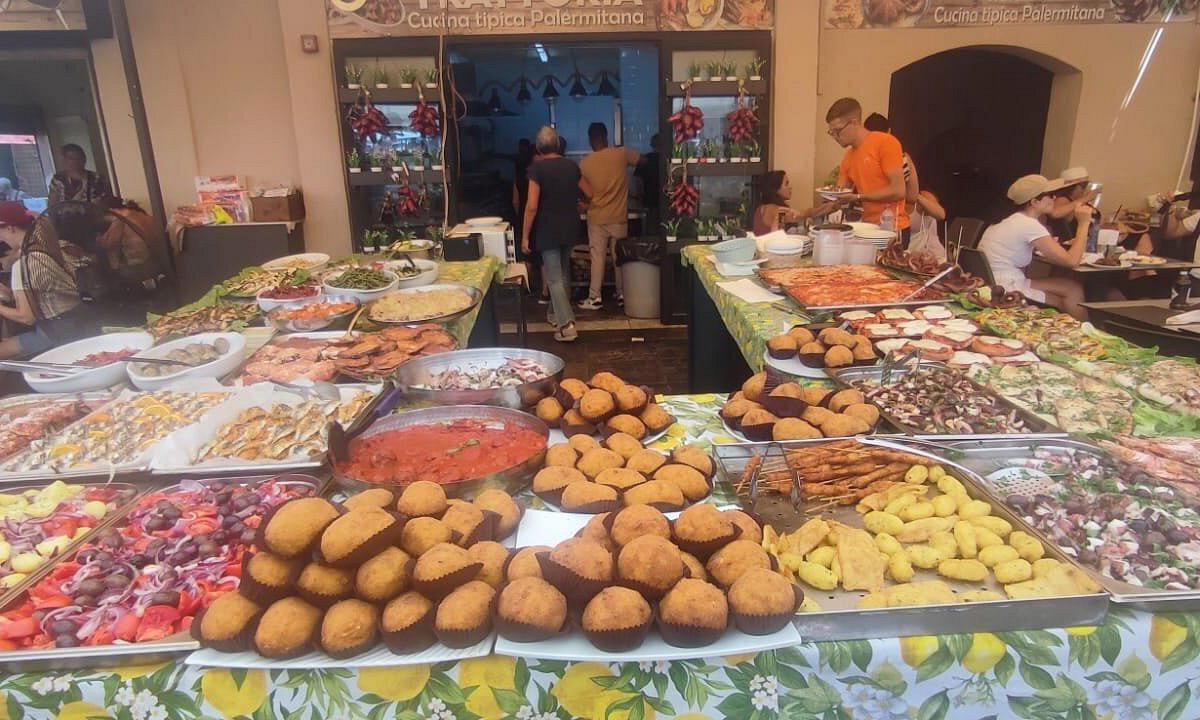
Via Ballarò and What It Means to Eat Here
Palermo's Ballarò market is not a picturesque backdrop. It is one of the oldest continuously operating street markets in the Mediterranean, a dense corridor of vendors, noise, and produce that has shaped the neighbourhood's cooking more than any single kitchen could. Restaurants on or adjacent to Via Ballarò operate inside that context rather than alongside it. The market's logic, its emphasis on seasonal produce, its North African and Arabic inflections carried forward from centuries of trade and occupation, reaches into how the district's cooks think about a dish. Da Umberto sits at number 2, at the edge of this current.
That address is itself an editorial statement about what kind of dining experience is on offer. In cities like Palermo, where the gap between street-level eating and formal restaurant dining has historically been narrower than in northern Italian cities, a restaurant that occupies market-adjacent real estate is implicitly committing to a certain relationship with its ingredients and its neighbourhood. The Ballarò quarter does not reward venues that operate as islands. The restaurants here that endure tend to do so because they are legible to the neighbourhood and not merely imported into it.
Sicilian Cooking at the Street's Edge
Sicilian cuisine is among the more historically complex on the Italian peninsula, a product of Phoenician, Arab, Norman, Spanish, and Greek influence folded into an island geography that produces some of the Mediterranean's most expressive ingredients: pistachios from Bronte, swordfish from the Strait of Messina, capers from Pantelleria, blood oranges from Catania's volcanic plains. Palermo's version of that cuisine skews toward the unrefined and the direct. This is not the refined regional cooking you find at Reale in Castel di Sangro or Piazza Duomo in Alba, where technique and concept carry equal weight to produce. In Palermo's older quarters, the tradition is one of immediacy: food that reflects what the market yielded that morning, prepared with methods that have not required reinvention because they remain effective.
That tradition has shaped a local dining scene that is harder to categorise by conventional tier than cities with cleaner separations between casual and formal eating. Venues like Mec Restaurant, which operates at the higher end of Palermo's Sicilian register, and A' Cuncuma, which takes a more creative approach to local ingredients, represent the ambition side of that spectrum. At the other end, institutions like Antica Focacceria San Francesco and the Ancient Saint Francis Focaccia Shop anchor the street-food tradition that predates the restaurant as a category. Da Umberto occupies the space between these poles: a sit-down address with deep roots in the market district.
The Ballarò Quarter as Dining Context
Understanding where Da Umberto fits requires understanding what Ballarò has become in the past decade. The market and its surrounding streets have attracted a growing number of restaurants and small trattorias as Palermo's profile as a travel destination has risen, partly driven by increased editorial coverage of Sicilian food culture and partly by a broader reappraisal of southern Italian cities. That increased attention has not homogenised the area. The neighbourhood retains enough density and demographic complexity that it has not softened into a tourist-facing version of itself in the way that some Roman or Florentine market districts have.
For the visitor, that means eating in Ballarò still carries some of the friction and reward of eating in a neighbourhood that exists for its own purposes first. It is a different category of experience from the controlled settings of, say, Osteria Francescana in Modena or Le Calandre in Rubano, where the room itself is part of the offering. In Ballarò, the room is less important than what comes out of it.
Italy's Regional Dining Spectrum and Where Palermo Sits
Italy's restaurant culture is often discussed through its northern and central anchors: the three-Michelin-star addresses of Lombardy and Piedmont, the creative laboratories of Emilia-Romagna, the wine-driven dining of Tuscany. Sicily, and Palermo in particular, operates in a different register within that national conversation. The island's cuisine has received formal recognition in isolated cases, with kitchens like Uliassi in Senigallia and Enrico Bartolini in Milan demonstrating what Italian coastal and regional cooking can achieve at its most technically ambitious. But Palermo's contribution to Italian culinary identity has always come more from its market culture and its street-food vocabulary than from its restaurant tier.
That is not a limitation. It is a specific strength. The cooking that emerges from a market district like Ballarò carries a kind of cultural density that purely restaurant-driven food cultures sometimes lack. When a dish arrives in a Palermitan trattoria, there is often a legible line between the ingredient's origin and the preparation, a transparency of sourcing that more formal dining environments sometimes obscure beneath technique. Venues in Palermo's Ballarò area, including the restaurant, benefit from proximity to that supply chain in ways that restaurants in more removed settings cannot replicate.
For reference to what Sicilian cooking looks like when it moves toward a more contemporary frame, AMMODO offers a useful comparison within the city. Beyond Palermo, the broader Italian regional dining conversation includes addresses like Dal Pescatore in Runate and Quattro Passi in Marina del Cantone, which frame what Italian coastal and regional cooking can look like at a different level of formality.
Planning Your Visit
Via Ballarò 2 is walkable from Palermo's historic centre, positioned within the Albergheria district that houses the Ballarò market. The market itself is most active in the mornings, which informs when the neighbourhood has its greatest energy. The restaurant is open Monday, Wednesday through Sunday from 10 AM to 3 PM, and closed Tuesday. Given the neighbourhood's character and the restaurant's market-adjacent position, dress expectations are almost certainly informal. Given the neighbourhood's character and the restaurant's market-adjacent position, dress expectations are almost certainly informal.
Price Lens
Comparable venues nearby, for context on price, style, and recognition.
| Venue | Cuisine | Price | Notes |
|---|---|---|---|
| Da UmbertoThis venue — the venue you are viewing | Ballaro, Sicilian Street Food | $ | Not listed |
| Porta Carbone - Cala | Not listed | $ | Kalsa, Sicilian Street Food - Pani Ca' Meusa |
| Frittola di Ballarò | Not listed | $ | Ballarò, Traditional Sicilian Frittola Street Food |
| AMMODO - La pizza di Daniele Vaccarella | Not listed | $$ | Via Empedocle Restivo, Modern Italian Pizza |
| FUD | Olivella, Sicilian Street Food & Burgers | $$ | Not listed |
| Sapurito Cucina Povera e Pizza | Ristorante tipico Siciliano Palermo centro | Not listed | $$ | Politeama, Traditional Sicilian Cucina Povera and Pizza |
Continue exploring
More in Palermo
Restaurants in Palermo
Browse all →
Bars in Palermo
Browse all →
Hotels in Palermo
Browse all →
Wineries in Palermo
Browse all →
At a Glance
- Lively
- Rustic
- Casual Hangout
- Street Scene
Current opening hours
- Monday
- 10 AM–3 PM
- Tuesday
- Closed
- Wednesday
- 10 AM–3 PM
- Thursday
- 10 AM–3 PM
- Friday
- 10 AM–3 PM
- Saturday
- 10 AM–3 PM
- Sunday
- 10 AM–3 PM
Hours can change for holidays and private events. Last verified .
Busy and noisy market atmosphere with casual street-side seating and a lively, chaotic vibe.