
A 16-seat, counter-only curry specialist in Hommachi, selected for Tabelog Curry WEST “Tabelog 100” in 2023 and 2024. Curry Senmonten Hakugintei Itwu biru ten belongs to Osaka’s practical lunch culture: compact, price-conscious, and built around a single category rather than broad menu theatre.
Pearl is the En Primeur Club membership app — saves, bookings, and concierge access live there. Same editors, same standards.
- Address
- Japan, 〒541-0054 Osaka, Chuo Ward, Minamihonmachi, 3 Chome−6−14 地下2階 Itoh Bldg. B2F
- Phone
- +81 6-6484-5414
- Website
- tabelog.com
 Saves & bookings on Pearl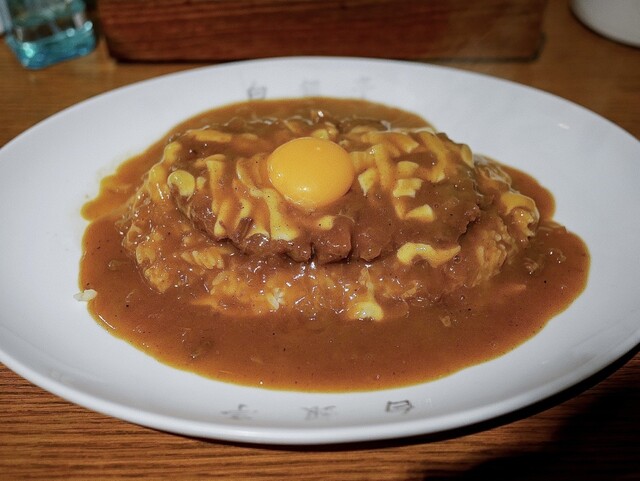
Hommachi is office Osaka before it is sightseeing Osaka: station exits, basement corridors, suit traffic, and lunch decisions made with a hard stop in mind. That setting matters for curry. In this part of Chuo Ward, curry is less about ceremony than precision under pressure, a genre designed for solo diners, short breaks, and repeat habits. Curry Senmonten Hakugintei Itwu biru ten fits that rhythm with a counter-only room in the basement of the Itoh Building, closer in spirit to Osaka’s working-day canteens than to destination dining rooms.
Osaka’s curry culture has its own grammar. It borrows from Japanese curry’s postwar comfort-food base, but the city’s sharper lunch counters often push toward stronger spice, tighter menus, and faster turnover. The point is not breadth. The point is whether a specialist can make one category hold attention across repeat visits. Selection for Tabelog Curry WEST “Tabelog 100” in both 2023 and 2024 places this address inside that more serious regional conversation, alongside curry houses judged by consistency rather than décor or tasting-menu ambition.
Basement curry in Hommachi, built for the business-lunch clock
The geography explains the experience. Hommachi sits between commercial Osaka and the city’s better-known food districts, which gives its lunch rooms a different kind of authority. Namba and Dotonbori trade heavily on spectacle; Hommachi rewards places that work at pace and survive office regulars. A 16-seat counter configuration, split into two short runs of seats, reinforces that compact format. This is a solo or two-person meal, not a lingering group plan.
That distinction is useful for travellers. Osaka’s dining reputation often gets reduced to street food shorthand, yet the city’s everyday strength lies in highly specific formats: curry counters, udon shops, kissaten, pork-bun queues, standing bars, and late-night grills. The counter curry house is part of that ecosystem. It asks less of the diner than kaiseki or omakase, but it also gives less cover to inconsistency. When the room is small and the category narrow, execution has nowhere to hide.
Compared with higher-ticket Japanese dining rooms such as Ajikitcho Bumbuan or performance-led counters such as Teppanyaki WAJO, this is a different Osaka proposition entirely: price restraint, speed, and category focus. Hyakka Koushin Shokudo sits closer in casual-lunch logic, while hotel-adjacent or European-leaning rooms such as Brasserie RÉGINE and La Veduta occupy another register. The useful comparison is not luxury versus budget; it is whether a meal belongs to Osaka’s daily operating system or to its occasion economy. Curry Senmonten Hakugintei Itwu biru ten belongs firmly to the former.
The specialist curry signal, not the broad-menu compromise
The defining idea is specialization. In Japan, “senmonten” signals a shop built around a dedicated category, and curry benefits from that discipline. Generalist restaurants can treat curry as a dependable menu filler; specialist counters are judged on balance, heat, rice, pace, and whether the plate feels calibrated rather than merely filling. The Tabelog Curry WEST recognition matters because it separates category specialists from casual curry listings across western Japan.
There is no chef narrative to lean on here, and that is not a weakness. Osaka has many dining rooms where personality, lineage, or brand story carries the room. Curry counters work differently. The credibility comes through format and repetition: a small seat count, no private-room layer, no broad hospitality script, and a price band that keeps the meal in everyday territory. At this level, the editorial question is practical and demanding: does the place justify being chosen over the many other fast lunches around Hommachi?
The answer depends on what the reader is seeking. For a drawn-out meal, this is the wrong category. For a sharp Osaka lunch that shows how the city treats comfort food as craft, it is the right kind of evidence. The value is not rarity for its own sake; it is the chance to see a narrow Japanese dining format operating in the neighbourhood where it makes sense.
How it fits into an Osaka food day
A strong Osaka itinerary needs contrast. Pair a Hommachi curry lunch with other compact, category-led stops rather than forcing every meal into the same register. For bread and coffee, 52CHO-ME BAKERY and .cafe show the city’s quieter daytime side. For the snack culture that visitors associate more readily with Osaka, 551 Horai (551蓬莱) is a useful counterpoint. Dinner can move more comfortably into Italian at a canto (Italian) or Neapolitan cooking at 99 Pizza Napoletana Gourmet.
For broader planning, use Our full Osaka restaurants guide for dining structure, then layer in Our full Osaka hotels guide, Our full Osaka bars guide, Our full Osaka wineries guide, and Our full Osaka experiences guide. Travellers comparing Japanese casual formats beyond Osaka can also look at [Curry Senmon Ten] Maruyama Kyoju. in Sapporo, [ki:] in Kyoto, -Grilled beef Sukiyaki- KAMAKURA TANUKIAN 鎌倉 たぬき庵 in Kamakura. 鮪と炭火焼き うお炭 秋葉原店 in Tokyo.know in Kumamoto, (Shoku) Vietnam in Kawasaki, Jōdo Saké Bar in Los Angeles, and Onigiri Time in Pasadena.
The editorial case is compact but clear. Hommachi gives this curry counter its reason for being: a dense business district, a lunch-hour tempo, and diners who reward focus over embellishment. In a city often sold through excess, this is Osaka in a more exacting key: small room, narrow brief, public recognition, and a meal category that has earned serious local attention without pretending to be grand.
Recognition, Side-by-Side
Comparable venues in the metro at similar price points.
| Venue | Cuisine | Price | Notes |
|---|---|---|---|
| Curry Senmonten Hakugintei Itwu biru tenThis venue — the venue you are viewing | Japanese Curry House | $ | Not listed |
| Okonomiyaki Kiji Honten | Osaka okonomiyaki & modan-yaki | $ | Kita |
| Fuse Hosomi Shoten | Ramen & Tsukemen Shop | $ | Fuse |
| Madam Curry | Japanese Curry | $ | Chūō |
| Teishokudo Kongoseki | Japanese Curry & Teishoku | $ | Chūō |
| Shiawase Tachinomi Yume Gorilla | Japanese standing bar (tachinomi) with fresh seafood and sake | $ | Kita |
Recognition history
Dated appearances from independent guides and award organizations, with the underlying list record or original source where available.
Tabelog 100 #1 · No. 1
Tabelog · Tabelog 100 - Curry - WEST - 2024
Continue exploring
More in Osaka
Restaurants in Osaka
Browse all →




Bars in Osaka
Browse all →

Hotels in Osaka
Browse all →



Wineries in Osaka
Browse all →
At a Glance
- Lively
- Intimate
- Solo
- After Work
- Casual Hangout
- Standalone
Current opening hours
- Monday
- 11:30 AM–3 PM
- Tuesday
- 11:30 AM–3 PM
- Wednesday
- 11:30 AM–3 PM
- Thursday
- 11:30 AM–3 PM
- Friday
- 11:30 AM–3 PM
- Saturday
- 11:30 AM–3 PM
- Sunday
- Closed
Hours can change for holidays and private events. Last verified .
A no-frills, basement curry counter with just 16 seats, bright and functional rather than decorative, often busy with lines at lunch and a casual, energetic atmosphere typical of popular downtown Osaka curry shops.