On Rue du Montparnasse, the street that has defined Breton crêpe culture in Paris for generations, Crêperie les Cormorans holds a address with genuine historical weight. The surrounding block remains one of the few places in the capital where the galette-and-cider tradition survives in recognisable form, making it a reference point for anyone tracing where regional French craft meets urban appetite.
Pearl is the En Primeur Club membership app — saves, bookings, and concierge access live there. Same editors, same standards.
- Address
- 63 Rue du Montparnasse, 75014 Paris, France
- Phone
- +33770131476
- Directions
- Get directions
 Saves & bookings on Pearl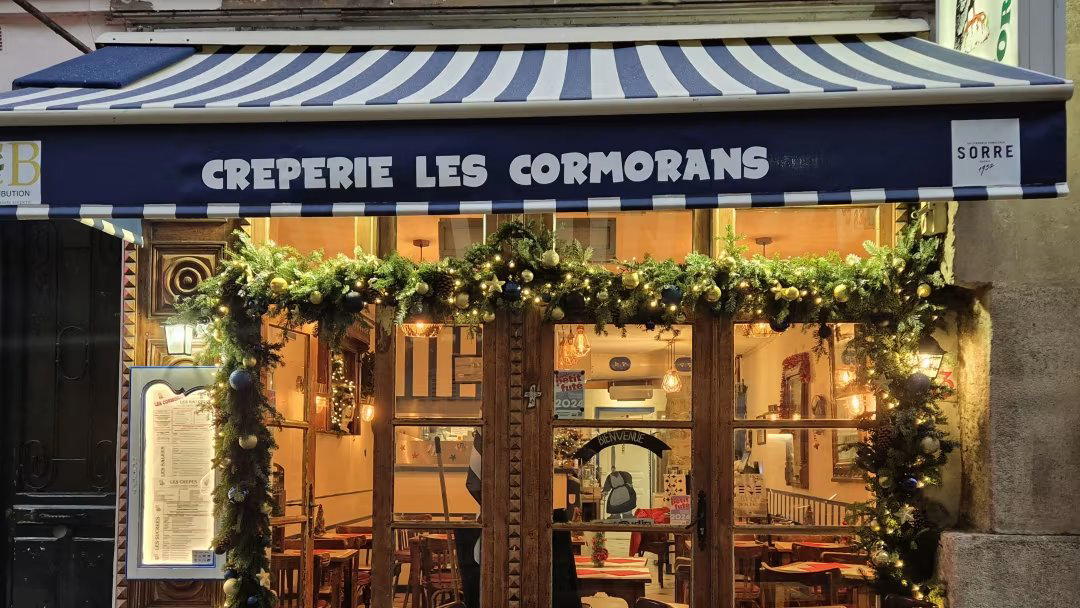
Montparnasse and the Breton Crêpe: A Street With a Long Memory
Rue du Montparnasse did not become Paris's crêperie corridor by accident. The concentration of Breton establishments along this short stretch of the 14th arrondissement dates to the early twentieth century, when waves of Breton migrants arrived at the nearby Gare Montparnasse and settled in the surrounding neighbourhood. What followed was less a culinary trend than a self-sustaining community infrastructure: crêperies, cider houses, and Breton social clubs that served a population maintaining strong ties to home. That origin story matters because it explains why the galette-and-cider pairing on this street carries a different register than the same combination served elsewhere in Paris as tourist shorthand. Here, the format has continuity.
Crêperie les Cormorans sits at 63 Rue du Montparnasse, inside that tradition. The address places it directly within the historically dense block of Breton food culture in the capital, where the competition is both longstanding and immediate. For a visitor trying to understand how a regional French craft survives and adapts inside a major city, this street is the right place to look, and this crêperie is one of its examples.
The Galette as Technical Object
The Breton galette de sarrasin, buckwheat crêpe, is a deceptively demanding format. Buckwheat contains no gluten, which means the batter behaves differently from wheat-based crêpe batters: it tears more readily, requires a seasoned iron billig at precise temperature, and demands a spreader technique built through repetition rather than instruction. The lacey, slightly crisp perimeter of a properly executed galette is the visible result of that technical discipline, and it is one of the clearest signals separating a crêperie with genuine craft from one going through the motions.
The pairing logic is equally specific. Dry Breton cider, with its low alcohol and high acidity, cuts through the earthiness of buckwheat in a way that wine generally does not. The combination arrived in Paris alongside the crêperies themselves and has remained structurally unchanged, which is notable in a city that regularly reprocesses regional traditions into something more cosmopolitan. On Rue du Montparnasse, the format's conservatism is a feature, not an oversight.
This intersection of imported method and indigenous ingredient sits at the heart of what makes the galette tradition worth examining seriously. Buckwheat is not native to Brittany in the strictest botanical sense, but it has been cultivated there since the sixteenth century and is now so thoroughly identified with the region that it functions as a local product. The crêperie format that carries it to Paris represents one of France's cleaner examples of a regional technique transplanted and preserved with minimal dilution. Compared to what happens to, say, Alsatian cuisine when it migrates to the capital, the Breton crêperie tradition on this street has maintained unusual fidelity to its source. For broader context on how France's regional cooking traditions relate to its fine-dining establishment, the work happening at restaurants like Bras in Laguiole and Auberge de l'Ill in Illhaeusern shows how deeply rooted regional identity can coexist with serious technical ambition.
Where This Fits in Paris's Broader Dining Picture
Paris's restaurant economy has a pronounced upper tier. The three-Michelin-star bracket includes addresses like Alléno Paris au Pavillon Ledoyen, Arpège, and L'Ambroisie, while the modern French middle ground is represented by places such as Kei and Le Cinq at the Four Seasons George V. The crêperie tradition occupies a completely different economic and social position: it is everyday food in the original sense, priced and formatted for regular use rather than occasion dining.
That positioning is not a limitation. In a city where the pressure to perform gastronomy at every price point has produced a lot of self-conscious bistro cooking, the crêperie format's refusal to overcomplicate is part of its value. The galette does not need a narrative or a tasting note. It needs a good billig, quality buckwheat flour, and fillings sourced with some care. Whether a given crêperie on Rue du Montparnasse meets that standard is something a visitor can assess quickly and cheaply, which is itself a useful quality in a dining scene where some experiences require months of advance planning. For a wider sweep of the city's food options, the Paris restaurants guide maps the range from addresses like these to the upper tiers of the capital's cooking.
France's regional cooking traditions extend well beyond Paris, of course. The country's most technically serious regional restaurants include Flocons de Sel in Megève, Mirazur in Menton, Troisgros in Ouches, and Paul Bocuse's Auberge du Pont de Collonges. The crêperie tradition and those establishments exist in different registers, but they share a common foundation: the idea that French cooking is most coherent when it stays connected to a specific place and its specific products. The galette de sarrasin on Rue du Montparnasse is, in its own modest way, an expression of the same logic.
For international context on how French technique travels, Le Bernardin in New York City remains the reference point for French classical discipline applied outside France, while Lazy Bear in San Francisco shows how the communal dining format, which the crêperie also employs, in its own casual register, can be reworked for a contemporary American audience. Other French regional addresses worth understanding for comparison include Les Prés d'Eugénie in Eugénie-les-Bains, Georges Blanc in Vonnas, Auberge du Vieux Puits in Fontjoncouse, and La Table du Castellet in Le Castellet.
Dining Details
Style and Standing
Comparable venues nearby, for context on price, style, and recognition.
| Venue | Cuisine | Price | Notes |
|---|---|---|---|
| Crêperie les CormoransThis venue — the venue you are viewing | Breton Crêperie | $$ | Not listed |
| Le Petit Saint-Benoit | Classic French Bistro | $$ | 6th Arrondissement (Saint-Germain-des-Prés) |
| Bistro V | Modern French Bistro | $$ | 5th Arr. - Panthéon |
| Grizzli Cafe | Traditional French Bistro | $$ | Saint-Merri |
| Groot | French Street Food Pies | $$ | Sentier |
| Le Cellier | Modern French Bistro with Breton Influences | $$ | 9e arrondissement |
Continue exploring
More in Paris
Restaurants in Paris
Browse all →
Bars in Paris
Browse all →

Hotels in Paris
Browse all →
Wineries in Paris
Browse all →
At a Glance
- Cozy
- Lively
- Classic
- Casual Hangout
- Family
- Terrace
Current opening hours
- Monday
- 11:30 AM–2:30 PM, 6:30–10:30 PM
- Tuesday
- Closed
- Wednesday
- 6:30–10:30 PM
- Thursday
- 11:30 AM–2:30 PM, 6:30–10:30 PM
- Friday
- 11:30 AM–2:30 PM, 6:30–11 PM
- Saturday
- 11:30 AM–11 PM
- Sunday
- 11:30 AM–10:30 PM
Hours can change for holidays and private events. Last verified .
Warm, convivial traditional setting with lounge elements, sometimes noisy due to popularity.