
CRANE puts Tokyo’s burger culture in a compact Sotokanda room rather than a luxury dining frame. Its Tabelog Hamburger 100 selections across 2017, 2018, 2019, 2021, 2022, 2024, and 2026 give it a stronger signal than the casual format suggests, while the Hamburger, Cafe, and American categories keep the experience closer to a focused neighborhood counter than a destination tasting room.
Pearl is the En Primeur Club membership app — saves, bookings, and concierge access live there. Same editors, same standards.
- Address
- Japan, 〒101-0021 Tokyo, Chiyoda City, Sotokanda, 6 Chome−16−3 国際6163ビル
- Phone
- +81 3-6806-0026
- Website
- instagram.com
 Saves & bookings on Pearl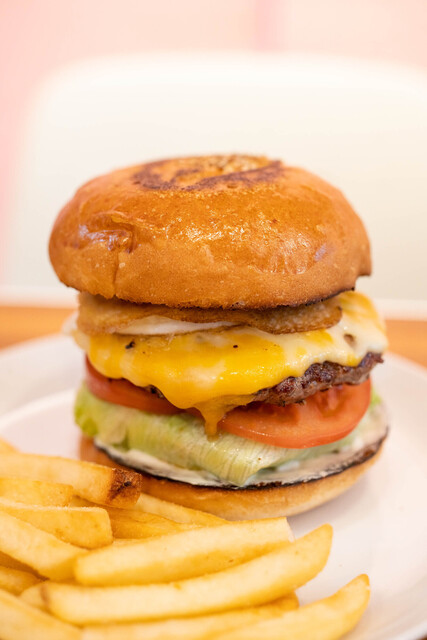
Sotokanda changes register quickly: electronics shops, rail-side foot traffic, narrow commercial buildings, and small restaurants working with little margin for spectacle. In that setting, the Tokyo burger shop is less about Americana as theme park and more about compression: a compact room, a short-format meal, and a design logic built around turnover, proximity, and the discipline of doing one category well. CRANE belongs to that version of the city’s casual dining culture, where the physical container matters because it shapes the meal as much as the menu category does.
Tokyo’s serious hamburger scene has matured into its own category, separate from both fast food and hotel-lounge sandwiches. The strongest rooms tend to be small, visually direct, and organized around a single promise: a burger meal that can hold attention without borrowing the rituals of omakase or the length of a tasting menu. Recognition on Tabelog’s Hamburger 100 list in 2017, 2018, 2019, 2021, 2022, 2024, and 2026 places this shop inside that specialist group. That matters because the award is category-specific; it does not reward broad ambition, it rewards performance within the hamburger field.
A small Sotokanda room built for a focused burger meal
The spatial cue is modesty. Twenty table seats create a different rhythm from a counter-only ramen shop or a multi-course dining room: the meal has enough room for a burger-and-shake format, but not enough space for lingering theatrics. In Tokyo, that middle scale is useful. It lets a casual restaurant carry craft signals without dressing itself up as fine dining, and it keeps the experience anchored in the neighborhood rather than in a hotel or department-store dining floor.
The listed categories, Hamburger, Cafe, and American, also explain the design brief. This is not a broad Western restaurant category in the older Tokyo sense; it is a tighter urban format where the burger leads and the cafe element softens the edges. Milkshake culture sits naturally in that frame, not as nostalgia alone but as part of a complete short meal. The room’s table layout supports that: groups can sit down, order within a familiar grammar, and leave without the formality attached to higher-priced reservation dining.
That distinction matters in Tokyo because the city often makes casual formats compete with formal ones for attention. Kaiseki rooms such as Kikuchi, higher-budget grilled formats such as Namaiki, and specialist yakitori or tempura-soba venues such as Tori Tsune Shizen Do and Tentenkyokyo Umean operate with different time commitments, spending expectations, and service codes. A burger shop in Sotokanda has to win on precision and repeatability instead. Its credibility comes from staying narrow.
The award signal is category discipline, not luxury theater
Tabelog’s Hamburger 100 selection is the main trust signal here, and its repeated presence over multiple cycles is more useful than a single burst of attention. Tokyo diners are fluent in category hunting: curry, ramen, tonkatsu, soba, and burgers all have their own maps. A repeated hamburger listing says the shop has kept relevance inside a crowded casual field, where the gap between a good meal and a forgettable one is often execution rather than expense.
The price tier reinforces the point. This is a low-to-mid casual spend by Tokyo restaurant standards, far from the reservation pressure and ceremonial pacing that define the city’s tasting-menu economy. That makes the judgment different. The question is not whether the room performs like a luxury restaurant; it is whether the burger format has enough clarity to justify being sought out in a city with dense alternatives. The repeated category recognition answers that more convincingly than decorative language would.
Design, in this context, is not marble, lighting drama, or a grand entrance. It is the operational shape of the place: a compact dining room, table seating rather than a pure counter, non-smoking status, and take-out availability. Those details matter because they determine how the restaurant fits into a Tokyo day. It can function as a planned casual meal, a pause between Akihabara and Ueno-area movement, or a lower-ceremony alternative when the city’s more formal dining rooms feel like too much structure.
How to place it in a Tokyo eating itinerary
The useful way to read CRANE is as a specialist casual address, not a substitute for Tokyo fine dining. It belongs in an itinerary that also makes room for the city’s other narrow-format strengths: curry houses, yakitori counters, cafe rooms, seafood izakaya, and small bars. For nearby and citywide restaurant planning, see . 鮪と炭火焼き うお炭 秋葉原店, 12/10 Shinjuku ten, 124. KAGURAZAKA (Yakitori), 2D Cafe, 3 Chome no Curry Ya San, and Our full Tokyo restaurants guide.
Travelers building a broader Tokyo trip should separate meal planning from the rest of the city’s logistics. Use Our full Tokyo hotels guide for where to stay, Our full Tokyo bars guide for drinking plans, Our full Tokyo wineries guide for wine-led addresses, and Our full Tokyo experiences guide for non-restaurant scheduling. For Japan and wider dining context, compare the casual-specialist lane with -Grilled beef Sukiyaki- KAMAKURA TANUKIAN 鎌倉 たぬき庵 in Kamakura.cafe in Osaka.know in Kumamoto, (Shoku) Vietnam in Kawasaki, [Curry Senmon Ten] Maruyama Kyoju. in Sapporo, [ki:] in Kyoto, Jōdo Saké Bar in Los Angeles, and Onigiri Time in Pasadena.
The editorial case is simple: Tokyo rewards narrow specialization, and the burger category is no longer an afterthought. A small Sotokanda room with repeated Hamburger 100 recognition gives travelers a clean read on that shift. Choose it when the day calls for a compact, category-led meal rather than a long reservation built around ceremony.
Budget Reality Check
Comparable venues by category and price.
| Venue | Cuisine | Price | Notes |
|---|---|---|---|
| CRANEThis venue — the venue you are viewing | Chiyoda, American Burgers | $ | Not listed |
| CHATTY CHATTY | Not listed | $$ | Shinjuku, Gourmet American-style Burger Shop |
| Majo no Chiisana Mori no Hamburger | Meguro, Organic Hamburger & Cafe | $$ | Not listed |
| No.18 | Toshima, Gourmet Hamburger Shop | $$ | Not listed |
| shake tree burger&bar | Sumida, Gourmet American Burger Bar | $$ | Not listed |
| BOSSA BURGER | Not listed | $$ | Adachi, Classic American-style Burgers & Bar |
Recognition history
Dated appearances from independent guides and award organizations, with the underlying list record or original source where available.
Tabelog 100 #14 · No. 14
Tabelog · Tabelog 100 - Hamburger - 2026







At a Glance
- Modern
- Cozy
- Trendy
- Casual Hangout
- Solo
- Group Dining
- Standalone
Current opening hours
- Monday
- 11:30 AM–9:30 PM
- Tuesday
- 11:30 AM–9:30 PM
- Wednesday
- 11:30 AM–9:30 PM
- Thursday
- 11:30 AM–9:30 PM
- Friday
- 11:30 AM–10:30 PM
- Saturday
- 11:30 AM–9:30 PM
- Sunday
- 11:30 AM–9:30 PM
Hours can change for holidays and private events. Last verified .
Casual, simple, and neighborhood-oriented, with a relaxed fast-casual feel.