
Tabelog 100 #16
Our verdict
Cinnamon Garden Kannai ten brings Sri Lankan cooking into Yokohama’s Kannai dining circuit at a modest spend, with lunch and dinner positioned well below the city’s high-ticket counter formats. Its selection for Tabelog 100 Asian cuisine / Ethnic cuisine EAST in 2023 and 2024 gives the room a clear credential without turning the meal into ceremony.

Pearl is the En Primeur Club membership app, where members save venues, book tables and use the concierge.
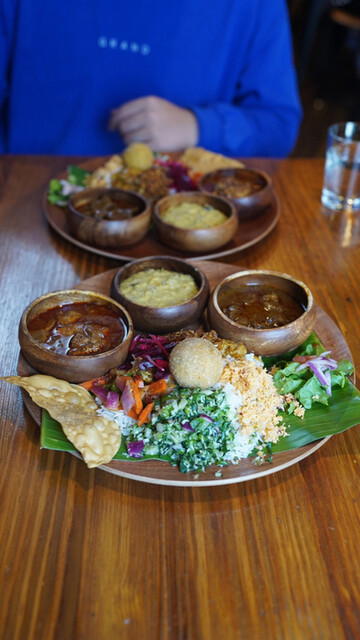
Kannai’s restaurant streets are practical before theatrical: office workers, municipal buildings, station exits, second-floor dining rooms and quick decisions between trains. That suits Sri Lankan food, whose appeal in Japan often rests less on spectacle than on plate architecture: rice, curry, vegetable preparations, heat, acidity and texture arranged so each bite changes. Cinnamon Garden Kannai ten belongs to that urban category, where the room is secondary to rhythm and the menu carries the argument.
Yokohama’s dining identity is often framed through Chinatown, hotel dining and waterfront polish, but its everyday story is more mixed. Kannai and Naka Ward have long absorbed working lunches, izakaya habits, curry counters, Chinese kitchens and small specialist restaurants upstairs or off tourist routes. In that context, a Sri Lankan address selected for Tabelog 100 Asian cuisine / Ethnic cuisine EAST in both 2023 and 2024 signals not luxury positioning, but category strength in a competitive eastern-Japan field.
Sri Lankan structure in a city built on mixed dining habits
Sri Lankan cooking reads differently from the thicker Japanese curry model that dominates casual expectations. Its grammar is modular: rice anchors the plate, curries and accompaniments pull in separate directions, and the diner mixes. The structure rewards contrast rather than a single sauce-driven arc, so the format can feel sharper than its price tier suggests. Cinnamon Garden Kannai ten is categorized as Sri Lankan, which matters in Yokohama because South Asian dining is often folded into broader curry culture. A specialist label narrows the promise.
The pricing places the restaurant in a useful lane. Lunch sits at JPY 1,000 to JPY 1,999, while dinner is JPY 2,000 to JPY 2,999. Against Yokohama’s higher-commitment formats, that is a different proposition: 1000 (Yakitori (Grilled chicken skewers)) operates in a JPY 15,000 to JPY 19,999 yakitori bracket, while Yakitori Hifumi is listed at JPY 10,000 to JPY 14,999 and scica at JPY 6,000 to JPY 7,999. Even Minami Indian Ten Bodhisena, another South Asian comparison in Yokohama, runs dinner at JPY 3,000 to JPY 3,999. The point is not that lower spend makes the meal casual by default; it means the cooking must earn attention without counter theatre, course pacing or wine-pairing economics.
The Tabelog score, 3.54, should be read with Japanese review culture in mind, where mid-3 ratings can indicate serious local traction rather than faint praise. More persuasive is repeat Tabelog 100 inclusion for Asian and ethnic cuisine in EAST, a list that separates specialist cooking from the noise of general restaurant search. For a Sri Lankan restaurant in Kannai, that puts the cooking in a regional conversation, not just neighbourhood convenience.
The room supports the food, not the other way around
There is no reason to over-romanticize the setting. The address is on the second floor of a building in Tokiwacho, close to Kannai Station, and the operational details point to a functional restaurant, not a design-led destination. Non-smoking status, children welcome, no private rooms and no private use describe a room built for regular dining rather than staged occasion dining. That fits a menu style dependent on appetite and pacing, not ceremony.
Family suitability follows. Children are welcome, the listed spend is moderate by Yokohama standards, and the cuisine can be approached through rice-based combinations rather than a rigid tasting format. That does not mean every dish will be mild or familiar; Sri Lankan cooking often uses spice, coconut, curry leaves, dried fish, lentils and sambols in direct ways rather than hotel-dining softness. But the format lets a table share, compare and adjust.
Reservations are listed as unavailable, which changes timing. This is not a diary-planned counter meal; treat it as a Kannai meal to target around service windows, knowing popular low-price specialist rooms can be more constrained than their spend suggests. Payment is more flexible than at many small Japanese restaurants: major credit cards, transport IC cards, WAON and PayPay are listed. Parking is unavailable, so rail is the natural approach.
Where it fits in a Yokohama eating day
The strongest use case is a meal that adds another register to a Yokohama itinerary. Pairing Kannai with Chinatown can make sense for visitors, but the better editorial move is to use this address as a counterweight to the city’s familiar dining images. Yokohama is not only harbor views and banquet rooms; it is small-format cooking in station-adjacent buildings, where immigrant and regional Asian cuisines create a parallel map of the city.
For readers building a wider Yokohama plan, the comparison points matter. Aichun, Ajowan, Alpenjiro Honten and Anzen Shokudo show how the city rewards specificity across cuisines and formats. The broader planning layer sits in Our full Yokohama restaurants guide, while non-restaurant context can be built through Our full Yokohama hotels guide, Our full Yokohama bars guide, Our full Yokohama wineries guide and Our full Yokohama experiences guide.
For a wider Japan and beyond-Japan reading list, the useful contrast is breadth rather than similarity: -Grilled beef Sukiyaki- KAMAKURA TANUKIAN 鎌倉 たぬき庵 in Kamakura. 鮪と炭火焼き うお炭 秋葉原店 in Tokyo.cafe in Osaka.know in Kumamoto, (Shoku) Vietnam in Kawasaki, [Curry Senmon Ten] Maruyama Kyoju. in Sapporo, Jōdo Saké Bar in Los Angeles and Onigiri Time in Pasadena map how focused, modest-format restaurants travel across cities without needing luxury signals.
The verdict is practical and critical: Cinnamon Garden Kannai ten is interesting because its menu category, price tier and repeat Tabelog 100 recognition intersect cleanly. It gives Yokohama diners a Sri Lankan option with enough external validation to justify a detour within Kannai, yet remains priced and formatted like an everyday meal. That tension is the appeal.
Frequently asked questions
Does Cinnamon Garden Kannai ten work for a family meal?
Yes. The Tabelog listing marks it as child-friendly, and it is selected for Tabelog 100 EAST 2024 in Yokohama's Kannai area. The lunch price band also sits below the dinner band, which suits a casual family stop.
What is the atmosphere like at Cinnamon Garden Kannai ten?
The setting is practical rather than theatrical: a second-floor address in Tokiwacho, a short walk from Kannai Station, with non-smoking service and no private rooms. It reads as a straightforward neighbourhood dining room in Yokohama, not a destination built around formality.
What should I budget for a meal at Cinnamon Garden Kannai ten?
Pricing at Cinnamon Garden Kannai ten is listed as JPY 2,000 - JPY 2,999 JPY 1,000 - JPY 1,999.
What days is Cinnamon Garden Kannai ten closed?
Hours at Cinnamon Garden Kannai ten: Mon: Closed; Tue: Closed; Wed: 11:30 AM–2:30 PM, 5–9 PM; Thu: 11:30 AM–2:30 PM, 5–9 PM; Fri: 11:30 AM–2:30 PM, 5–9 PM; Sat: 11:30 AM–2:30 PM, 5–9 PM; Sun: 11:30 AM–2:30 PM.
Where is Cinnamon Garden Kannai ten located?
Cinnamon Garden Kannai ten is located in Yokohama.
What's Cinnamon Garden Kannai ten best at?
Its main strength is Sri Lankan cooking at an accessible price point, with lunch from JPY 1,000 to JPY 1,999 and dinner from JPY 2,000 to JPY 2,999. Selection for Tabelog 100 EAST 2024 gives it a useful credential in Yokohama's Asian dining scene.
Comparable Spots
Comparable venues for orientation by cuisine and category.
| Venue | Cuisine | Price | Awards | Notes |
|---|---|---|---|---|
| Cinnamon Garden Kannai tenThis venue (the venue you are viewing) | Sri Lankan Curry House | $10–20 | Tabelog 100 #16 | Not listed |
| scica | Modern Yoshoku / Western Cuisine | $50–100 | Tabelog 100 #1 | JPY 6,000 - JPY 7,999 |
| Minami Indian Ten Bodhisena | South Indian Restaurant | Not listed | Tabelog 100 #62 | JPY 3,000 - JPY 3,999 JPY 1,000 - JPY 1,999 |
| Nakajo | Edomae Sushi Omakase | $300–500 | Tabelog Bronze #305 | Sushi |
| 1000 | Japanese | Not listed | Tabelog Bronze #392 | Yakitori (Grilled chicken skewers), JPY 15,000 - JPY 19,999 |
| Yakitori Hifumi | Omakase Yakitori | $50–100 | Tabelog 100 #20 | JPY 10,000 - JPY 14,999 |
Recognition history
Dated appearances from independent guides and award organizations, with the underlying list record or original source where available.
Tabelog 100 #16 · No. 16
Tabelog · Tabelog 100 - Asian cuisine / Ethnic cuisine - EAST - 2024
Continue exploring
More in Yokohama
Restaurants in Yokohama
All restaurants in Yokohama →


Bars in Yokohama
Browse all →


Details
- Cozy
- Casual
- Casual Hangout
- Family
- Solo
- Standalone
- A La Carte
- Vegetarian Friendly
Current opening hours
- Monday
- Closed
- Tuesday
- Closed
- Wednesday
- 11:30 AM–2:30 PM, 5–9 PM
- Thursday
- 11:30 AM–2:30 PM, 5–9 PM
- Friday
- 11:30 AM–2:30 PM, 5–9 PM
- Saturday
- 11:30 AM–2:30 PM, 5–9 PM
- Sunday
- 11:30 AM–2:30 PM
Hours can change for holidays and private events. Hours as of .
Casual and direct, with a neighborhood-restaurant feel rather than a formal dining atmosphere.