Churreria El Moro Centro
Few addresses in Mexico City carry the kind of daily, democratic authority that Churrería El Moro Centro does. Planted on Eje Central Lázaro Cárdenas in the Centro Histórico since 1935, it is the city's longest-running churro house, serving the fried dough strips alongside thick, old-world-style chocolate drinks at any hour. The format has barely shifted in nine decades, which is precisely the point.
Pearl is the En Primeur Club membership app — saves, bookings, and concierge access live there. Same editors, same standards.
- Address
- Eje Central Lázaro Cárdenas 42, Centro Histórico de la Cdad. de México, Centro, Cuauhtémoc, 06000 Ciudad de México, CDMX, Mexico
- Website
- elmoro.mx
- Directions
- Get directions
 Saves & bookings on Pearl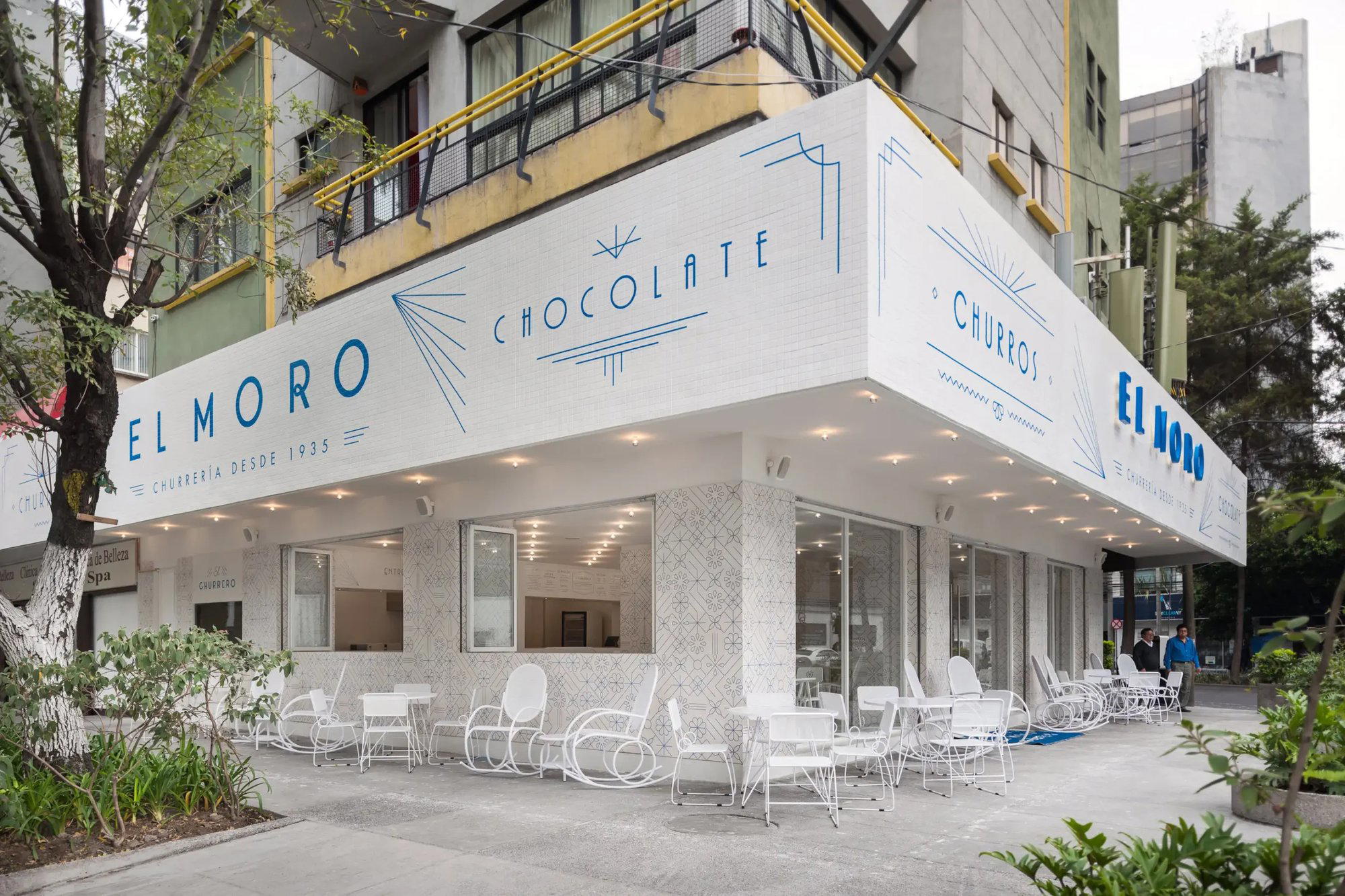
Where the Centro Histórico Begins Its Day, and Ends Its Night
Step onto Eje Central Lázaro Cárdenas after midnight and the street reads like a city in fast-forward: commuter buses grinding past baroque facades, taco stalls flaring under fluorescent light, the distant percussion of a cumbia soundsystem. Against that backdrop, the yellow-and-white tiled frontage of Churrería El Moro Centro operates as a kind of temporal anchor. Fried churros, thick chocolate, a counter stool if you want one, define the format today. That consistency, in a city that reinvents itself block by block, is its own statement.
Mexico City's Centro Histórico sits at the cultural and historical centre of Mexican urban life, a neighbourhood that rewards visitors who move slowly and eat often. The dining character here runs toward tradition and volume rather than the tasting-menu experimentation you find at Pujol or the native-ingredient scholarship of Quintonil in Polanco. El Moro belongs to a different tier entirely, not a destination restaurant by any fine-dining definition, but an institution that illustrates what Mexico City does with popular food traditions when it decides to take them seriously over a long time.
Churros as Living Craft: Spanish Technique, Mexican Identity
The churro is a Spanish colonial import that Mexico absorbed and domesticated so thoroughly that it now reads as entirely its own. The method, extruding a choux-adjacent dough through a star-tipped press directly into hot oil, arrived from the Iberian peninsula, but the rhythm of consumption here is distinctly Mexican: any hour, any day, with chocolate or without, as breakfast, as a post-theatre snack, as fuel after a night out. This is the pattern that El Moro has served since the 1930s, and it maps neatly onto the editorial angle that defines interesting food addresses in Mexico right now: inherited technique applied to local habit until the seam between them disappears.
That tension between imported method and local identity runs through contemporary Mexican cooking at every price point. At the higher end, it drives the menus at Em and shapes the sourcing philosophy at Rosetta. Further afield, the same instinct drives the open-fire approach at Animalón in Valle de Guadalupe and the regional-product focus at Levadura de Olla in Oaxaca. El Moro sits at the oldest, most distilled end of that same continuum, the point where the technique has been so thoroughly metabolised that asking whether it is Spanish or Mexican feels beside the point.
The chocolate served alongside the churros follows a similar logic. Spanish-style chocolate drinks were historically thick, spiced, and taken with fried dough, a preparation that travelled to New Spain and layered over pre-existing indigenous cacao traditions. The result at El Moro is something that belongs to neither origin point cleanly: it is Mexico City's version of the thing, shaped by nine decades of a single address deciding what the drink should taste like at 2am when the city needs it.
The All-Hours Format and What It Tells You About the City
One of the more useful facts about El Moro is that it operates around the clock. This is not an accident of ambition or a marketing calculation, it reflects the actual structure of Centro Histórico life, where the overnight population includes shift workers, party-goers arriving from clubs further south, and the steady stream of people who simply live nearby and eat on a different schedule than restaurants typically serve. The 24-hour churro house occupies a niche that few food formats can fill: it is hot, fast, affordable, and requires no preamble. You sit down, you order, the churros arrive quickly.
In a city where reservation-led dining at Sud 777 or the technically ambitious tasting formats at Le Chique in Puerto Morelos require planning weeks in advance, El Moro is the corrective, the reminder that Mexico City's food culture is deep enough to reward both ends of the effort spectrum. The same city that produces the indigenous-ingredient rigour of KOLI Cocina de Origen in Monterrey or the farm-sourced precision of Olivea in Ensenada also sustains a churro counter that has not needed to reinvent itself in nine decades. That breadth is the point.
Positioning in the Mexico City Eating Hierarchy
It is worth being explicit about where El Moro sits relative to the rest of Mexico City's dining map. This is not a restaurant in the sense that Alcalde in Guadalajara or Arca in Tulum are restaurants. There is no tasting menu, no wine programme, no chef profile to cite. The price point is accessible to almost anyone eating in the city, which puts it in a different competitive set from the $$$ and $$$$ addresses that dominate most premium travel editorial. But El Moro earns its place in any serious account of Mexico City eating because institutions like it are what the expensive restaurants are in conversation with, they represent the popular foundation that gives the haute tier its cultural legitimacy.
Visitors building a full Mexico City itinerary might reasonably spend an evening at Pujol and the following morning at El Moro, and both experiences are necessary to understand what this city does with food. The same logic applies across Mexico's broader dining geography: the specialist producers and regional-produce-led tasting menus at places like Lunario in El Porvenir, HA' in Playa del Carmen, or Pangea in San Pedro Garza García exist in a food culture that also prizes long-running popular formats with no ambition to become something else. For a fuller map of where El Moro fits within Mexico City's dining character, the city's neighbourhood-by-neighbourhood dining scene stretches from tasting menus to late-night counters.
Planning Your Visit
El Moro Centro is on Eje Central Lázaro Cárdenas 42 in the Centro Histórico, within walking distance of the Zócalo and the Bellas Artes metro station. Because it operates 24 hours, timing is flexible, early mornings before the major sites open and late nights after concerts or theatre at the nearby Palacio de Bellas Artes are both natural fits. No reservation is needed or possible; the format is walk-in, counter or table, order at the station. Expect it to be busy on weekend nights and Sunday mornings, when the churro-and-chocolate combination functions as the informal civic breakfast of half the neighbourhood. There is no dress code. For those comparing similar experiences within Mexico's broader food culture, the contrast with the high-technique tasting formats at Le Bernardin in New York or Lazy Bear in San Francisco makes the democratic accessibility of El Moro feel like its own form of editorial argument.
Comparable Options
Comparable venues nearby, for context on price, style, and recognition.
| Venue | Cuisine | Price | Notes |
|---|---|---|---|
| Churreria El Moro CentroThis venue — the venue you are viewing | Traditional Mexican Churrería | $ | Not listed |
| Lonchería María Isabel | Traditional Mexican Fried Quesadillas | $ | Polanco Chapultepec |
| Puerto Prendes | Traditional Mexican Seafood | $$ | Roma Norte |
| Don Vergas | Sinaloa-Style Mexican Seafood | $$ | Tabacalera |
| TESTAL - Roma | Modern Mexican Antojitos | $$ | Juarez |
| La Chinampa | Authentic Mexican Taqueria | $$ | Cuauhtemoc |
Continue exploring
More in Mexico City
Restaurants in Mexico City
Browse all →
Bars in Mexico City
Browse all →
At a Glance
- Classic
- Well Known
- Casual Hangout
- Late Night
- Historic Building
- Local Sourcing
Current opening hours
- Monday
- 12–3 AM, 7 AM–12 AM
- Tuesday
- Open 24 hours
- Wednesday
- Open 24 hours
- Thursday
- Open 24 hours
- Friday
- Open 24 hours
- Saturday
- Open 24 hours
- Sunday
- Open 24 hours
Hours can change for holidays and private events. Last verified .
Classic, bustling pastry shop atmosphere with mesmerizing open churro-frying process.