China Pearl
China Pearl anchors Tyler Street in Boston's Chinatown, one of the neighbourhood's most established dining rooms for Cantonese-style dim sum and banquet service. The multilevel space draws weekend crowds well before noon, functioning as a community institution rather than a trend-driven destination. Its longevity on Tyler Street places it in a comparable set defined by tradition and volume rather than tasting-menu ambition.
Pearl is the En Primeur Club membership app — saves, bookings, and concierge access live there. Same editors, same standards.
- Address
- 9 Tyler St, Boston, MA 02111
- Phone
- +16174264338
- Website
- chinapearlrestaurants.com
- Directions
- Get directions
 Saves & bookings on Pearl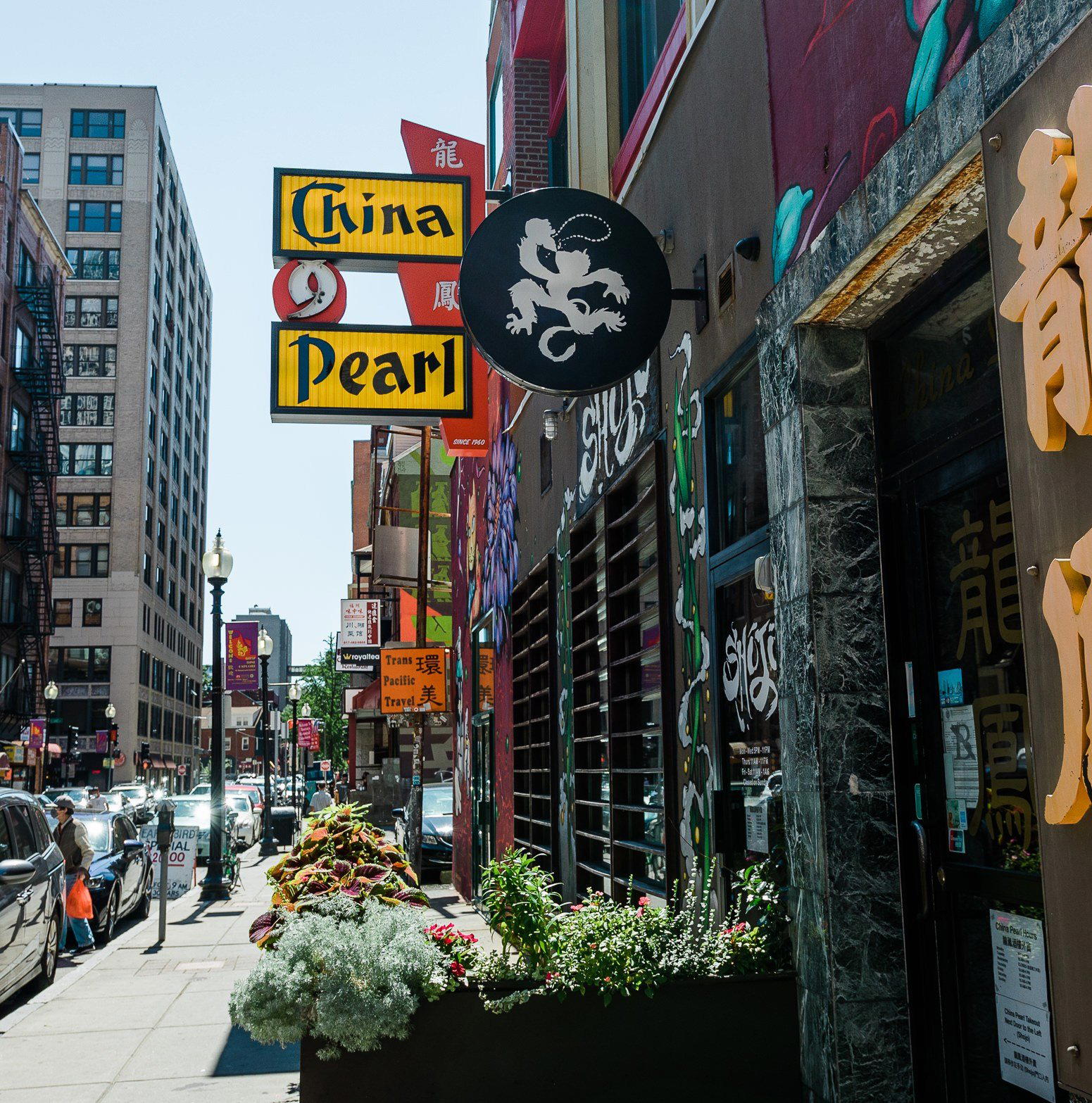
Tyler Street and the Dim Sum Tradition
Boston's Chinatown occupies a compressed grid between the Theater District and South End, and Tyler Street functions as its primary dining artery. The neighbourhood is one of the oldest Chinese communities on the East Coast, and its restaurant culture reflects that depth: the emphasis here is on Cantonese cooking, on family-format tables, and on the kind of institutional longevity that chain concepts cannot replicate. China Pearl sits at 9 Tyler St, a multilevel dining room that has served as a reference point in this neighbourhood for decades. Unlike the tasting-counter format that defines so much of contemporary Boston dining, from 311 Omakase to Agosto, China Pearl operates in a register that predates the city's current fine-dining cycle entirely.
The Room and the Ritual
Entering on a weekend morning, the sound arrives before the visual does: the clatter of bamboo baskets, the metallic clang of cart wheels on linoleum, the layered noise of large tables working through rounds of tea and small plates. The space is large by Chinatown standards, with seating across multiple floors that accommodates the kind of group sizes the neighbourhood's banquet tradition demands. This is not a room designed for quiet conversation or intimate meals. It is designed for movement, for shared plates landed in quick succession, for the organised chaos that defines traditional dim sum service at volume.
That format, the roving cart service or order-by-sheet system, is a specific dining culture with its own logic. Dishes arrive at the pace of the kitchen rather than the pace of the diner, which means early arrivals typically see the widest selection. In Boston, as in Cantonese dim sum houses across North America, weekend mornings from roughly 10am onward represent peak service. Arriving at opening puts you ahead of the crowd that builds through late morning; by noon, the larger tables tend to be occupied by extended family groups that booked in advance.
Chinatown Context: Positioning Among Peers
Boston's dining conversation in 2024 and 2025 has concentrated heavily on the waterfront and Back Bay, with venues like 1928 Rowes Wharf and 75 on Liberty Wharf drawing attention to the harbour corridor, and steakhouse anchors like Abe and Louie's holding their ground in the Back Bay. Chinatown operates on a different axis entirely. The competition on Tyler Street and its surrounding blocks is not for Michelin attention or James Beard consideration; it is for neighbourhood trust, for consistency across decades, and for the kind of regulars who show up every Sunday with three generations in tow.
China Pearl competes within that set. Its longevity on Tyler Street is itself a form of credentialing in a neighbourhood where restaurants open and close with regularity. The venues that survive across multiple decades in a high-rent, high-turnover corridor do so because they maintain a base of local loyalty that insulates them from trend cycles. That is a different value proposition from what you find at Le Bernardin in New York City or The French Laundry in Napa, but it is no less meaningful as a marker of a restaurant's role in its city.
On Beverages: Tea Service and the Question of a Wine List
Dim sum's native beverage pairing is tea, and the editorial angle of wine-list depth applies differently here than it would at a European-format restaurant. Cantonese dim sum culture is built around yum cha, literally "drink tea," and the tea selection at a traditional house functions as the beverage program by default. The range typically spans Pu-erh, Jasmine, Chrysanthemum, and Oolong, with each choice calibrated to the richness of what arrives on the table. Pu-erh in particular, with its earthy fermented character, is the conventional choice for cutting through the fat of roasted pork and egg tarts.
Restaurants operating in this format rarely maintain deep wine cellars, and the expectation of sommelier-driven curation does not map onto the category. A diner seeking that level of beverage programming in Boston would look toward venues like Smyth in Chicago or Providence in Los Angeles as reference points for what a dedicated cellar program looks like at the upper end of American fine dining. What China Pearl offers instead is something those rooms cannot replicate: the pairing logic that has developed over centuries between Cantonese food and Chinese tea, applied at volume and without ceremony. For anyone interested in how beverage pairing works outside the European wine tradition, a dim sum service is a more instructive exercise than it first appears.
What to Order and How to Approach the Menu
Dim sum menus at Cantonese houses of this type follow a recognisable grammar. The steamed items, har gow and siu mai chief among them, anchor every order and function as benchmarks for kitchen quality. The pastry component of har gow, its translucency and elasticity, and the ratio of shrimp to filling in siu mai tell you quickly what register the kitchen is operating at. Beyond those anchors, roasted items, turnip cake, taro dumplings, and egg tarts typically round out a table, with congee as an option for those who want something that sits outside the small-plate format.
For larger groups, banquet-format ordering is a distinct mode from dim sum service. Whole roasted duck and whole fish preparations move to the centre of the table rather than arriving in bamboo baskets, and the pace shifts accordingly. The banquet tradition in Boston's Chinatown is tied closely to community events, wedding dinners, and milestone celebrations, which is why the room's scale makes sense: it is not oversized for a restaurant, it is correctly sized for its actual social function.
Planning Your Visit
The restaurant is located at 9 Tyler St in Boston's Chinatown, walking distance from both the Boylston and Chinatown MBTA stops. Booking ahead for large groups, particularly on weekend mornings, is advisable given the neighbourhood's consistent draw. Those visiting Boston across a broader dining itinerary can place Chinatown in context alongside the city's other registers: our full Boston restaurants guide maps the city's dining character from the waterfront to the South End. For comparison points outside Boston, the format of traditional Cantonese dim sum at volume is a genuinely different experience from what you find at precision-driven American restaurants like Blue Hill at Stone Barns in Tarrytown, Single Thread Farm in Healdsburg, or Addison in San Diego. The value here is not in refinement of execution at small scale; it is in the depth of a tradition served at full volume, in a room that has been doing exactly this for longer than most of Boston's current dining conversation has existed.
- Siu Mai
- Har Gow
- Peking Duck
- Roast Duck
- Crispy Fried Chicken in Cantonese Style
- Liu Sha Bao
- Sticky Rice
- Chicken Feet
- Congee
Credentials Lens
Comparable venues nearby, for context on price, style, and recognition.
| Venue | Cuisine | Price | Notes |
|---|---|---|---|
| China PearlThis venue — the venue you are viewing | Authentic Cantonese Dim Sum & Banquet | $$ | Not listed |
| The Q | Pan-Asian with Mongolian Hot Pot | $$ | Downtown Crossing |
| Jumbo Seafood 珍寶軒 | Traditional Cantonese Seafood | $$ | Chinatown |
| Cafe Noodo | Hand-Pulled Noodle Shop | $$ | West End |
| Picco | Modern Italian Pizza & Ice Cream | $$ | South End |
| West End Johnnie's | American Gastropub | $$ | Bulfinch Triangle |
Continue exploring
More in Boston
Restaurants in Boston
Browse all →
Bars in Boston
Browse all →
Hotels in Boston
Browse all →
Wineries in Boston
Browse all →
At a Glance
- Lively
- Well Known
- Classic
- Group Dining
- Family
- Casual Hangout
- Brunch
- Private Dining
Current opening hours
- Monday
- 11 AM–9 PM
- Tuesday
- Closed
- Wednesday
- 11 AM–9 PM
- Thursday
- 11 AM–9 PM
- Friday
- 11 AM–9 PM
- Saturday
- 10 AM–9 PM
- Sunday
- 10 AM–9 PM
Hours can change for holidays and private events. Last verified .
Busy, chandelier-lit dining hall with a lively atmosphere; 50-50 mix of Chinese families and tourists creates an energetic, authentic dim sum experience.