On Rue Tholozé in Montmartre's 18th arrondissement, Chez Pitou occupies a street that moves at a different pace from the tourist circuits below Sacré-Cœur. The address places it squarely in a neighbourhood dining tradition built on regulars rather than passing trade, and planning a visit requires understanding how that kind of Paris table actually works.
Pearl is the En Primeur Club membership app — saves, bookings, and concierge access live there. Same editors, same standards.
- Address
- 28 Rue Tholozé, 75018 Paris, France
- Phone
- +33142542421
- Website
- chezpitoumontmartre.com
- Directions
- Get directions
 Saves & bookings on Pearl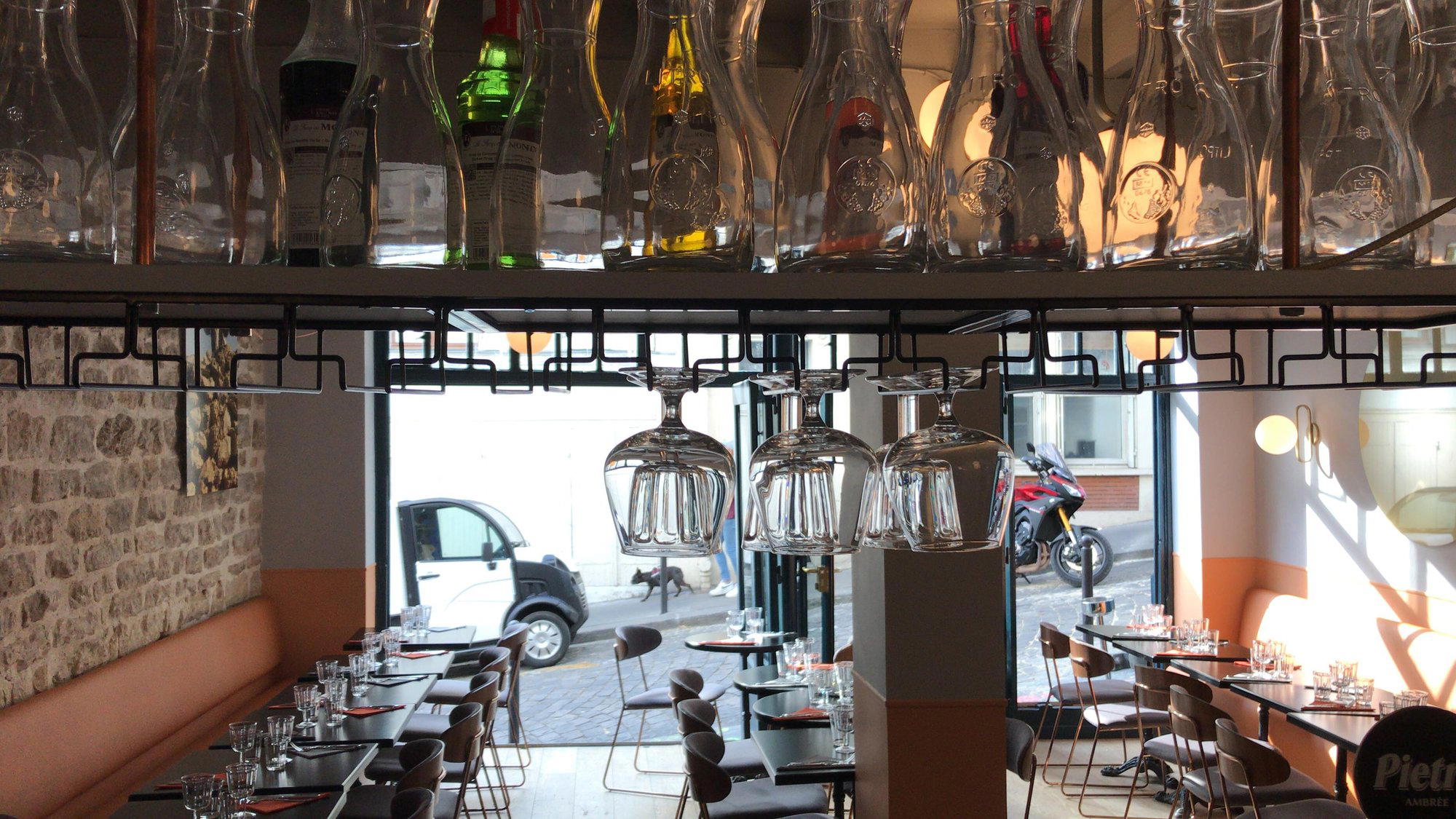
A Street That Works Against Discovery
Rue Tholozé runs at a slight incline through the 18th arrondissement, connecting the lower reaches of Montmartre to the quieter residential blocks that most visitors never reach. It is the kind of street where locals shop for bread in the morning and argue about wine in the evening, where a restaurant earns its reputation over years of neighbourhood loyalty rather than weeks of press attention. Chez Pitou, at number 28, belongs to that tradition. Its address is the first thing to understand about it: this is not a destination restaurant in the Michelin-circuit sense, positioned to intercept tourists or corporate expense accounts. It is a Montmartre address, which carries specific expectations about informality, regularity, and the relationship between a room and its local clientele.
That contrast is worth naming plainly. Paris dining at its upper register, the tier occupied by Alléno Paris au Pavillon Ledoyen, Le Cinq at the Four Seasons George V, or L'Ambroisie on the Place des Vosges, operates by codified rules: formal booking windows, dress expectations, tasting menus priced well above €150 per head. Neighbourhood restaurants in the 18th operate on a different logic entirely: the room is smaller, the booking system is often informal, and the value proposition rests on consistency and familiarity rather than spectacle. Chez Pitou sits in that second world.
The Logistics of Booking a Neighbourhood Table in Montmartre
The editorial angle that matters most for anyone planning a visit to Chez Pitou is not what is on the plate, it is how to get through the door. Neighbourhood restaurants in Paris at this level frequently operate without the digital infrastructure that international visitors expect. Online booking platforms, dedicated reservation email addresses, and English-language websites are common at the Michelin-starred end of the market; they are far less consistent at the neighbourhood end, where a reservation may still mean a phone call, a handwritten name in a paper diary, and a table held on trust.
Reservation is recommended. That itself is a signal. It positions the restaurant in the cohort of Paris addresses that reward persistence and local knowledge over algorithmic discovery. The approach that works at Kei or Arpège, booking six to eight weeks ahead via a dedicated reservations system, does not translate directly to a table on Rue Tholozé. Visitors who arrive at the neighbourhood expecting the same frictionless entry will be wrong-footed.
The practical recommendation here is to plan arrival around the neighbourhood itself. Reservation is recommended, and lunch or early evening timing is the safest bet. Montmartre's dining scene rewards exploration on foot. Rue Tholozé is walkable from Abbesses metro station, and the surrounding blocks contain enough alternative options that arriving without a confirmed reservation is a reasonable risk if the primary goal is the neighbourhood rather than the specific address. Arriving in the early evening is the safest approach for a smaller Paris bistro.
Where Chez Pitou Sits in the Broader French Dining Picture
French restaurant culture at the neighbourhood level has its own lineage, and understanding that lineage contextualises what the restaurant likely represents. The great French dining institutions, Paul Bocuse's Auberge du Pont de Collonges, Auberge de l'Ill in Illhaeusern, Troisgros in Ouches, built their reputations across generations on classical technique applied to regional product. That tradition runs through French cooking at every price tier. A neighbourhood bistro in the 18th arrondissement draws on the same cultural inheritance, even if the frame is a zinc bar and a chalkboard rather than white linen and a sommelier team.
Houses like Bras in Laguiole, Les Prés d'Eugénie in Eugénie-les-Bains, and Flocons de Sel in Megève demonstrate how deeply the French dining tradition values rootedness in place. A Montmartre bistro operates on the same principle at a different scale: the room is a function of its neighbourhood, its suppliers are local, and its regulars are the validation system. That is a different kind of credentialism from a Michelin star, but it is not a lesser one.
Internationally, the same logic applies to neighbourhood-rooted restaurants that resist easy categorisation. Lazy Bear in San Francisco built a following through community-first format before formal recognition caught up. Le Bernardin in New York represents the opposite trajectory: formal recognition first, neighbourhood embeddedness second.
What to Expect from the Address
What the address and neighbourhood context do allow is a reasonable set of expectations about format. Bistros on streets like Rue Tholozé in Montmartre typically operate with a short, seasonally adjusted menu: three or four starters, a similar number of mains, and a dessert selection that changes more slowly. Wine lists at this level tend to be concise and producer-led rather than comprehensive, often featuring natural or low-intervention bottles that reflect the 18th arrondissement's longstanding interest in that style. The room is almost certainly small. Noise levels at neighbourhood bistros of this type run higher than at formal dining rooms, conversation carries across tables, and the kitchen is rarely hidden.
For pricing context, the restaurant is in the €€€ tier, with an average spend of about $40 per person. That positioning is part of the value argument: the restaurant, if it follows the Montmartre bistro model, offers a fundamentally different transaction from Georges Blanc in Vonnas or Auberge du Vieux Puits in Fontjoncouse, not a lesser one, but a different one.
Readers planning a longer Paris itinerary may also want to cross-reference addresses from Mirazur in Menton and La Table du Castellet for regional contrast before or after a Paris stay.
Quick reference: 28 Rue Tholozé, 75018 Paris. Reservation recommended. Price tier: €€€.
Credentials Lens
Comparable venues nearby, for context on price, style, and recognition.
| Venue | Cuisine | Price | Notes |
|---|---|---|---|
| Chez PitouThis venue — the venue you are viewing | Classic French Bistro | $$$ | Not listed |
| Le Relais Haussmann | Traditional French Bistro | $$$ | 8th arrondissement |
| Le Café Marly | Modern French Brasserie | $$$ | Louvre/Palais-Royal |
| La Renommée | Refined French Brasserie with New York Influences | $$$ | 1er arrondissement |
| Huguette | French Seafood Bistro | $$$ | Saint-Germain-des-Prés |
| Chez Savy | Traditional French Brasserie | $$$ | 8th Arr. - Élysée |
Continue exploring
More in Paris
Restaurants in Paris
Browse all →
Bars in Paris
Browse all →
Hotels in Paris
Browse all →
Wineries in Paris
Browse all →
At a Glance
- Cozy
- Classic
- Intimate
- Date Night
- Casual Hangout
- Historic Building
- Extensive Wine List
- Farm To Table
Current opening hours
- Monday
- Closed
- Tuesday
- 7–11 PM
- Wednesday
- 7–11 PM
- Thursday
- 7–11 PM
- Friday
- 12–2 PM, 7–11 PM
- Saturday
- 12–2 PM, 7–11 PM
- Sunday
- 12–3 PM
Hours can change for holidays and private events. Last verified .
Cozy and inviting with rustic stone accent walls, beamed ceilings, warm lighting, and a laid-back friendly atmosphere.