Our verdict
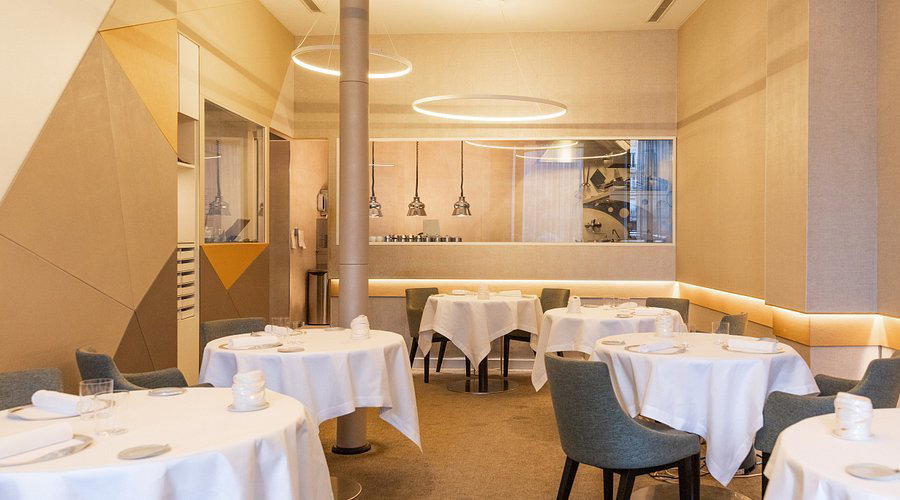
On Rue Trousseau in the 11th arrondissement, Chefs à Table occupies a quieter register than the grand-room institutions of the 8th. The format places the progression of courses at the centre of the experience, making it a reference point for how the contemporary Paris bistro-gastronomique tradition handles multi-course sequencing away from the palace hotel circuit.

Pearl is the En Primeur Club membership app, where members save venues, book tables and use the concierge.

The 11th's Approach to the Formal Meal
Paris has always maintained two parallel tracks for serious dining. One runs through the 8th arrondissement, through palace hotels and grand rooms where ceremony is part of the price: places like Le Cinq at Four Seasons Hôtel George V or Alléno Paris au Pavillon Ledoyen, where the room itself is a statement. The other track runs through the eastern arrondissements, where the emphasis shifts from architectural grandeur to what actually arrives on the plate. Chefs à Table, at 15 Rue Trousseau in the 11th, belongs to the second tradition.
Rue Trousseau sits between the Place de la Bastille and the Marché d'Aligre, a stretch that draws a local crowd rather than a tourist one. The street is calm without being anonymous. Approaching from the Bastille side, you pass wine shops and small producers that signal the neighbourhood's food-focused character before you arrive at the address itself. That approach matters: the 11th has become one of the more consequential dining districts in Paris over the past fifteen years, producing a cohort of restaurants that treat the multi-course format seriously without replicating the formality of the palace circuit.
The Progression as the Point
In contemporary French dining, the multi-course tasting format has split into two distinct schools. The first uses the sequence as a vehicle for technical demonstration, each course a discrete statement, often referencing classical training from lineages that connect back to houses like Arpège or L'Ambroisie. The second school treats the progression as a narrative, where the early courses establish register and pace, the middle courses carry the weight, and the close, both savoury and sweet, provides resolution rather than mere addition.
Chefs à Table operates within that second school. The format at this address is oriented around sequencing as an editorial act: the decision about what comes first, what builds, and what closes is as considered as the individual preparations themselves. This approach has clear precedents in the French regional tradition, where restaurants like Troisgros in Ouches and Bras in Laguiole built reputations not just on individual dishes but on how a meal was shaped across its full arc.
In a city where the roster of serious tasting menus also includes technically demanding formats at Kei and classically anchored ones at L'Ambroisie, Chefs à Table represents the neighbourhood-scale version of this ambition: a commitment to the full progression without the overhead of a grand room.
Paris's 11th in Context
The 11th arrondissement's emergence as a serious dining district followed a recognisable pattern. A first wave of natural wine bars and market-driven bistros established the neighbourhood's appetite for product-led cooking. A second wave, which includes addresses operating at the format level of Chefs à Table, brought more structured ambition: longer menus, more deliberate sequencing, the kind of meal that requires a reservation rather than a walk-in.
This mirrors what happened in other cities where dining culture migrated from established luxury corridors into formerly industrial or residential districts, a pattern visible in London's Bermondsey, New York's lower Manhattan, or San Francisco's Mission, where Lazy Bear built a communal tasting format that similarly sits outside the white-tablecloth establishment. In Paris, the 11th now has enough critical mass that it functions as a peer district to the more decorated addresses further west, rather than as a challenger to them.
The French Regional Frame
Understanding Chefs à Table also means understanding what it is not. It does not occupy the same tier as the destination-scale institutions of provincial France: the multi-generational operations at Auberge de l'Ill in Illhaeusern, Georges Blanc in Vonnas, or Les Prés d'Eugénie in Eugénie-les-Bains, where the address itself is the reason for travel. Nor does it position against the alpine precision of Flocons de Sel in Megève or the Mediterranean-facing ambition of Mirazur in Menton.
What Chefs à Table represents, instead, is the Paris-specific version of serious dining at neighbourhood scale: a restaurant that takes the tasting progression seriously, operates in a district with genuine food culture, and positions against city peers rather than national destination addresses. That is a distinct and useful category for the reader who wants a considered multi-course experience in Paris without the ceremonial weight or the €€€€ pricing of the palace circuit.
Practical Reference
Chefs à Table is located at 15 Rue Trousseau in the 11th arrondissement, accessible from the Bastille or Ledru-Rollin metro stations. As with most Paris restaurants at this format level, advance booking is advisable, particularly for weekend services. Current hours, reservation policies, and menu formats should be confirmed directly with the venue, as these details are subject to change. For a fuller picture of how this address sits within the broader Paris dining scene, see our full Paris restaurants guide. Comparable addresses in terms of format and positioning include the classic rooms at Paul Bocuse in Collonges-au-Mont-d'Or and Auberge du Vieux Puits in Fontjoncouse, though both operate at a different scale and outside the city. Within Paris, La Table du Castellet and the transatlantic reference point of Le Bernardin in New York illustrate how the formal progression format travels across different contexts.
Address: 15 Rue Trousseau, 75011 Paris, France. Nearest metro: Bastille (lines 1, 5, 8) or Ledru-Rollin (line 8).
Frequently asked questions
What's the address for Chefs à Table?
Chefs à Table is located at 15 Rue Trousseau, 75011 Paris, France, Paris.
How does Chefs à Table fit within the broader 11th arrondissement dining scene in Paris?
The 11th arrondissement established itself as a serious dining district through successive waves of natural wine bars and market-led cooking, with Chefs à Table representing the more formally structured end of that neighbourhood evolution at 15 Rue Trousseau. It sits between the casual bistronomie that defined the district's early reputation and the destination-scale institutions of the French provinces, occupying a mid-register that is specific to contemporary Paris dining.
What should I order at Chefs à Table?
Chefs à Table operates within the tasting menu format, meaning the kitchen sets the progression rather than the guest selecting individual dishes. The multi-course sequence is the structure, so there is no à la carte ordering to navigate. Arrive with the expectation that the meal unfolds on the restaurant's terms, as is standard for this tier of dining in Paris's 11th arrondissement.
Is Chefs à Table reservation-only?
Given its position in Paris's 11th arrondissement tasting-menu circuit, walk-in availability at Chefs à Table is unlikely on any busy service. The format, a fixed progression meal in a neighbourhood room off Rue Trousseau, draws a regular local following alongside out-of-district diners. Booking ahead through direct contact is the practical approach.
What's the signature at Chefs à Table?
The defining characteristic at Chefs à Table is the structured tasting progression itself, delivered in the context of the 11th arrondissement's market-driven, producer-focused dining culture rather than the grand-room formality of the 8th. That positioning, serious sequenced cooking without palace-hotel ceremony, is what distinguishes the room from comparable tasting counters across Paris.
How does Chefs à Table handle allergies?
As with most Paris tasting-menu restaurants, dietary restrictions and allergies should be communicated at the time of booking, not on arrival. Fixed progression menus require the kitchen to adapt courses in advance rather than in service. check the venue's official channels via the Rue Trousseau address to confirm current protocols before your visit.
A Minimal comparable set
Comparable venues nearby, for context on price, style, and recognition.
| Venue | Cuisine | Price | Notes |
|---|---|---|---|
| Chefs à TableThis venue (the venue you are viewing) | Modern French Bistro | $50–100 | Not listed |
| Bistrot Des Tournelles | Classic French Bistro | $50–100 | Le Marais, Classic French Bistro |
| Chez Françoise | Traditional French Bistro | $50–100 | 7e Arr. - Palais-Bourbon, Traditional French Bistro |
| L'Alivi | Traditional Corsican | $50–100 | Marais, Traditional Corsican |
| Chez Santa | Offal-Focused French Bistro | $30–50 | Republique, Offal-Focused French Bistro |
| Lipp | Traditional Alsatian Brasserie | $50–100 | Saint-Germain-des-Prés, Traditional Alsatian Brasserie |