
Tabelog 100 #36
Our verdict
Cafe Accueil Ebisu ten reflects Tokyo’s café culture at its more versatile end: pancakes and omurice by category, wine and cocktails in the drinks column, and enough room structure to handle dates, families, and private gatherings without pretending to be a small counter. Its Tabelog Cafe EAST “Tabelog 100” 2025 selection gives the address a useful quality signal in a city where cafés range from design set pieces to serious all-day dining rooms.

Pearl is the En Primeur Club membership app, where members save venues, book tables and use the concierge.
The menu
What to order
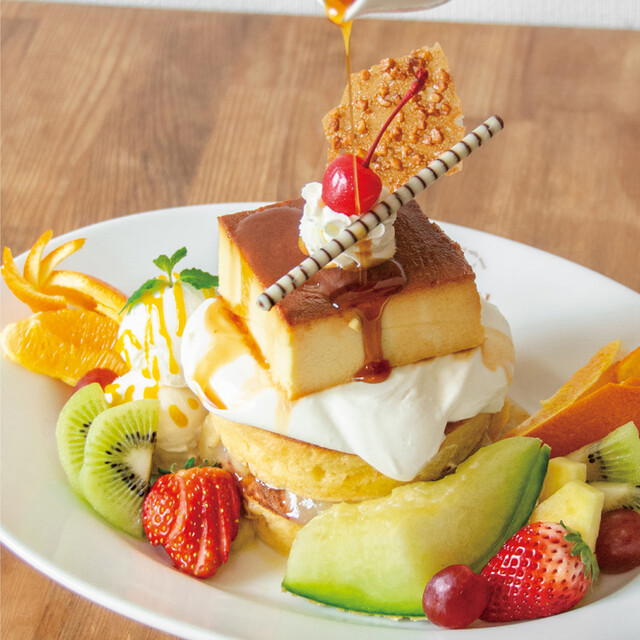
- Seasonal pancakes (e.g., melon pancakes)
- Omurice with demi-glace sauce
- Afternoon tea sets
- Italian pudding à la mode
Approaching the Ebisu-Daikanyama seam, Tokyo’s café genre changes character. It is less grab-and-go coffee than rooms built for lingering: sofa seating, terrace tables, stroller-friendly circulation, counter seats for solo customers, and drinks lists that treat wine and cocktails as part of the format, not an afterthought. Cafe Accueil Ebisu ten fits that broader category, where pancakes and omurice sit beside party use, daytime meetings, and early-evening drinking.
That breadth matters because Tokyo’s café scene is not one scene. There are illustrated interiors such as 2D Cafe, curry-focused neighborhood specialists such as 3 Chome no Curry Ya San, and compact food-first rooms closer to restaurants than cafés. Ebisu and Daikanyama add another layer: polished, social, and more comfortable with wine glasses on the table than many station-adjacent coffee shops. For a wider read on the city’s dining range, use Our full Tokyo restaurants guide, then compare the café category against the city’s hotel, bar, winery, and experience circuits through Our full Tokyo hotels guide, Our full Tokyo bars guide, Our full Tokyo wineries guide, and Our full Tokyo experiences guide.
Pancakes, omurice, and a drinks list that pushes the café format past coffee
The defining idea is range. The listing sits in the café, pancake, and omurice bracket, a combination that says more about contemporary Tokyo than a single-dish identity would. Pancakes carry the dessert-café audience; omurice brings yoshoku tradition into the room; wine and cocktails give the format a later-day function. It is not a chef-led tasting counter and should not be judged by that grammar. The useful comparison is with Tokyo’s all-day social rooms, where flexibility is part of the appeal.
The wine angle is especially telling. Many cafés in Japan remain coffee-and-dessert led, with alcohol present but secondary. Here, the drinks description emphasizes wine and cocktails, including a stated focus on both. That does not make the room a wine bar, but it places it in a more adult café lane: useful for groups that want pancakes at one end of the table and a glass of wine at the other. In Tokyo, where specialization often drives reputation, this hybrid format has to earn credibility through consistency rather than rarity.
Tabelog Cafe EAST “Tabelog 100” 2025 selection is the main external trust signal, supported by earlier selections in 2021 and 2022. Editorially, that places the café inside a curated café cohort rather than the anonymous middle of the category. Its Tabelog score of 3.66 also suggests enough public evaluation to matter in a city where scoring culture is demanding and small differences carry weight.
Ebisu-Daikanyama favors cafés with social range, not just dessert appeal
Ebisu and Daikanyama reward rooms that can shift tone during the day. A café here has to absorb shopping breaks, weekday lunches, stroller traffic, dates, group celebrations, and post-work drinks without feeling improvised. Cafe Accueil Ebisu ten has that physical vocabulary: 160 seats, multiple areas on the first floor, sofa seating upstairs, counter seating, terrace space, wheelchair access, power outlets, and projector facilities. Those details point to a venue built for duration and mixed use, not a narrow pastry showcase.
Tokyo travelers often overcorrect toward tiny counters and reservation-only dining, then miss the city’s large-format café culture. This is where the comparison set helps. Sake Hidejiro sits in a higher-spend sake-dining bracket; Sora to Mugi to occupies a lower-priced casual lane; BLACOWS works from a burger format; Sel Sal Sale, Sushi Takehan, and specialist addresses such as 124. KAGURAZAKA (Yakitori) operate with different expectations. A café like this is not competing on omakase intensity or bar-seat scarcity. It competes on whether the room, menu categories, and drinks program can carry several occasions across one service day.
That distinction explains why the address suits visitors not building a meal around a single chef name. The kitchen identity is expressed through category and format rather than biography: pancakes, omurice, café dining, wine, cocktails, take-out, celebrations, and private use. Tokyo has ample places where the chef’s counter is the point. This is a more social proposition, with credibility from a café-specific award list rather than borrowed fine-dining prestige.
How to use it in a Tokyo itinerary
Use this as an Ebisu-Daikanyama anchor when the day needs a seated pause with more range than coffee and cake. Families have children welcome and stroller access; groups have a room designed for gatherings; solo diners are not forced into formal restaurant posture. The non-smoking policy, card and digital payment acceptance, and terrace option add ease, while the note that seating requests are not guaranteed keeps expectations in check.
Dietary planning requires caution. That matters in Tokyo, where café menus may include sauces, dairy, eggs, wheat, and shared preparation contexts not always obvious from English category labels.
For readers building a broader Japan food map, this café sits at the casual-social end, far from the tighter formats represented by 鮪と炭火焼き うお炭 秋葉原店 or 12/10 Shinjuku ten. The category also travels differently outside Tokyo: compare with.cafe in Osaka.know in Kumamoto, (Shoku) Vietnam in Kawasaki, [Curry Senmon Ten] Maruyama Kyoju. in Sapporo, and [ki:] in Kyoto. If the itinerary extends beyond Japan, Jōdo Saké Bar in Los Angeles and Onigiri Time in Pasadena show how Japanese food and drink formats shift abroad. Closer to Tokyo’s day-trip orbit, -Grilled beef Sukiyaki- KAMAKURA TANUKIAN 鎌倉 たぬき庵 in Kamakura belongs to a more meal-centered tradition. The verdict: choose Cafe Accueil Ebisu ten when the priority is an award-recognized Tokyo café with pancake and omurice credentials, wine and cocktail availability, and a room built for multiple kinds of company.
Standing Among Peers
Comparable venues by price and recognition.
| Venue | Cuisine | Price | Awards | Notes |
|---|---|---|---|---|
| Cafe Accueil Ebisu tenThis venue (the venue you are viewing) | Pancake-focused cafe with omurice and Western-style comfort food | $20–30 | Tabelog 100 #36 | Not listed |
| THE ROASTERY BY NOZY COFFEE | Specialty Coffee / Café | $10–20 | Tabelog 100 #62 | Shibuya |
| FUGLEN TOKYO | Specialty coffee bar with Scandinavian influence | $10–20 | Tabelog 100 #66 | Shibuya |
| GAZTA | Basque cheesecake specialty shop | $10–20 | Tabelog 100 #60 | Minato |
| Tricolore Honten | Historic Ginza kissaten & cafe | $10–20 | Tabelog 100 | Chūō |
| Ginza Swiss Honten | Classic yoshoku (Japanese Western-style) & katsu curry | $20–30 | Tabelog 100 #61 | Chūō |
Recognition history
Dated appearances from independent guides and award organizations, with the underlying list record or original source where available.
Tabelog 100 #36 · No. 36
Tabelog · Tabelog 100 - Cafe - EAST - 2025
Continue exploring
More in Tokyo
Restaurants in Tokyo
All restaurants in Tokyo →


Bars in Tokyo
All bars in Tokyo →





Details
- Cozy
- Lively
- Trendy
- Whimsical
- Brunch
- Casual Hangout
- Family
- Group Dining
- Celebration
- After Work
- Date Night
- Rooftop
- Garden
- Private Dining
- Standalone
- Beer Program
- A La Carte
- Set Menu
- Coffee
- Tea
- Beer
- Soft Drinks
- Vegetarian Friendly
Current opening hours
- Monday
- 11 AM–10 PM
- Tuesday
- 11 AM–10 PM
- Wednesday
- 11 AM–10 PM
- Thursday
- 11 AM–10 PM
- Friday
- 11 AM–10 PM
- Saturday
- 11 AM–10 PM
- Sunday
- 11 AM–10 PM
Hours can change for holidays and private events. Hours as of .