Buvette

Our verdict
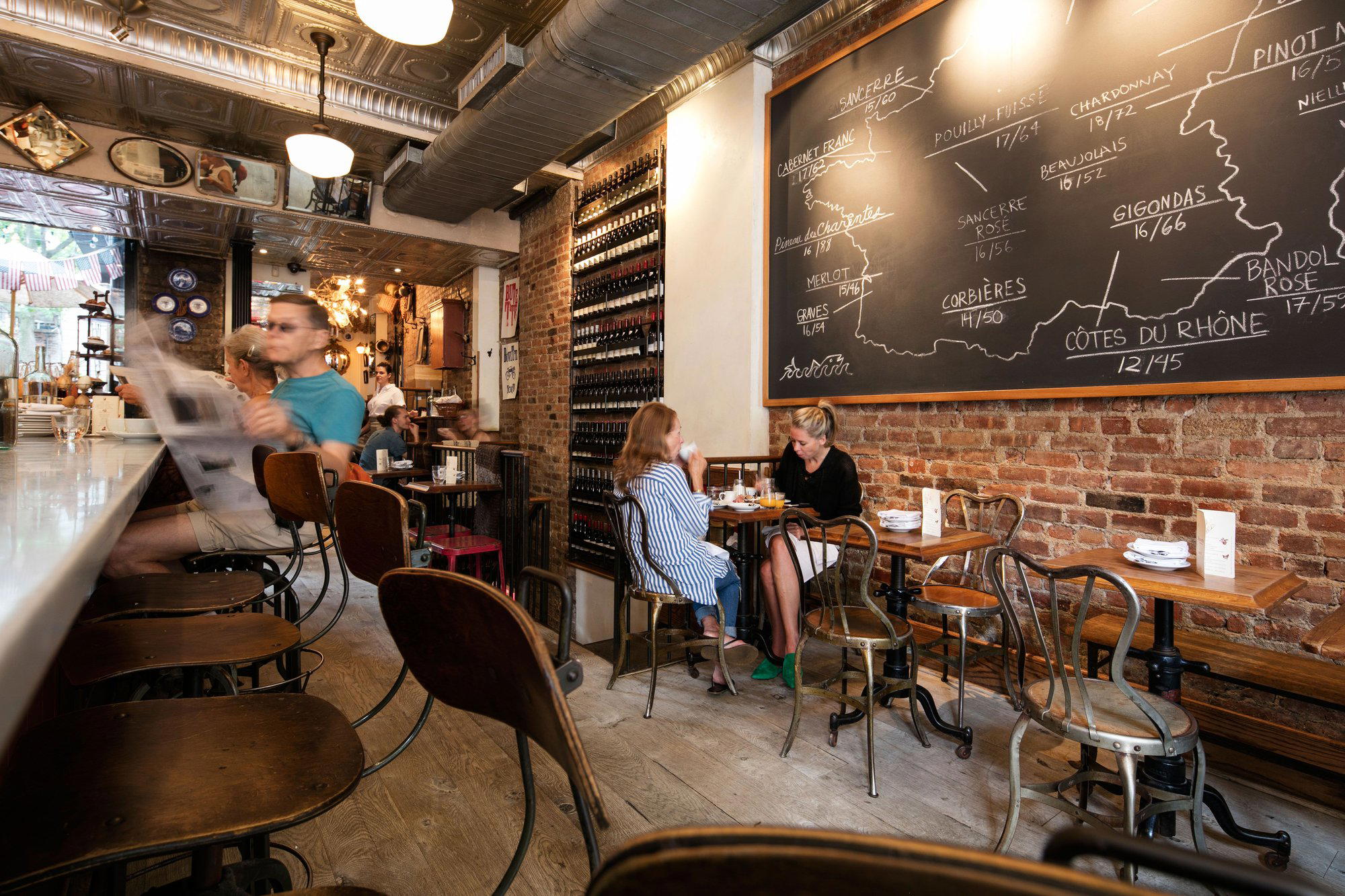
Buvette on Grove Street occupies the quieter register of West Village dining, where marble counters, wine-smudged chalkboards, and unhurried French bistro fare push back against New York's appetite for spectacle. The room runs small and the hours run long, making it the kind of address that rewards regulars more than planners. Walk-ins are common; reservations, less so.

Pearl is the En Primeur Club membership app, where members save venues, book tables and use the concierge.
The menu
What to order
- Steak tartare
- Croque madame
- Brandade de morue
- Coq au vin
- Octopus salad
- Braised leeks with shallot vinaigrette
Grove Street Before the Rush
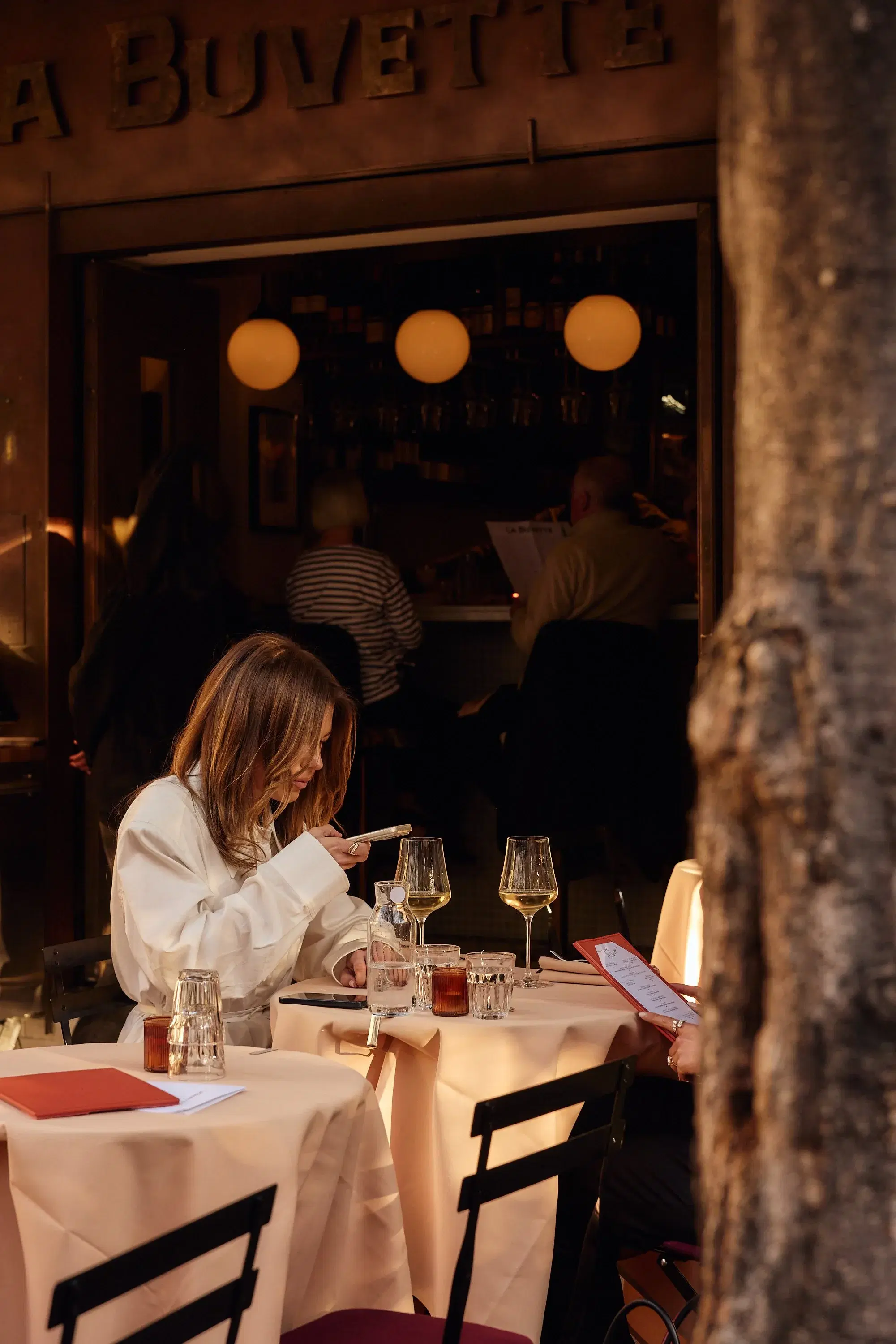
The West Village has a particular grammar: narrow blocks, Federal-era rowhouses, and a dining culture that runs closer to Paris than to Midtown. Grove Street sits inside that logic. Buvette, at number 42, occupies a ground-floor space that reads immediately as French without announcing it loudly. The marble counter, the bottles stacked to the ceiling, the handwritten chalkboard menu, these are not decorative gestures. They are the operating system of a certain kind of Parisian gastrotheque, transplanted to lower Manhattan and left largely intact.
Arriving in the early evening, before the room fills, gives the clearest read on what the space is actually doing. The lighting is low, the tables are close, and the noise level rises quickly once the counter seats fill. This is not a room designed for quiet business dinners. It is designed for the kind of meal that stretches past its original schedule, where a glass of Beaujolais becomes two and the charcuterie plate arrives before anyone has made a decision about the main.
Where Buvette Sits in the New York Bistro Scene
New York's French restaurant tier runs from the white-tablecloth formality of Le Bernardin and the contemporary ambition of Eleven Madison Park down through a middle band of brasseries, and then further still to a smaller, more personal category that functions closer to a neighbourhood wine bar than a destination restaurant. Buvette operates in that lower tier by design, not by default. The price point sits well beneath the $$$$ bracket occupied by Per Se or Masa, and the format, small plates, an extensive by-the-glass list, no tasting menu, signals different intentions entirely.
That positioning is deliberate. The French bistro tradition that Buvette draws from is one of accessibility and repetition: the same dishes, executed well, available to the same regulars on the same Tuesday as on a Friday night. This model has largely retreated from Manhattan, where real estate pressure pushes most operators toward higher covers and faster turns. That Buvette maintains a format this unhurried, in a neighbourhood this expensive, is itself a statement about what the room is for.
For readers tracking the fuller range of American fine dining, our New York City restaurants guide maps the city's dining tiers more completely, and comparable scene-driven formats appear in cities like San Francisco at Lazy Bear and in Chicago at Smyth.
The Food: French Bistro as Conviction, Not Nostalgia
French bistro cooking in New York often becomes a kind of period recreation, steak frites served more as cultural reference than as a genuinely considered dish. Buvette avoids that trap by staying specific. The menu is built around the gastrotheque format: small plates, cured and preserved items, eggs in various states, wine-friendly preparations that reward slow eating. Croque-madame, sardines, tartines, and soft-boiled eggs with anchovy are the architecture of this kind of cooking, and the kitchen handles them with the confidence of a place that has no interest in improvising its way out of the tradition.
The wine list operates on the same principle: largely French, largely natural-leaning, with enough by-the-glass options that the meal can be built around the wine rather than the other way around. For readers who have spent time at Frasca Food and Wine in Boulder or at the farm-to-table seriousness of Blue Hill at Stone Barns, Buvette will read as a different kind of ambition, less horticultural, more convivial.
Getting In: The Booking Reality
Buvette operates on a different booking logic than most of the addresses in this tier of New York dining. The room is small, which means even modest demand creates a waitlist on weekend evenings. Walk-ins are absorbed when possible, particularly at the counter seats, and the no-reservation approach that the venue has historically favoured means that early arrivals, before 6pm on a weekday, tend to find space without difficulty. The calculus shifts sharply on Friday and Saturday nights, when the West Village as a whole draws visitors alongside its regulars.
The practical advice here is the same as for any small-format room that does not take advance bookings through a conventional system: arrive early or arrive late. The room turns over, but not quickly, and a 9:30pm arrival can work as well as a 5:45pm one. This is a meaningfully different booking experience than securing a table at Atomix, where months-ahead planning is the norm, or at reservation-heavy destinations like The French Laundry in Napa, Addison in San Diego, or The Inn at Little Washington. At Buvette, the door is the booking system.
Internationally, this kind of walk-in, counter-seat format maps onto a longer tradition. The Italian analogy holds: places like Dal Pescatore in Runate or the more structured experience at Atelier Moessmer in Brunico represent one end of the European spectrum, while a room like Buvette represents the other: lower planning friction, higher spontaneity premium.
Planning Your Visit
Buvette is at 42 Grove Street in the West Village, accessible from the 1 train at Christopher Street or the A/C/E at 14th Street. The neighbourhood is walkable, and the surrounding blocks, Commerce Street, Bedford Street, contain enough comparable low-key wine bars and restaurants to build a full evening around the area rather than a single address. If Buvette is full, the loss is manageable; if it has seats, the gain is a particular kind of New York evening that has become harder to find as the city's dining economy has pushed toward spectacle and scale.
For readers building a wider itinerary, Emeril's in New Orleans, Providence in Los Angeles, and Single Thread Farm in Healdsburg represent the more structured end of American dining, where pre-planning matters significantly more. Buvette is the counterargument.
Frequently asked questions
Where exactly is Buvette?
Buvette is located at 42 Grove St, New York, NY 10014, New York City.
How does Buvette's gastrotheque format differ from a traditional French bistro in New York City?
Buvette positions itself as a gastrotheque rather than a conventional bistro, a format centered on all-day grazing across small plates, drinks, and coffee rather than a structured two- or three-course service. At 42 Grove Street in the West Village, that means the room functions as a neighborhood anchor from morning through late evening, a span most French concepts in New York no longer attempt at this scale. The approach places it closer to a Parisian zinc bar than to the white-tablecloth French tier operating elsewhere in Manhattan.
What's the must-try dish at Buvette?
The gastrotheque format at Buvette is built for grazing rather than a single signature centerpiece. The croque-madame and tartines are the clearest expressions of the kitchen's approach, French bistro cooking treated as conviction rather than period recreation. Ordering across several small plates at 42 Grove Street is the more useful strategy than arriving with one dish in mind.
Do they take walk-ins at Buvette?
Walk-ins are the primary route into Buvette for most diners. The room at 42 Grove Street is small and does not operate on a conventional advance-reservation system in the way that larger New York addresses do, which means showing up, particularly outside peak weekend hours, is a functional strategy. Timing toward off-peak service windows improves the odds considerably.
Side-by-Side Snapshot
| Venue | Cuisine | Price | Awards | Notes |
|---|---|---|---|---|
| BuvetteThis venue (the venue you are viewing) | French Bistro Gastrothèque | $30–50 | Not listed | Not listed |
| Le Bernardin | French Seafood Fine Dining | $300–500 | 3 Michelin Stars · World's 50 Best #13 | French, Seafood |
| Atomix | Modern Korean Tasting Menu | $300–500 | 2 Michelin Stars · World's 50 Best #7 | Modern Korean, Korean |
| Per Se | French Fine Dining Tasting Menu | $300–500 | 3 Michelin Stars · World's 50 Best #40 | French, Contemporary |
| Masa | Traditional Japanese Omakase | $500+ | 2 Michelin Stars · World's 50 Best #27 | Sushi, Japanese |
| Eleven Madison Park | Contemporary Plant-Based Fine Dining | $300–500 | 3 Michelin Stars · World's 50 Best #4 | French, Vegan |
Recognition history
Dated appearances from independent guides and award organizations, with the underlying list record or original source where available.
Opinionated About Dining Casual in North America Recommended
Opinionated About Dining
Buvette
Featured Guides
Continue exploring
More in New York City
Restaurants in New York City
All restaurants in New York City →
Bars in New York City
All bars in New York City →





Details
- Cozy
- Elegant
- Classic
- Intimate
- Date Night
- Casual Hangout
- Brunch
- Late Night
- After Work
- Garden
- Terrace
- Historic Building
- Design Destination
- Standalone
- Extensive Wine List
- Craft Cocktails
- Local Sourcing
- Street Scene
- Garden
- Small Plates
- A La Carte
- Wine
- Cocktails
- Digestifs
- Vegetarian Friendly
- Vegan Options
- Gluten Free Options
Current opening hours
- Monday
- 8 AM–12 AM
- Tuesday
- 8 AM–12 AM
- Wednesday
- 8 AM–12 AM
- Thursday
- 8 AM–12 AM
- Friday
- 8 AM–12 AM
- Saturday
- 8 AM–12 AM
- Sunday
- 8 AM–12 AM
Hours can change for holidays and private events. Hours as of .
Light-filled space with European details including antique furniture, heirloom keepsakes above a marble bar, and baskets of seasonal ingredients; feels like stepping into Paris with candlelit evenings and tree-lined street views.