Bustronome
Bustronome reimagines dining on London's Thames, serving multi-course meals aboard a glass-roofed double-decker bus that travels past the city's most recognisable landmarks. The format places the journey itself at the centre of the experience, making the route as relevant as the menu. Departing from Victoria Embankment, it occupies a category of its own among London's event dining options.
Pearl is the En Primeur Club membership app — saves, bookings, and concierge access live there. Same editors, same standards.
- Address
- Coach Bay, 40B Victoria Embankment, London WC2N 6PB, United Kingdom
- Phone
- +442037445554
- Website
- bustronome.com
- Directions
- Get directions
 Saves & bookings on Pearl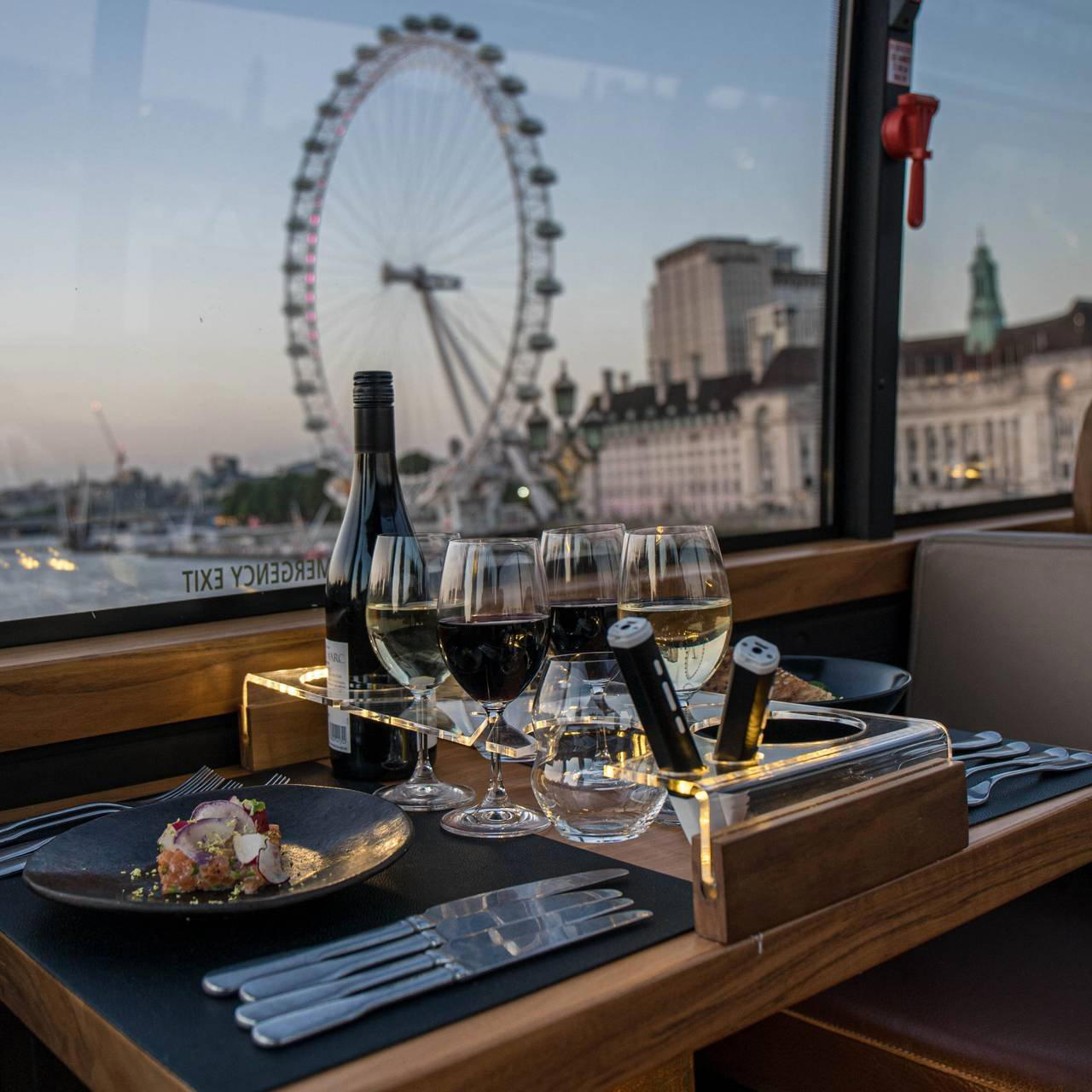
Dining in Motion: London's Bus Restaurant Explained
Bustronome is a restaurant in London serving British with French twist cuisine at a price tier of $120 per person. London has a well-documented hierarchy of fixed-address fine dining: Michelin-starred rooms from CORE by Clare Smyth and Restaurant Gordon Ramsay, destination tasting menus at Sketch's Lecture Room, and neighbourhood anchors like The Ledbury. Bustronome operates entirely outside that structure. It is a glass-roofed, double-decker touring bus departing from Coach Bay on Victoria Embankment, where the dining room moves through the city rather than waiting for diners to arrive. The experience puts a multi-course meal inside a format more commonly associated with sightseeing, and that tension between restaurant logic and transit logic is what makes it different from booking any other London table.
The Route as the Room
The bus departs from Coach Bay, 40B Victoria Embankment, London WC2N 6PB, a staging point that positions it immediately within one of London's densest concentrations of monumental architecture. The Thames runs alongside, and the route covers landmarks that would take a full day to reach on foot. On the upper deck, the glass roof and panoramic windows frame the cityscape as the primary visual context for the meal. This is the structural logic of the format: the venue is also the itinerary. Courses arrive in sequence while the city moves outside, which means timing is fixed, pacing is managed by the route, and the experience is closer to a theatre performance than a conventional dinner service.
That distinction matters for how you approach the booking. Unlike static restaurants, where a reservation time can stretch or compress depending on the table's mood, a touring dining experience runs on a schedule. Courses are served, the bus moves, and the window for each dish is set by the route, not by your appetite. Diners arriving without that expectation sometimes find the tempo surprising. Arriving with it is how you get full value from the format.
How This Format Compares to Other Theatrical Dining in the UK
Experiential dining in the UK has split into two broad categories. The first is destination restaurants where environment is a secondary selling point: The Waterside Inn in Bray uses its riverside setting, Midsummer House in Cambridge its island position, and Gidleigh Park in Chagford its moorland estate. The food is the primary argument; the setting reinforces it. The second category, which includes Bustronome, inverts this. The setting, or in this case the moving route, shares equal billing with the food, and the format is itself the product. Other touring formats exist globally, and London's Bustronome franchise is part of a Paris-originated concept. For context, experiential dining operations in cities like San Francisco (see Lazy Bear) or New York (see Le Bernardin) also handle the balance between format and cuisine differently, but neither makes the vehicle itself the room.
Among UK options that take environment seriously, L'Enclume in Cartmel, Moor Hall in Aughton, and Ynyshir Hall in Machynlleth each anchor the meal to a specific place. Bustronome does the opposite: it moves through place, which is a fundamentally different proposition.
Booking Bustronome: What to Know Before You Go
Because the experience is time-bound and group-capacity based, planning considerations are different from those at a fixed-address restaurant.
First, the format is occasion-specific. The combination of a moving route, a fixed menu, and a glass-roofed dining deck positions this as an event rather than a Tuesday dinner. It draws a corporate events market, celebration groups, and tourists alongside individual diners, which affects the ambient character of the experience depending on when you book. Lunchtime and evening departures typically carry different crowd compositions.
Second, the booking window is worth respecting. Touring dining experiences with fixed departure slots and limited capacity fill on a schedule that differs from à la carte restaurants. Weekend evening slots, in particular, move faster than midweek lunch runs.
Third, dietary requirements require advance communication, more so than at a conventional restaurant. When the kitchen is operating from a moving vehicle with a fixed menu and limited prep space, substitutions are structurally harder to accommodate. Any allergies or dietary restrictions should be declared at the time of booking, not on the day.
How Bustronome's Logistics Compare to Peers
| Venue | Format | Price Tier | Booking Lead Time | Dietary Flexibility |
|---|---|---|---|---|
| Bustronome (London) | Moving dining bus | Mid-to-high | 2-4 weeks recommended | Advance notice required |
| Dinner by Heston Blumenthal | Fixed restaurant | ££££ | 4-6 weeks typical | Good flexibility |
| Hand and Flowers, Marlow | Fixed pub-restaurant | £££ | 6-8 weeks for weekends | Moderate flexibility |
| Hide and Fox, Saltwood | Fixed restaurant | £££ | 2-4 weeks | Advance notice preferred |
| Opheem, Birmingham | Fixed restaurant | £££ | 2-3 weeks | Good flexibility |
| Restaurant Andrew Fairlie | Fixed hotel restaurant | ££££ | 4-8 weeks | Advance notice preferred |
What Drives the Decision
The case for Bustronome rests on whether the format itself is the draw. If the goal is to eat technically accomplished food London offers, the city's full restaurant range offers options that are harder to compete with on purely culinary grounds. But if the goal is an experience where the city itself becomes the dining room, the format has no direct equivalent at this address. Victoria Embankment, as a departure point, is not incidental: the Thames view, the bridge crossings, and the density of recognisable skyline all accumulate into something that a fixed address cannot replicate. That specificity of place-in-motion is what the format trades on, and it is a legitimate argument for a particular kind of occasion.
The practical discipline required, communicating dietary needs, arriving on time for a departure rather than drifting into a restaurant, is real, but manageable. Treat it like a flight with better food and a more interesting window seat.
Credentials Lens
Comparable venues nearby, for context on price, style, and recognition.
| Venue | Cuisine | Price | Notes |
|---|---|---|---|
| BustronomeThis venue — the venue you are viewing | British with French twist | $$$$ | Not listed |
| Francatelli | Modern British Fine Dining | $$$$ | St. James's |
| Brooklands by Claude Bosi | Modern British Fine Dining by Claude Bosi | $$$$ | Belgravia |
| Peggy Porschen Afternoon Tea @ The Lanesborough | British Afternoon Tea with Peggy Porschen Pastries | $$$$ | Belgravia |
| The Georgian at Harrods | Classic British Fine Dining | $$$$ | Brompton |
| Afternoon Tea at The Milestone Hotel | Traditional British Afternoon Tea | $$$$ | Kensington Palace Gardens |
Continue exploring
More in London
Restaurants in London
Browse all →
Bars in London
Browse all →
Hotels in London
Browse all →



At a Glance
- Scenic
- Elegant
- Sophisticated
- Special Occasion
- Date Night
- Celebration
- Panoramic View
- Extensive Wine List
- Skyline
- Street Scene
Current opening hours
- Monday
- 12–2 PM, 7–10 PM
- Tuesday
- 12–3 PM, 7–10 PM
- Wednesday
- 12–3 PM, 7–10 PM
- Thursday
- 12–3 PM, 7–10 PM
- Friday
- 12–2 PM, 7–10 PM
- Saturday
- 12–2 PM, 7–10 PM
- Sunday
- 12–2 PM, 7–10 PM
Hours can change for holidays and private events. Last verified .
Elegant and comfortable with fully glazed roof providing far-reaching city views, creating a sophisticated sightseeing dining atmosphere.