Brodo
On Hudson Street in the West Village, Brodo occupies a format that New York largely invented and the rest of the country has spent years trying to replicate: the walk-up broth window. The concept strips the dining experience to its functional core, positioning it against a city of tasting-menu counters and full-service rooms as a deliberate exercise in restraint and specificity.
Pearl is the En Primeur Club membership app — saves, bookings, and concierge access live there. Same editors, same standards.
- Address
- 496 Hudson St, New York, NY 10014
- Phone
- +1 212 366 0600
- Website
- brodo.com
- Directions
- Get directions
 Saves & bookings on Pearl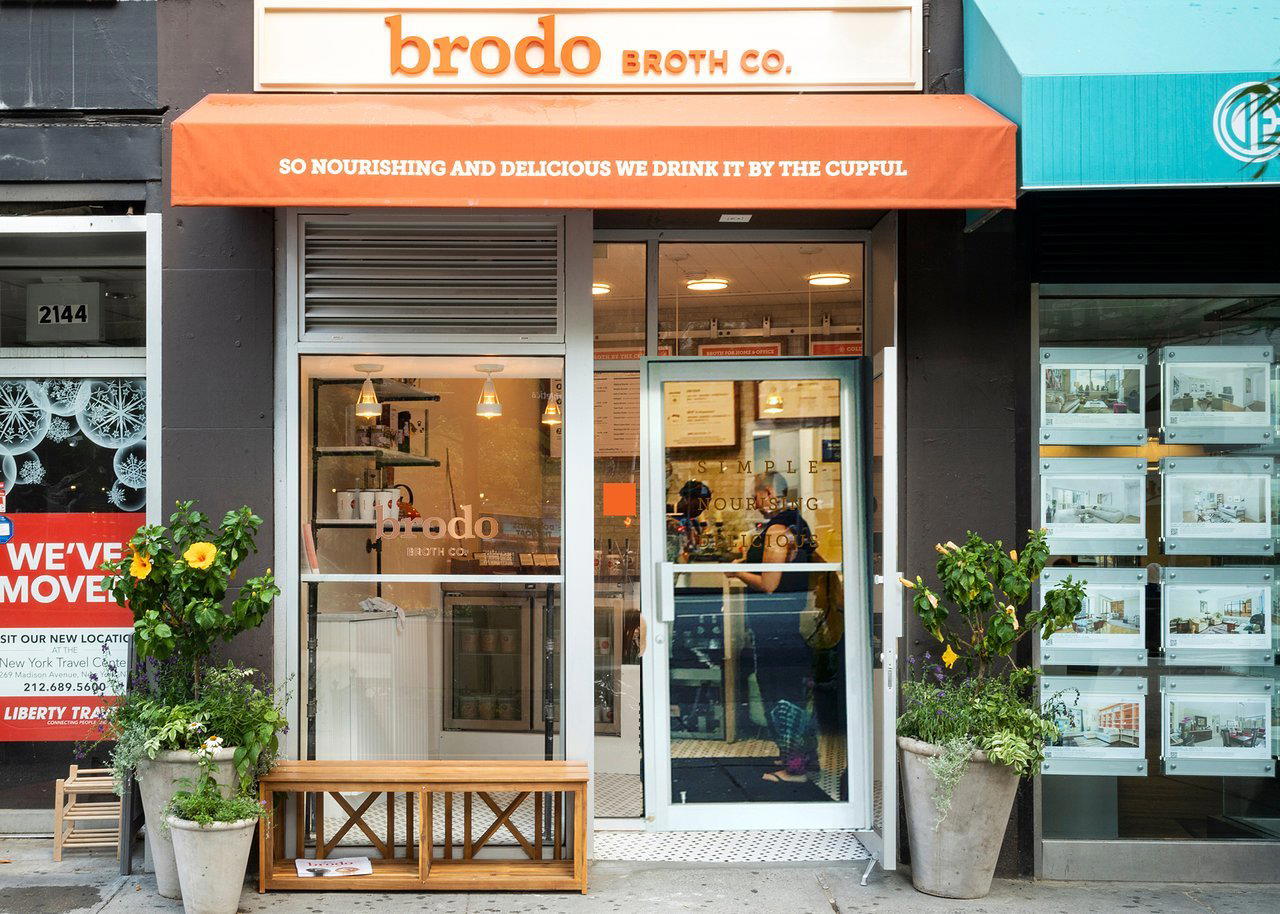
A Window, Not a Room
The West Village operates at two speeds. There are the destination restaurants drawing reservation-hunters from across the borough, places where the room itself is part of the proposition, and then there are the storefronts that have been feeding the neighbourhood for decades without a dining room at all. Brodo at 496 Hudson Street belongs to the second category, and its format is the editorial point worth making: in a city where dining has trended toward increasingly elaborate physical containers, from the cathedral ceilings of Eleven Madison Park to the hushed, counter-wrapped precision of Masa, a walk-up broth window on Hudson Street represents a conscious refusal of spectacle.
The physical proposition is minimal by design. There is no dining room to assess, no seating arrangement to decode, no ambient lighting calibrated to flatter the plates. What exists is a service window cut into a West Village ground floor, a menu of broths and add-ins, and the sidewalk. That reduction of format is, paradoxically, an architectural statement in itself. The container here is the street, and the experience is whatever the city delivers on a given afternoon.
The Broth Window as New York Format
To understand Brodo's position in the city's dining ecology, it helps to understand the format's origins. The broth window concept gained mainstream attention in New York around the mid-2010s, when bone broth moved from restaurant kitchen staple to standalone product. New York was the city that proved the concept could sustain a dedicated operation, that consumers would pay a coffee-shop price point for a cup of carefully made broth consumed standing on a sidewalk or carried through a neighbourhood.
Le Bernardin, Per Se, Atomix, Brodo operates in an entirely different register of hospitality. The comparison is not competitive; it is contextual. A city that supports both the $400-per-head omakase and the walk-up broth window is a city with a genuinely pluralist food culture, and Brodo's continued presence on Hudson Street says something about that pluralism that no award citation could.
Blue Hill at Stone Barns in Tarrytown to the ingredient-driven kitchens at Single Thread Farm in Healdsburg, where broth and stocks function as foundational kitchen elements rather than featured products. The difference is that Brodo made the broth the product, not the supporting infrastructure.
West Village, Hudson Street, and the Question of Setting
Location is context in New York, and the West Village is a specific kind of context. Hudson Street runs through among the more residentially stable, commercially dense neighbourhoods in Manhattan, an area where foot traffic is high, rents are punishing, and longevity is a credential. A concept that has held a Hudson Street address is a concept that has sustained itself over time.
The neighbourhood also shapes who uses a place like Brodo. West Village foot traffic skews toward residents rather than destination visitors. A walk-up window on Hudson Street is not a tourist stop; it is a neighbourhood utility. That distinction matters for format legibility. The broth window works because the neighbourhood provides the regulars that a no-reservation, no-dining-room concept requires to sustain itself. Unlike the city's high-end tasting rooms, where out-of-town visitors on a New York City dining itinerary form a significant portion of the customer base, Brodo's model depends on the repeat customer, the person who builds it into a weekly routine rather than a once-a-visit occasion.
That dynamic is not distinctive to Brodo. Across American dining cities, particularly durable neighbourhood operations tend to be those that serve a function in daily life rather than a role in occasional celebration. Lazy Bear in San Francisco and Smyth in Chicago occupy the destination end of that spectrum. Brodo occupies the opposite pole, where the value proposition is consistency and convenience rather than occasion-marking.
What the Format Implies About Quality
A walk-up window imposes a particular kind of quality discipline. There is no dining room experience to absorb a mediocre product, no sommelier pairings or amuse-bouches to distribute value across a longer arc. The broth in the cup is the entirety of the proposition, which means the sourcing and technique have to carry the full weight of the customer's decision to return. This is a harder editorial case to make for a tasting-menu restaurant, where many elements can compensate for any single weakness, than it is for a single-product format where there is nowhere to hide.
That structural honesty places Brodo in an interesting peer group with other American single-focus operations, the raw-bar window, the fried-chicken counter, the specialty coffee bar, formats where the producer's commitment to one thing is the entire argument. Operations like Providence in Los Angeles or Addison in San Diego make their case through breadth and refinement; Brodo makes its case through reduction and specificity.
Brodo in the Broader American Dining Conversation
The bone broth category has had a complicated decade. It arrived with wellness-culture momentum, attracted scepticism from nutritionists and food writers alike, and has since settled into a more durable middle position as a product category that does not need to make health claims to justify itself. What remains, stripped of the functional-food marketing, is the culinary argument: a well-made broth is a technically demanding product that rewards good sourcing and long, careful extraction. That argument holds regardless of the wellness conversation surrounding it.
The French Laundry in Napa or Emeril's in New Orleans, treat it as foundational rather than featured. Brodo's contribution to that conversation is to ask what happens when the foundational element becomes the product, when the thing that usually disappears into a sauce or a risotto gets its own window on Hudson Street.
Frasca Food and Wine in Boulder and ingredient-led European operations like Atelier Moessmer Norbert Niederkofler in Brunico and Dal Pescatore in Runate, where the argument for simple, technique-driven preparations has sustained multi-decade operations. The register is different, but the underlying commitment to doing one category of thing with rigour is the same. The Inn at Little Washington makes the case through formal ceremony; Brodo makes it through a walk-up window on a West Village street.
Same-City Peers
Comparable venues nearby, for context on price, style, and recognition.
| Venue | Cuisine | Price | Notes |
|---|---|---|---|
| BrodoThis venue — the venue you are viewing | Bone Broth Shop | $ | Not listed |
| Bobwhite Counter | Southern Fried Chicken & Comfort Food | $ | East Village |
| Mike's Coffee and Deli | Classic American Deli | $ | Midtown South-Flatiron-Union Square |
| Moonrise Bagels | Stuffed New York Bagels | $ | Greenwich Village |
| Little Ruby's SoHo | Australian Café & American Comfort Food | $$ | SoHo-Little Italy-Hudson Square |
| Café Standard | American Bistro Café | $$ | East Village |
Continue exploring
More in New York City
Restaurants in New York City
Browse all →
Bars in New York City
Browse all →
Hotels in New York City
Browse all →
Wineries in New York City
Browse all →


At a Glance
- Cozy
- Casual Hangout
- Standalone
Current opening hours
- Monday
- 9 AM–7 PM
- Tuesday
- 9 AM–7 PM
- Wednesday
- 9 AM–7 PM
- Thursday
- 9 AM–7 PM
- Friday
- 9 AM–7 PM
- Saturday
- 10 AM–7 PM
- Sunday
- 10 AM–7 PM
Hours can change for holidays and private events. Last verified .
Casual takeout spot with a cozy, comforting atmosphere focused on hot broth beverages.