Moonrise Bagels
Our verdict
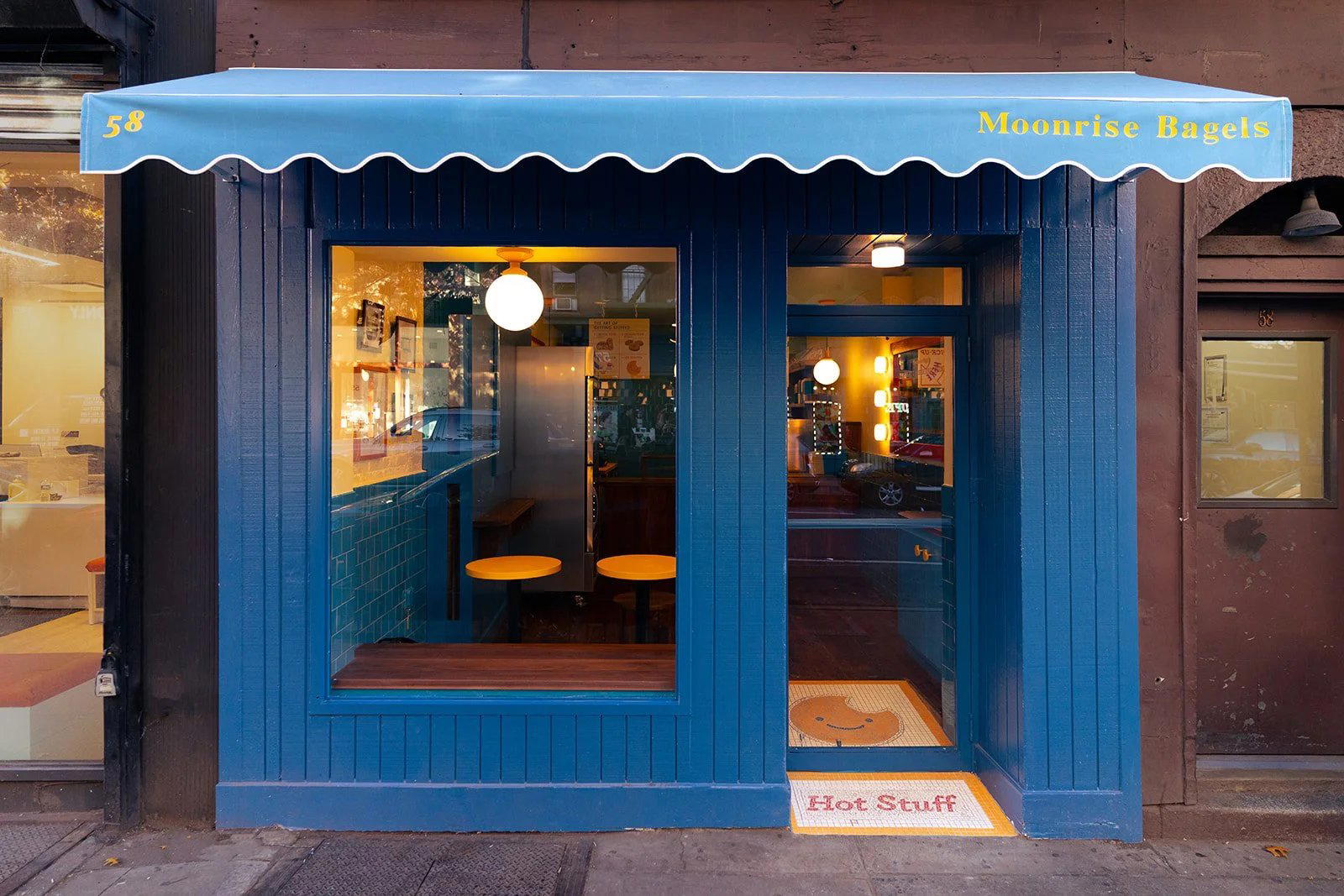
Moonrise Bagels at 58 W 8th St sits inside Greenwich Village's dense daytime dining corridor, where the city's conversation about ethical sourcing and waste-conscious production has quietly reshaped even the most workaday breakfast formats. In a New York market where most quick-service operations treat provenance as an afterthought, Moonrise positions itself in a smaller tier that takes the supply chain seriously.

Pearl is the En Primeur Club membership app — saves, bookings, and concierge access live there. Same editors, same standards.
- Address
- 58 W 8th St, New York, NY 10011
- Phone
- (646) 429-8655
- Website
- moonrisebagels.com
- Directions
- Get directions
The menu
What to order
- Bacon Egg and Cheese Stuffed Bagel
- Philly Cheesesteak Stuffed Bagel
- Buffalo Chicken Stuffed Bagel
The Bagel Counter as Ethical Argument
New York's bagel culture is old enough to have calcified into myth. The city spent decades insisting that water chemistry explained everything — that the mineral composition of the municipal supply was the secret variable separating a proper New York bagel from everything produced west of the Hudson. That argument served its purpose, but it also froze the conversation, making it harder to ask newer questions about where the grain comes from, how fermentation is managed, and what happens to the trim and surplus at the end of a morning rush. A newer generation of producers has been asking those questions with increasing seriousness, and Moonrise Bagels at 58 W 8th St in Greenwich Village belongs to that current.
Greenwich Village sits at a particular intersection in New York's food geography. The neighbourhood has never been a pure fine-dining corridor in the way that midtown or the West Village's Hudson Street stretch has been — it operates instead as a mixed register, where a table at a serious wine-focused restaurant can sit two doors from a counter serving coffee and hand-rolled dough. That mixed character creates space for daytime operations to take on more editorial weight than they might elsewhere. When Le Bernardin or Eleven Madison Park commit to sourcing discipline or waste protocols, the food press notices immediately. When a neighbourhood bagel shop does the same, the shift is quieter but arguably more structurally significant, because it changes what everyday eating looks like at scale.
Sourcing as the Starting Point
The sustainability story in American grain-based baking has moved considerably in the last decade. What was once a niche concern, heritage wheat varieties, regional mills, direct farmer relationships, has become a legible category signal, separating operations that treat flour as a commodity from those that treat it as an ingredient with provenance. The best-documented version of this shift in the broader restaurant world appears at tasting-menu level: Single Thread Farm in Healdsburg and Lazy Bear in San Francisco have both built sourcing frameworks that trace ingredients back to specific producers. The interesting development in recent years is that this framework has started migrating downmarket, into formats where margins are tighter and the temptation to revert to commodity inputs is stronger.
Moonrise Bagels operates in that migrated space. The address at 58 W 8th St places it inside the foot-traffic reality of lower Manhattan's daytime economy, where quick-service formats live and die on throughput. Operating with ethical sourcing discipline under those conditions is a different proposition than doing so inside a 20-course tasting menu where ticket prices can absorb the cost differential. The fact that this conversation is happening at the counter level, in a city where Masa and Per Se anchor the upper end of the price distribution, says something about how broadly the sustainability imperative has spread through New York's food culture.
Waste Reduction at the Production Scale
Bagel production generates a specific and well-understood waste profile. Boiling and baking at volume means that misshapen pieces, broken rings, and end-of-day surplus accumulate in ways that a high-volume operation cannot always absorb into the menu. The standard industry response is disposal. The more considered response, composting, day-old programs, partnerships with food recovery organisations, repurposing trim into other preparations, requires operational commitment that adds friction to an otherwise streamlined production model.
Across the United States, the venues most visibly engaged with this problem tend to cluster at either the very high end, where the brand capital from sustainability claims is large, or in mission-driven independent operations where the values are structural rather than cosmetic. Alinea in Chicago and The French Laundry in Napa have each made documented commitments to waste reduction at the production level. The logic is the same whether the kitchen is producing a 15-course progression or a morning batch of boiled dough: the choices made at the production stage determine the waste profile, and those choices can be made deliberately. Moonrise, operating at the counter scale in Greenwich Village, is part of the same broad movement, even if the format and price point place it in an entirely different tier.
The Village as Context
West 8th Street runs through a section of Greenwich Village that has historically supported independent operators over chain formats, though that balance has shifted under pressure from rising commercial rents. The survival of independent daytime counters in this corridor reflects both the neighbourhood's pedestrian density and a consumer base that has demonstrated some willingness to support operations that price their ethics into the product. That dynamic gives a sustainability-oriented bagel counter more room to operate than the same format would have in a purely transactional retail corridor.
For visitors building a day around the neighbourhood, the West 8th St address sits within walking distance of Washington Square Park and the broader NYU-adjacent foot traffic that defines the area's daytime character. Practical planning for Moonrise is direct: as a counter-format breakfast and lunch operation, peak hours will follow standard New York morning-rush patterns, with the busiest window typically running from opening through mid-morning. No reservation is required for a counter operation of this type. For context on the wider dining picture, our full New York City restaurants guide covers the range from neighbourhood counters to tasting-menu rooms, and our New York City hotels guide, bars guide, and experiences guide map the rest of the city's hospitality offering. The New York City wineries guide covers the state's growing natural wine presence for those extending beyond the meal.
New York's counter-format breakfast operations divide, roughly, between those treating the product as a commodity and those treating it as something worth sourcing carefully. The former category is large; the latter is smaller and growing. The argument travels down the price ladder as well. And Atomix in New York itself has shown that rigorous sourcing discipline can coexist with a tightly focused format, even if the formats are not comparable in price or complexity.
Frequently asked questions
Where do I go for Moonrise Bagels?
Moonrise Bagels is located at 58 W 8th St, New York, NY 10011, New York City.
How does Moonrise Bagels approach waste reduction in its production process?
Bagel production at any volume generates a predictable waste stream: misshapen rings, broken pieces, and over-boiled batches that don't meet counter standards. Grain-forward operations like Moonrise Bagels in Greenwich Village tend to address this more deliberately than commodity shops, often repurposing off-spec product into breadcrumbs, croutons, or staff meals rather than discarding it. This kind of closed-loop thinking is increasingly common among New York City's independent bakery counters that treat sourcing and waste as connected concerns rather than separate ones.
What should I eat at Moonrise Bagels?
Moonrise Bagels builds its menu around heritage-grain production, so the bagels themselves are the focal point rather than the toppings. The grain sourcing approach means the bread has a distinct flavor profile that differs from commodity flour operations. Ask what's freshly out of the oven when you arrive at 58 W 8th St, as counter-format shops in this category typically rotate based on production runs.
Do I need a reservation for Moonrise Bagels?
Bagel counters in New York operate as walk-in formats by convention, and Moonrise Bagels at 58 W 8th St follows that model. Expect queues during peak morning hours, particularly on weekends, which is standard across Greenwich Village's independent breakfast operators. Arriving before 9am is the practical approach if you want first pick of production.
What has Moonrise Bagels built its reputation on?
Moonrise Bagels has positioned itself within New York's counter-format breakfast scene as a sourcing-conscious operation, drawing attention for its use of heritage wheat varieties at a time when most high-volume bagel shops still rely on commodity flour. That positioning aligns it with a broader shift in American grain-based baking that has been building over the past decade. Its West 8th Street address in Greenwich Village, a corridor with a documented history of supporting independent operators, provides the right commercial context for that kind of differentiation.
Can Moonrise Bagels accommodate dietary restrictions?
Heritage-grain bagel shops in New York typically offer a narrower but more considered product range than mass-market operations, which can work in favor of customers with specific wheat sensitivities — though heritage wheat is not gluten-free. For precise information on ingredients and any allergen accommodations at Moonrise Bagels, contacting the counter at 58 W 8th St, New York, NY 10011 directly is the reliable route.
A Tight Comparison
A quick peer check to anchor this venue’s price and recognition.
| Venue | Cuisine | Price | Awards | Notes |
|---|---|---|---|---|
| Moonrise BagelsThis venue — the venue you are viewing | Stuffed New York Bagels | $10–20 | Not listed | Not listed |
| Le Bernardin | French Seafood Fine Dining | $300–500 | 3 Michelin Stars · World's 50 Best #13 | French, Seafood |
| Atomix | Modern Korean Tasting Menu | $300–500 | 2 Michelin Stars · World's 50 Best #7 | Modern Korean, Korean |
| Masa | Seasonal Hokkaido Tempura Omakase | $150–200 | Tabelog 100 #34 | Sushi, Japanese |
| Per Se | French Fine Dining Tasting Menu | $300–500 | 3 Michelin Stars · World's 50 Best #40 | French, Contemporary |
| Eleven Madison Park | Contemporary Plant-Based Fine Dining | $300–500 | 3 Michelin Stars · World's 50 Best #4 | French, Vegan |
Continue exploring
More in New York City
Restaurants in New York City
Browse all →
Bars in New York City
Browse all →
Hotels in New York City
Browse all →




Details
- Trendy
- Cozy
- Casual Hangout
- Brunch
- Standalone
- A La Carte
Casual bagel shop atmosphere focused on innovative stuffed bagels with a modern twist on breakfast classics.