
Our verdict
One of the Latin Quarter's most enduring Alsatian brasseries, Balzar has operated from its Rue des Écoles address since 1886, drawing Sorbonne academics, neighbourhood regulars, and visiting readers in roughly equal measure. The format is the point: choucroute, steak frites, and crème caramel served in a room that has changed less than the street outside. Ranked in Opinionated About Dining's Casual Europe list in both 2024 and 2025.

Pearl is the En Primeur Club membership app, where members save venues, book tables and use the concierge.
The menu
What to order
- Steak Frites
- Sole Meunière
- Duck Confit
- Beef Bourguignon
- Tarte Tatin
- Onion Soup
- Escargots
The Latin Quarter's Brasserie Standard
Paris has two distinct brasserie registers. The first is grand-boulevard spectacle: mirrored halls, theatrical service, and pricing that reflects the room as much as the plate. The second is neighbourhood permanence: a fixed address, a menu that shifts with the market and the season rather than with culinary fashion, and a clientele that returns weekly rather than annually. Brasserie Balzar, on Rue des Écoles in the 5th arrondissement, has occupied the second register since 1886. Its longevity is a function of the Latin Quarter itself, a district where the Sorbonne, the publishing houses, and a dense concentration of long-term residents have historically supported exactly this kind of place.
Alsatian Brasserie in a Left Bank Context
The Alsatian brasserie format arrived in Paris in the late nineteenth century alongside the region's beer culture and its appetite for generous, direct cooking. The category is defined by a handful of specific dishes: choucroute garnie, the braised sauerkraut-and-charcuterie assembly that takes hours to build properly; onion tart; cervelas rémoulade; and the kind of direct grilled and roasted proteins that anchor a menu without requiring daily reinvention. What changes is the sourcing: a well-run brasserie kitchen tracks the market for fish, the season for game, and the provenance of its charcuterie with more attention than its fixed-format menu might suggest from the outside.
Balzar's position on the Alsatian brasserie spectrum places it in direct comparison with Bofinger, the Right Bank address that dates to 1864 and occupies a grander, more theatrical room. The two represent the format's range: Bofinger leans toward occasion dining and tourist trade; Balzar has retained a tighter neighbourhood function, with a room that seats regulars alongside visitors without tilting its identity toward either group.
Market Rhythm and the Seasonal Frame
The Alsatian brasserie format appears fixed, but the leading practitioners treat it as a seasonal structure rather than a static menu. The core dishes remain, but the fish of the day, the game birds in autumn, the asparagus service in April and May, and the stone fruit desserts of late summer all reflect what is moving through the Rungis market rather than what was printed on a laminated card five years ago. This is the operative logic of classical French brasserie cooking: the format provides stability and the market provides motion.
At Balzar, that rhythm connects to the Latin Quarter's own seasonal cadences. The academic calendar concentrates local traffic from October through June; July and August shift the clientele toward visitors. A kitchen that responds to seasonal sourcing maintains coherence across both populations because the market, not the audience, drives the menu.
This market-oriented approach is what separates the better Parisian brasseries from those operating on inertia. It also explains why the category continues to attract serious critical attention alongside the formal dining tier. Opinionated About Dining, which ranks across a broad range of formats and price points, placed Balzar in its Casual Europe ranking at position 549 in 2024 and 640 in 2025, an adjustment across two years but sustained presence on a list that covers hundreds of European addresses. That recognition sits at the opposite end of the formality scale from Paris's three-Michelin-star tier: Alléno Paris au Pavillon Ledoyen, Arpège, Kei, and L'Ambroisie all occupy a rarefied bracket where tasting menus and extended service are the format. Balzar operates in the register below that by design, and in Paris that register has its own critical vocabulary and its own audience.
The Room and Its Function
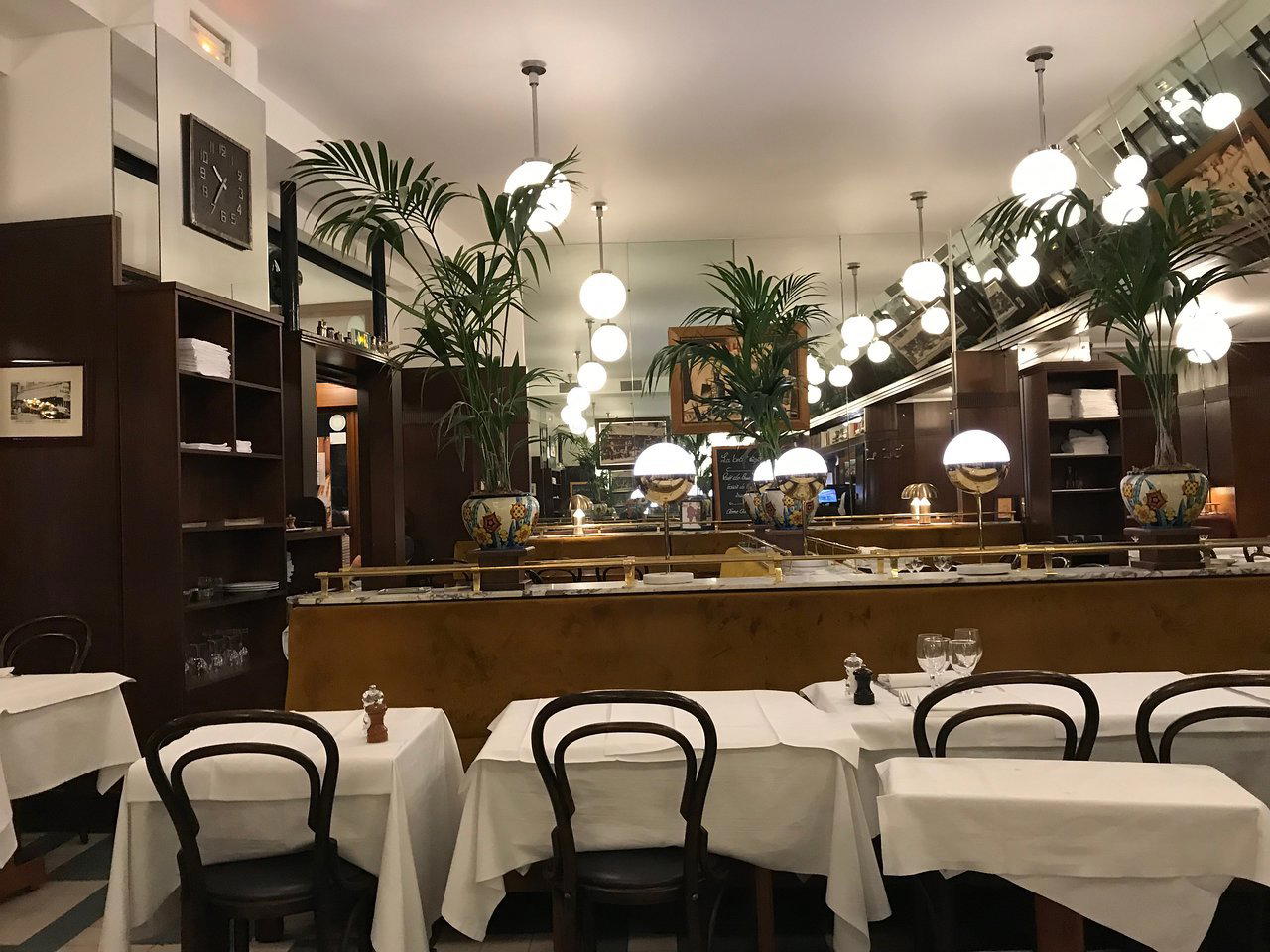
The 5th arrondissement brasserie room is a specific Parisian type: banquette seating, tiled floors, mirrors and coat hooks, a zinc or marble service bar, and a ceiling height that absorbs the noise of a full house without requiring lowered voices. These are not decorative choices; they are functional specifications for a room that runs lunch and dinner continuously from midday to late evening. Balzar's room on Rue des Écoles fits the archetype. The address has housed the brasserie since the nineteenth century, and the building's relationship with the street has remained consistent while the neighbourhood around it has shifted from a predominantly academic district to a mixed residential and tourist zone.
The continuous service model, open seven days from noon to 11:30 pm, is itself a significant feature in a city where many serious kitchens close between services and take Monday or Tuesday off entirely. For visitors staying in the 5th or 6th arrondissements, that availability across the full week and across the traditional lunch-dinner gap has practical weight.
Balzar in the Broader French Dining Register
Paris anchors France's formal dining hierarchy, but the country's serious cooking extends well beyond the capital. For context on the range: Auberge de l'Ill in Illhaeusern represents the Alsatian fine-dining tradition that shares a regional heritage with the brasserie format; Flocons de Sel in Megève and Mirazur in Menton show the range of regional French ambition; Troisgros in Ouches, Bras in Laguiole, and Paul Bocuse's Auberge near Lyon mark the tradition's historical depth. None of these are the same argument as Balzar. The brasserie format makes a different case: that French cooking's contribution to daily life is as significant as its contribution to special occasions.
For comparison outside France, Le Bernardin in New York City and Atomix both represent how French culinary influence travels internationally, each in a different direction from the classical brasserie root.
Planning a Visit
- Address: 49 Rue des Écoles, 75005 Paris
- Hours: Monday to Sunday, 12:00 pm to 11:30 pm (continuous service)
- Cuisine: Alsatian Brasserie
- Recognition: Opinionated About Dining Casual Europe, ranked #549 (2024) and #640 (2025)
- Booking: Walk-ins accepted; advance reservation advisable for peak lunch and dinner periods
- Getting There: Closest Metro stations are Cluny-La Sorbonne (line 10) and Maubert-Mutualité (line 10), both within a short walk
For further reading on eating and drinking in the city, see our full Paris restaurants guide, our Paris bars guide, our Paris hotels guide, our Paris wineries guide, and our Paris experiences guide.
Frequently asked questions
Is Brasserie Balzar award-winning?
Brasserie Balzar has received recognition including: Opinionated About Dining Casual in Europe Ranked #640 (2025); Opinionated About Dining Casual in Europe Ranked #549 (2024).
What's the best thing to order at Brasserie Balzar?
Start with the format: Balzar is an Alsatian brasserie, so the kitchen is built around choucroute garnie, onion tart, and steak frites rather than à la carte experimentation. The choucroute is the structural dish of this tradition and the clearest test of a kitchen's commitment to it. Balzar's OAD Casual Europe ranking, #549 in 2024, rising to #640 in 2025, reflects a room that delivers on the format's terms rather than departing from them.
When can I go to Brasserie Balzar?
Hours at Brasserie Balzar: Hours: Monday 12–11:30 pm Tuesday 12–11:30 pm Wednesday 12–11:30 pm Thursday 12–11:30 pm Friday 12–11:30 pm Saturday 12–11:30 pm Sunday 12–11:30 pm.
Where is Brasserie Balzar in Paris?
Brasserie Balzar is located at 49 Rue des Écoles, 75005 Paris, France, Paris.
Standing Among Peers
| Venue | Cuisine | Price | Awards | Notes |
|---|---|---|---|---|
| Brasserie BalzarThis venue (the venue you are viewing) | Classic French Brasserie | $30–50 | Not listed | Not listed |
| Alléno Paris au Pavillon Ledoyen | Modern French Fine Dining | $150–200 | 3 Michelin Stars · World's 50 Best #79 | Creative |
| Kei | Modern French with Japanese Influences | $300–500 | 3 Michelin Stars · World's 50 Best #93 | Contemporary French, Modern Cuisine |
| L'Ambroisie | Classic French Haute Cuisine | $300–500 | 2 Michelin Stars · World's 50 Best #23 | French, Classic Cuisine |
| Le Cinq - Four Seasons Hôtel George V | Modern French Fine Dining | $300–500 | 3 Michelin Stars · World's 50 Best #24 | French, Modern Cuisine |
| Plénitude | Modern French Sauce-Led Fine Dining | $300–500 | 3 Michelin Stars · World's 50 Best #14 | Contemporary French |
Recognition history
Dated appearances from independent guides and award organizations, with the underlying list record or original source where available.
Opinionated About Dining Casual in Europe Recommended
Opinionated About Dining
Full recognition history (3 entries)
Opinionated About Dining Casual in Europe Ranked #640
Opinionated About Dining
Opinionated About Dining Casual in Europe Ranked #549
Opinionated About Dining
Continue exploring
More in Paris
Restaurants in Paris
All restaurants in Paris →
Bars in Paris
All bars in Paris →
Details
- Classic
- Well Known
- Lively
- Business Dinner
- Group Dining
- Casual Hangout
- Historic Building
- Terrace
- Beer Program
- Extensive Wine List
- Street Scene
- A La Carte
- Set Menu
- Wine
- Beer
- Cocktails
Current opening hours
- Monday
- 8:30 AM–11:30 PM
- Tuesday
- 8:30 AM–11:30 PM
- Wednesday
- 8:30 AM–11:30 PM
- Thursday
- 8:30 AM–11:30 PM
- Friday
- 8:30 AM–11:30 PM
- Saturday
- 8:30 AM–11:30 PM
- Sunday
- 8:30 AM–11:30 PM
Hours can change for holidays and private events. Hours as of .
Bustling Belle Époque dining room with warm lighting, close-set tables creating an intimate yet lively atmosphere typical of traditional Parisian brasseries; terrace seating available for street-side dining.