
Our verdict
A specialist Spanish charcuterie and ibérico emporium in the 7th arrondissement, Bellota-Bellota occupies a niche that Paris's grand French tables leave wide open. The focus is on cured Iberian pork, jamón ibérico de bellota at its various grades, alongside Spanish provisions that reward both the committed connoisseur and the visitor wanting something categorically different from the city's dominant dining register. Recommended by Opinionated About Dining (2023).

Pearl is the En Primeur Club membership app, where members save venues, book tables and use the concierge.
The menu
What to order
- Iberian ham
- Mashed potatoes with chorizo
- Empanadas au jambon ibérique
Ibérico in the 7th: Where Paris Makes Room for Spain
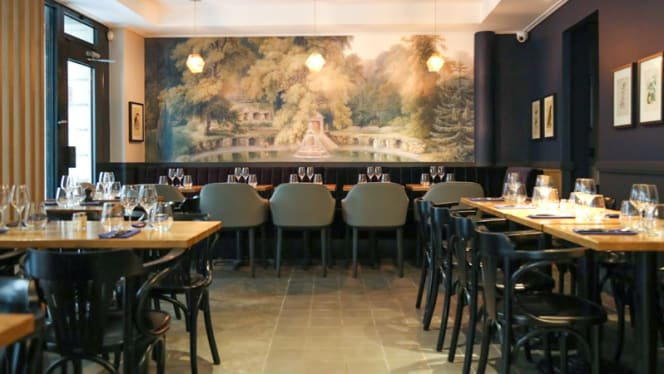
Rue Jean Nicot runs quietly through the 7th arrondissement, a street more likely to produce a boulangerie or a wine merchant than anything that reads as foreign. Walking into Bellota-Bellota, the shift is immediate and deliberate: legs of jamón hang from ceiling hooks, the counter holds vacuum-sealed lobes of lardo and wedges of manchego, and the air carries the dense, nutty weight of cured Iberian pork. This is not a restaurant that happens to serve charcuterie. It is a specialist provisions house that takes the carving of jamón ibérico de bellota as its central act.
That specialisation places it in a distinct category within Paris dining. The city's dominant register runs from the grand French tables, Alléno Paris au Pavillon Ledoyen, L'Ambroisie, Le Cinq, through contemporary operators like Kei and Arpège, all of which compete on technique, seasonality, and formal service. Bellota-Bellota does not compete in that field at all. Its reference points are Jabugo and Guijuelo, not the Michelin guide's French categories. The 2023 Opinionated About Dining casual recommendation acknowledges what it is: a focused, knowledgeable operation that does one thing at a high level of seriousness.
The Ibérico Tradition Behind the Counter
Understanding what Bellota-Bellota sells requires understanding the production hierarchy of Spanish jamón. Ibérico de bellota, the designation the shop's name references, comes from black Iberian pigs that have spent their final months in the dehesa, the oak-studded grassland of western Spain, foraging on acorns (bellotas). The fat infiltration that results is chemically distinct from grain-fed pork: higher in oleic acid, with a marbling pattern closer to Wagyu beef than to conventional ham. The finest examples, from 100% pata negra animals, are aged for a minimum of three years, sometimes four or five, before the leg is considered ready.
This is the tradition the shop positions itself within. In Spain, the specialist jamonería or charcutería operates as a destination in its own right, with trained cortadores (carvers) who slice by hand and charge accordingly. Paris has absorbed this model selectively, and the 7th arrondissement, with its concentration of diplomatic households, food-literate residents, and visitors drawn to the nearby Musée d'Orsay, is a credible location for it. The clientele for premium ibérico in Paris is smaller and more focused than the market for it in Madrid or Seville, which keeps operations like this one in a specialist tier rather than a mass-market one.
Fire, Salt, and the Basque Grill Parallel
The editorial angle of asador cooking, the Basque grill tradition, whole-animal roasting over charcoal, the primacy of the product over technique, connects to what Bellota-Bellota represents even without a live fire on the premises. Both traditions share the same philosophical foundation: the quality of the raw material, raised correctly and treated with restraint, is the point. A Basque asador in San Sebastián does not obscure its txuletón under sauce. A serious jamón counter does not cure its product with shortcuts or serve it cold and pre-sliced. In both cases, the cooking or curing method exists to reveal the animal rather than transform it.
That philosophy is increasingly legible to Paris diners who have eaten their way through the city's more technique-heavy tables and want something that reads as direct. The Spanish provisions model, where the product's provenance does most of the work, sits at the opposite end of the dial from the multi-course elaboration of a Troisgros or a Mirazur. Both are valid. They answer different questions.
Paris's Spanish Provisions Gap
France's relationship with Spanish food has historically been filtered through Basque proximity in the southwest and a handful of Paris specialists who brought Iberian products north. The city does not have the density of Spanish dining that London or Amsterdam has developed over the past two decades, which means a specialist like Bellota-Bellota occupies territory that remains relatively uncrowded. For comparison, ZURRIOLA in Tokyo and Arco by Paco Pérez in Gdańsk demonstrate how Spanish culinary identity travels in formal restaurant formats internationally. Bellota-Bellota takes a different approach: no elaborate dining room, no contemporary Spanish tasting menu. The shop format keeps the focus on the product and removes the layer of restaurant theatre.
That restraint is deliberate and, for the right visitor, appealing. France's own tradition of the specialist provisions shop, the fromagerie, the cave à vins, the boucherie chevaline, gives Parisians a frame of reference for the model. Bellota-Bellota operates within that frame but with Spanish product logic at its centre.
Seasonal Considerations and Planning
Jamón ibérico is not a seasonal product in the way that asparagus or truffles are, but the shop format means that visit timing carries practical weight. The 7th arrondissement sees significant tourist concentration in summer, driven by the Eiffel Tower and Musée d'Orsay proximity, which affects the atmosphere of the surrounding streets. Autumn and early winter, when the dehesa's acorn season has just concluded and the idea of cured pork feels more seasonally aligned with the weather, tend to be the more comfortable visiting windows for those treating the shop as a destination rather than a convenience stop.
The address at 18 Rue Jean Nicot is a short walk from the Invalides metro station and sits within easy reach of the 7th's food-retail concentration. No booking is required for a provisions purchase or counter tasting, which makes Bellota-Bellota one of the more accessible serious food stops in an arrondissement that otherwise routes visitors toward formal reservations at French tables. For those building a wider Paris food itinerary, the full picture is in our Paris restaurants guide, with further planning resources across the bars, hotels, wineries, and experiences guides.
For those whose France itinerary extends beyond Paris, the comparison between a specialist provisions stop and the country's formal dining tradition becomes sharper at addresses like Flocons de Sel in Megève, Auberge de l'Ill in Illhaeusern, Bras in Laguiole, or Paul Bocuse's Auberge du Pont de Collonges. None of those addresses overlap with what Bellota-Bellota does. That is precisely the point.
Frequently asked questions
at Bellota-Bellota?
The shop's name answers the question directly. Jamón ibérico de bellota, hand-carved at the counter, is the product the operation is built around. Within that category, the grade matters: look for 100% ibérico (pata negra) designations, which indicate full-blooded Iberian animals rather than crossbreeds. The fat in a properly aged bellota leg is pale, almost translucent, and dissolves at room temperature, the counter temperature at which it should be served. Beyond the jamón, a well-stocked Spanish charcutería of this type would carry lomo ibérico (cured loin), chorizo ibérico, and salchichón, as well as Spanish cheese and conservas (preserved seafood). The OAD 2023 casual recommendation suggests the overall product selection is taken seriously, which is the relevant credential here rather than any specific award for a single dish.
Peers You’d Cross-Shop
Comparable venues nearby, for context on price, style, and recognition.
| Venue | Cuisine | Price | Awards | Notes |
|---|---|---|---|---|
| Bellota-BellotaThis venue (the venue you are viewing) | Spanish Tapas & Iberico Ham | $30–50 | Not listed | Not listed |
| Maria Belza | Basque Tapas & Regional Spanish | $30–50 | Not listed | 10th arrondissement (Canal Saint-Martin) |
| Sugaar | Modern Basque Steakhouse | $100–150 | World's Best Steaks Europe's 50 Best #48 | 75006 |
| Miss Kô | Asian Fusion with Japanese & European Influences | $50–100 | Not listed | Champs-Élysées |
| Cavapapa | Seasonal French Bistro | $30–50 | Not listed | 15th arrondissement |
| Mollard | Traditional French Brasserie with Seafood | $50–100 | Not listed | 8th arrondissement |
Recognition history
Dated appearances from independent guides and award organizations, with the underlying list record or original source where available.
Opinionated About Dining Casual in Europe Recommended
Opinionated About Dining
Full recognition history (2 entries)
Opinionated About Dining Casual in Europe Recommended
Opinionated About Dining
Continue exploring
More in Paris
Restaurants in Paris
All restaurants in Paris →
Bars in Paris
All bars in Paris →
Hotels in Paris
All hotels in Paris →




Details
- Cozy
- Elegant
- Sophisticated
- Date Night
- Casual Hangout
- Open Kitchen
- Extensive Wine List
- Small Plates
- A La Carte
Current opening hours
- Monday
- Closed
- Tuesday
- 11 AM–8 PM
- Wednesday
- 11 AM–8 PM
- Thursday
- 11 AM–10:30 PM
- Friday
- 11 AM–10:30 PM
- Saturday
- 11 AM–10:30 PM
- Sunday
- Closed
Hours can change for holidays and private events. Hours as of .
Upscale yet cozy atmosphere with sophisticated details and warm welcoming service.