
Bar Tomate occupies a well-worn corner of Chamberí, one of Madrid's most food-literate neighbourhoods, where the menu reads less like a restaurant list and more like a selective argument for how Spanish ingredients should be handled. The format sits between casual bar and considered dining room, making it a useful entry point for understanding how Madrid's mid-register restaurant scene actually functions day to day.
Pearl is the En Primeur Club membership app — saves, bookings, and concierge access live there. Same editors, same standards.
- Address
- C. de Fernando el Santo, 26, Chamberí, 28010 Madrid, Spain
- Phone
- +34 917 02 38 70
- Website
- grupotragaluz.com
- Directions
- Get directions
 Saves & bookings on Pearl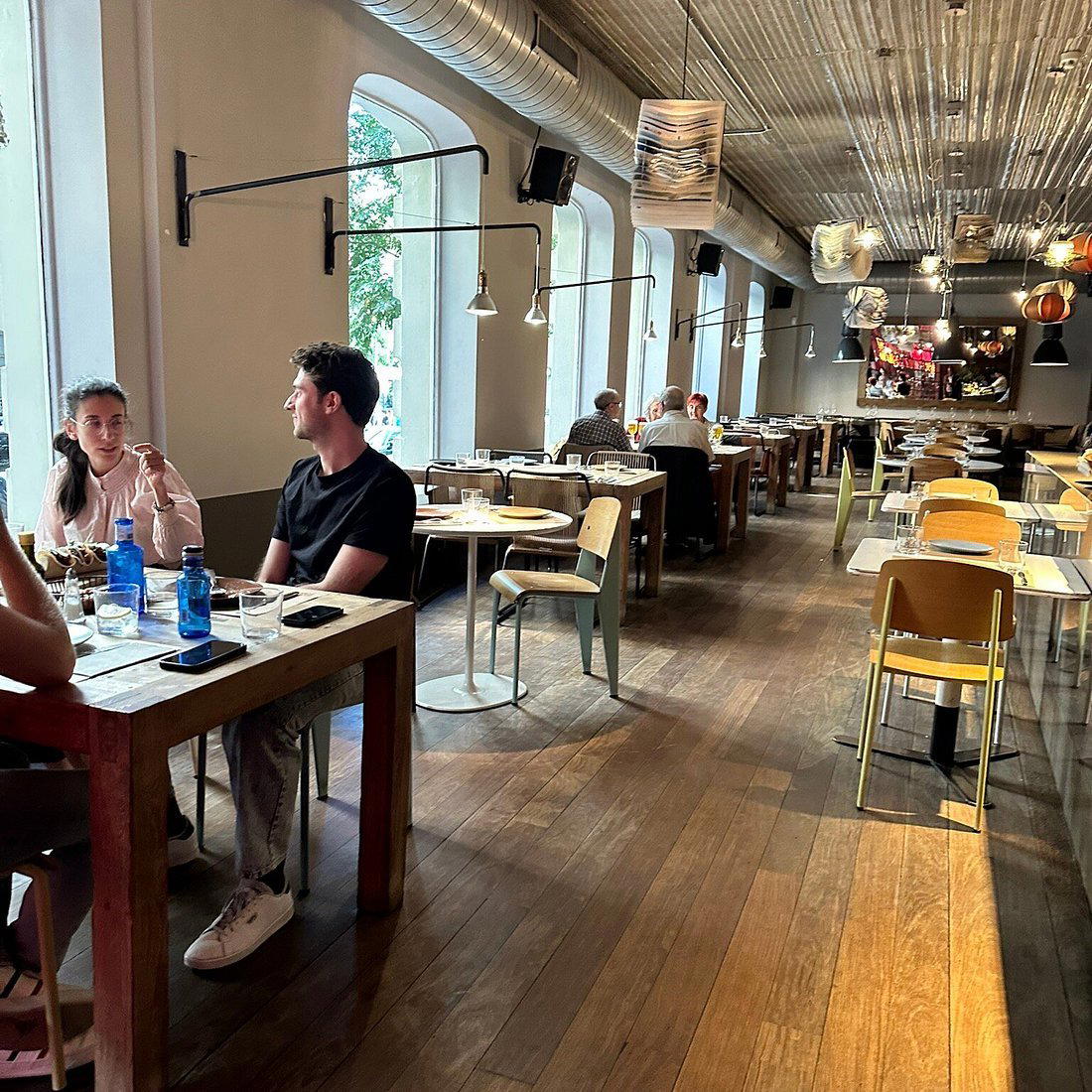
Chamberí's Approach to the Menu as Argument
Chamberí is the kind of Madrid neighbourhood that doesn't announce itself. The streets around Alonso Martínez and Fernando el Santo are dense with practising professionals, long-established residents, and a particular kind of restaurant that skips both tourist-facing simplicity and fine-dining ceremony. Bar Tomate sits on Calle de Fernando el Santo at number 26, inside this fabric. That address carries weight: the barrio has become one of the more reliable indicators of whether a restaurant is built for an informed local audience rather than a passing one. Venues here are held to a consistent standard by regulars who eat out often and have developed clear preferences.
The room at Bar Tomate reflects this orientation. The atmosphere is animated without being loud, the design is considered without being theatrical. Natural light pulls through the front during lunch service, and the evening shifts the energy toward the bar zone without fully changing the character of the space. It reads as a place people return to, rather than one they visit once for the occasion.
How the Menu Is Built, and What That Signals
The most instructive thing about Bar Tomate is the architecture of its menu. In Madrid's current mid-register dining scene, menus divide broadly into two types: those structured around a progression (tasting, dégustation, set courses) and those that function more like a considered market list, where the kitchen signals what it knows and trusts, and the diner assembles their own sequence. Bar Tomate belongs clearly to the second category. The menu format places the emphasis on ingredient and technique over theatrical narrative, which is a meaningful editorial choice by any kitchen.
That structure puts Bar Tomate in a different conversation from Madrid's more formally progressive houses. DiverXO, Coque, Deessa, and DSTAgE all operate in tasting-menu formats at the €€€€ tier, with Michelin recognition anchoring their positioning. Paco Roncero similarly sits in that creative-progressive bracket. Bar Tomate operates at a remove from those formats, not as a lesser version but as a different proposition entirely: the kind of room where the menu allows you to eat well, quickly or at length, according to your own tempo rather than the kitchen's.
This format carries a particular discipline. A list-based menu is unforgiving in a way that a tasting sequence is not. Each dish has to justify itself in isolation because there is no arc carrying it forward. It also demands that a kitchen know its sourcing precisely, since the structure invites comparison dish to dish. In Chamberí, where regular diners return across seasons, that discipline tends to be maintained or the room empties.
The Tomato as Organising Principle
The name is literal, not metaphorical. Tomatoes have an extended season in Spain, and the country's range of varieties, from the prized Marmande and Raf tomatoes of the south to the smaller, more acidic types grown further north, gives a kitchen genuine material to work with rather than a novelty hook. At Bar Tomate, the tomato functions as a recurring point of reference through the menu, appearing in forms that track the kitchen's range rather than simply its name recognition.
This is worth contextualising within Spanish cuisine broadly. The tomato is structurally embedded in the Iberian kitchen in a way that has no direct equivalent in French or Italian cooking. Sofrito, salmorejo, pa amb tomàquet, the slow-cooked bases of countless regional stews: the tomato is less a flavour note and more a medium. A kitchen that chooses to foreground it is making a statement about its relationship to Spanish culinary tradition rather than departing from it. Spain's wider fine-dining conversation at houses like Quique Dacosta in Dénia, El Celler de Can Roca in Girona, Mugaritz in Errenteria, and Aponiente in El Puerto de Santa María engages with local ingredients as conceptual raw material. Bar Tomate does something adjacent but less declarative: it uses the tomato as proof of sourcing credibility and seasonal range, which is a quieter but equally coherent argument.
Beyond the tomato, the menu reads as Spanish-Mediterranean in its broader orientation. That's a wide bracket, but in practice it means the kitchen is working with olive oil, cured fish, market vegetables, and Spanish charcuterie as its base vocabulary rather than reaching for international fusion reference points. This keeps the room clearly positioned: it is a Spanish kitchen with Mediterranean inflection, operating for a local audience with high expectations and moderate patience for explanation.
Madrid's Mid-Register and Where Bar Tomate Fits
Madrid's dining scene has polarised over the past decade. At the upper end, the city competes internationally: the restaurants named above represent a credible national fine-dining infrastructure that extends to Arzak in San Sebastián, Azurmendi in Larrabetzu, Martin Berasategui in Lasarte-Oria, Cocina Hermanos Torres in Barcelona, Ricard Camarena in València, and Atrio in Cáceres. At the lower end, Madrid's tapas and market culture remains intact and active. The mid-register, where Bar Tomate operates, has historically been the most contested space: too expensive to function as casual eating, not structured enough to command tasting-menu prices.
The rooms that survive in this bracket tend to do so by developing a reliable local base rather than cycling through visitor traffic. Chamberí's demographic supports this model. The neighbourhood runs at a higher average income than central Madrid and has a resident dining culture that functions on return visits and neighbourhood loyalty rather than occasion dining. Bar Tomate's positioning, address included, is well-calibrated for that dynamic.
For international reference, the format has loose parallels with mid-register European bars and bistros operating in the same analytical mode: places like Le Bernardin in New York City or Lazy Bear in San Francisco occupy entirely different price tiers and formats, but the underlying principle of menu-as-argument is the same. The difference is that Bar Tomate makes that argument without the scaffolding of tasting menus or formal credentials.
Planning a Visit
Bar Tomate is located at Calle de Fernando el Santo 26 in Chamberí, 28010 Madrid. The nearest metro stops are Alonso Martínez and Colón, both within a short walk. For visitors staying in the Salamanca or Chueca areas, the address is accessible without a taxi for most. The room functions well for both lunch and dinner, though the lunch service tends to draw a more local professional crowd; evenings shift toward a broader mix. Given the neighbourhood's density of well-regarded restaurants, Bar Tomate is a reasonable anchor for an evening that continues to the surrounding streets. See the full Madrid restaurants guide for broader context on how the city's dining areas compare.
How Bar Tomate Madrid compares with similar nearby venues.
| Venue | Cuisine | Price |
|---|---|---|
| Coquetto | Traditional Cuisine | €€€ |
| Saddle | Modern European, Modern Cuisine | €€€€ |
Recognition history
Dated appearances from independent guides and award organizations, with the underlying list record or original source where available.
Macarfi 6.1 Food Rating
Macarfi
Continue exploring
More in Madrid
Restaurants in Madrid
Browse all →
Bars in Madrid
Browse all →
Hotels in Madrid
Browse all →


At a Glance
- Trendy
- Rustic
- Modern
- Lively
- Casual Hangout
- Group Dining
- Brunch
- Late Night
- After Work
- Live Music
- Open Kitchen
- Standalone
- Craft Cocktails
- Beer Program
Current opening hours
- Monday
- 8:30 AM–1 AM
- Tuesday
- 8:30 AM–1 AM
- Wednesday
- 8:30 AM–1 AM
- Thursday
- 8:30 AM–1 AM
- Friday
- 8:30 AM–2 AM
- Saturday
- 10:30 AM–2 AM
- Sunday
- 10:30 AM–1 AM
Hours can change for holidays and private events. Last verified .
Bright and airy with large windows, wooden floors, vintage adornments, and red porcelain accents; warm mood lighting with a library feel created by bookshelves and lamps made from book pages
Know Before You Go
- Getting there
- C. de Fernando el Santo, 26, Chamberí, 28010 Madrid, Spain